
- Insurance & Cost Guide · NYC
Does my plan cover this? What will I actually owe? An honest, step-by-step breakdown of how root canal pricing works and how to use your benefits effectively.
Navigating Root Canal Costs: Insurance & What to Expect
If you’ve just been told you need a root canal, the next question usually comes immediately: Does insurance cover root canal treatment, and what will I actually owe? That’s a reasonable concern — and the honest answer is that no one can give you an exact number until you’ve had a proper exam and X-rays.
What we can do is explain how root canal pricing is determined, how dental insurance typically applies, and what you can do right now to get a clearer picture of your out-of-pocket responsibility.
A root canal removes infected or damaged tissue from inside a tooth in order to save it. When done at the right time and followed by the appropriate restoration, it’s one of the most effective ways to preserve a natural tooth that might otherwise need extraction.
Does Insurance Cover Root Canal Treatment in NYC?
The short answer: often yes, at least partially. But the specifics depend entirely on your plan. Many dental insurance plans with endodontic coverage will contribute toward a root canal — but the amount, the timing, and the restrictions vary widely.
The most important takeaway: the only way to know your actual coverage is to verify benefits before treatment begins. Your dental office can usually help with verification, and you can also call the member services number on the back of your insurance card and ask a few targeted questions (see the checklist below).

Why "Does It Cover Root Canals?" Is Only Half the Question
Gingivitis and periodontitis aren’t the same condition. They represent different stages of gum disease with very different implications for treatment and reversibility.
Remaining Deductible
The amount you must pay out-of-pocket before insurance starts contributing. If you haven’t met it yet, you’ll pay that first.
Coinsurance / Copay
Your share of the cost after the deductible. If the plan covers 70%, you pay 30% of the allowed amount.
Annual Maximum
The most your plan will pay in a benefit year. Once exhausted, remaining costs fall to you entirely.
In-Network Status
In-network providers have negotiated rates. Out-of-network treatment can significantly increase your share.
THE REAL-WORLD GAP
Two patients with plans that both “cover” root canals can end up owing very different amounts — based on where they are in the benefit year and how their specific plan is structured.
How Dental Insurance Typically Categorises Root Canals
Most dental plans group services into tiers — typically preventive, basic, and major. Root canals (endodontic treatment) may be classified as either basic or major depending on the plan.
CLASSIFIED AS BASIC
- Often covered at a higher percentage — commonly around 70–80%
- Coverage applies after the deductible is met
- Waiting periods less common for basic-tier services
CLASSIFIED AS MAJOR
- Often covered at a lower percentage — sometimes around 50% or less
- May include waiting periods before major coverage kicks in
- More likely to eat into the annual maximum quickly
NEITHER IS BETTER OR WORSE
What matters is how your plan’s classification interacts with your specific deductible, coinsurance percentage, annual maximum, and in-network status — not the label alone.
Understanding the Cost Breakdown of a Root Canal
Root canal treatment is not a single, uniform procedure with a fixed price. The cost is shaped by a specific combination of factors that vary from patient to patient — even from tooth to tooth in the same mouth.
Tooth Type & Canal Count
The biggest driver of cost. Front teeth have 1 canal; molars have 3–4+. More canals = more time, more complexity, higher fee.
Infection Severity
A straightforward infection with clear anatomy is more efficient to treat than one with significant bone involvement, calcified canals, or severe curvature.
Retreatment vs. First-Time
Retreatment (a second root canal on the same tooth) is more complex — previous material must be removed, canals re-cleaned, and new infection addressed. Often costs more.
Diagnostic Imaging
Standard X-rays are typically included. In complex cases, CBCT (3D imaging) may be recommended — often billed separately with variable coverage.
General Dentist vs. Endodontist
Endodontists complete additional specialty training and commonly use surgical microscopes. Fees are often higher, reflecting advanced training and case complexity.
Crown Required After
A crown is often recommended following root canal treatment — especially on back teeth. It’s billed as a separate procedure and may fall under a different coverage category.
Tooth Type Complexity at a Glance
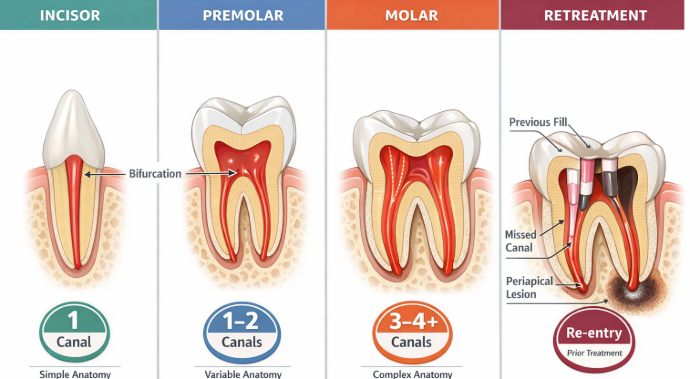
| Tooth Type | Typical # of Canals | Complexity | Crown Often Needed? |
|---|---|---|---|
| Front teeth (incisors, canines) | 1 | Lower — simpler anatomy, easier access | Less common — depends on remaining structure |
| Premolars | 1–2 | Moderate — may have split canals | Often yes, especially upper premolars |
| Molars | 3–4+ | Higher — multiple curved canals, harder to reach | Yes, nearly always recommended |
| Retreatment (any tooth) | Varies | Higher — removing prior material, navigating calcification | May already have a crown — replacement evaluated |
General Dentist vs. Endodontist

When you’re referred for a root canal — or deciding where to go — who performs the procedure can affect both the treatment plan and insurance billing. Many general dentists handle straightforward root canals comfortably. Complex cases are often referred to an endodontist.
GENERAL DENTIST
- Comfortable with front teeth and straightforward premolars
- Often the most accessible and convenient option
- Fees typically lower than specialist rates
- May refer complex cases to an endodontist
ENDODONTIST (SPECIALIST)
- 2–3 additional years of specialty training after dental school
- Commonly uses surgical microscopes and advanced instruments
- Handles molars, retreatment, calcified canals, suspected cracks
- Fees often higher — may be billed differently by insurance
CHECK NETWORK STATUS FOR BOTH PROVIDERS
Your plan may treat specialists differently. The endodontist may be out-of-network even if your general dentist is in-network. Always verify network status before proceeding with either provider.
In-Network vs. Out-of-Network: What This Means for Your Bill
- In-Network
- Provider has agreed to the plan's negotiated fee schedule
- Your coinsurance is applied to the lower, negotiated amount
- Balance billing beyond approved patient portions is typically not permitted
- Usually results in a lower total out-of-pocket cost
- Out-of-Network
- Provider may charge more than the plan's allowed amount
- Provider may charge more than the plan's allowed amount
- The difference between the office fee and allowed amount becomes balance billing
- Can significantly increase your out-of-pocket cost
Do You Need a Crown After a Root Canal?
Crowns are recommended so often that many patients assume it’s automatic. It isn’t automatic — but it’s common, especially for back teeth. After a root canal, the tooth can become more brittle over time. Molars and premolars handle strong chewing forces; a crown reinforces the tooth and reduces fracture risk.
CROWN IS STRONGLY RECOMMENDED WHEN:
- The tooth is a molar or premolar handling significant chewing forces
- There was significant decay or large existing fillings before the root canal
- The remaining tooth structure is limited after treatment
- Long-term durability of the tooth is the priority
CROWN MAY NOT BE IMMEDIATELY NEEDED WHEN:
- The tooth is a front tooth with strong remaining structure
- It isn't exposed to heavy bite forces
- A conservative composite restoration can adequately protect it
- Your dentist assesses the structural integrity as sufficient
BUDGET FOR BOTH TOGETHER
Many plans treat the root canal and crown as separate procedures — often under different coverage categories. Both may draw from the same annual maximum. For realistic budgeting, always factor in the crown cost alongside the root canal when planning treatment.
Financing Options for Major Dental Procedures
Even with insurance, the out-of-pocket cost for a molar root canal plus a crown can feel significant. Several options may help bridge the gap.
In-House Payment Plans
Many practices offer installment options directly through the office. Terms vary — ask about interest rates and minimum payments before enrolling.
Third-Party Dental Financing
Programs like CareCredit and LendingClub may offer promotional interest-free periods. Interest rates can be high after the promotional window — read the terms carefully.
HSA / FSA Funds
Health Savings Accounts and Flexible Spending Accounts can typically be used for dental expenses including root canals, X-rays, and crowns. Check your plan rules.
Phased Treatment Planning
In some cases, your dentist may be able to phase treatment across benefit periods — root canal this year, crown early next year. Not always clinically appropriate; your dentist advises based on infection risk and tooth stability
Maximising Your Benefits Before the Year Ends
MOST DENTAL PLANS RESET ON JANUARY 1
- Unused benefits do not roll over — once the year ends, unused maximum is gone
- If you've already met your deductible, treatment before year-end costs you less
- If you still have annual maximum remaining, it may be a good time to complete needed treatment
- If you're near your annual maximum, consider whether phasing treatment into the new year makes financial sense
- Always confirm with your dental office — they can help you plan around your benefit year
How to Verify Your Root Canal Benefits
Use this checklist when calling your insurance company — or send it to your dental office for pre-treatment insurance verification. Getting clear answers to these questions before treatment begins is the most effective way to avoid billing surprises.

1. Is my plan active today? Any waiting periods for major services that I haven't completed yet?
2. Is root canal treatment covered —and is it classified as basic or major under my plan?
3. Do I need pre-authorisation or a pre-determination before treatment begins?
4. What is my remaining deductible for this benefit year?
5. What is my coinsurance or copay for root canal treatment specifically?
6. Is a crown covered after a root canal? What is the coinsurance percentage for crowns?
7. What is my annual maximum — and how much of it have I used so far this year?
8. Is this provider in-network? If not, what is the allowed amount and reimbursement percentage?
9. Are there frequency limits — for example, crowns covered only once every 5–7 years?
10. Are there alternate benefits clauses that could reduce coverage for root canal treatment?
LET US HELP
At Toothology, our team can assist with insurance verification before your appointment so you have a clear picture of your estimated out-of-pocket costs before treatment begins. Call us or book a consultation and we’ll walk through it with you.
Key Insurance Terms Explained
Insurance documents are full of jargon. Here’s what the most important terms actually mean when applied to root canal coverage.
Deductible
Coinsurance
Annual Maximum
Allowed Amount (UCR)
Alternate Benefits Clause
Waiting Period
Pre-determination
Frequently Asked Questions
Does insurance cover root canals?
Often yes, at least partially. Coverage depends on your plan’s classification (basic vs. major), deductible, coinsurance, annual maximum, and whether the provider is in-network.
How much is a root canal without insurance?
Out-of-pocket cost depends on the tooth type, complexity, whether you see a general dentist or endodontist, and local market rates.
How much is a root canal with insurance?
It depends. After deductible, coinsurance, annual maximum, and network status are applied, your share can range from a smaller portion to most of the fee.
Is a root canal covered by medical insurance?
Usually no. Medical insurance typically doesn’t cover routine dental procedures. Limited exceptions may apply in trauma cases or unusual circumstances, depending on the plan.
How much does a root canal and crown cost?
Total cost varies by tooth type, provider, materials, location, and whether additional steps are needed (like a buildup).
Does dental insurance cover root canals and crowns?
Many plans cover both, but often under different categories and percentages. Root canals may be basic or major; crowns are usually major. (Coverage varies.)
Why is root canal treatment not covered by insurance?
Most plans don’t exclude root canals outright—but coverage can be limited by waiting periods, classification as major, annual maximum exhaustion, frequency limits, or alternate benefit clauses.
What to do when you max out your dental insurance?
When the annual maximum is used, remaining costs are typically out-of-pocket until the plan resets. Options may include HSA/FSA funds, financing, in-house payment plans, or, if clinically safe, phasing treatment into the next benefit year.
GET A CLEAR COST ESTIMATE
We help patients understand their benefits before treatment begins. Book a consultation and we’ll verify your insurance with you.
CALL US DIRECTLY
IN THIS GUIDE
TOOTHOLOGY DENTAL
Williamsburg, Brooklyn, NY
Serving Greenpoint, Bushwick, Bed-Stuy & Downtown Brooklyn
718-678-3800
Emergency line available
Open Hours
Mon – Thu: 10:00 AM – 6:00 PM Friday: 10:00 AM – 2:00 PM Sunday: 10:00 AM – 2:00 PM Saturday: Closed
OUR COMMITMENT
- Board-Certified Pediatric Dentists
- Child-Friendly, Anxiety-Reducing Care
- Same-Day Emergency Slots
- Low-Radiation Digital X-Rays
- Most Major Insurance Accepted