
- Chipped Tooth Repair Guide · Brooklyn
You felt it before you saw it. Now the question is — bonding, a crown, or something else? The answer depends on what the exam actually shows. Here’s what you need to know.
How to Handle a Chipped Tooth: Bonding vs. Crowns
You bite into a crusty piece of bread, feel a tiny crunch that doesn’t belong there, and run your tongue across your teeth. A quick trip to the mirror confirms it: a small notch along the edge of a front tooth, or a corner that wasn’t missing this morning. The good news is that a chipped tooth is one of the most common dental concerns — and in many cases, very fixable.
The less-good news is that a chip that looks minor on the surface can sometimes hide a deeper crack, a compromised filling, or a nerve that’s closer to the surface than it should be. This is why every new chip deserves a proper evaluation — even a small one. The right answer — bonding, filling, a crown, or sometimes just smoothing a sharp edge — depends on what the exam actually shows.
First Steps to Take When You Chip a Tooth
What you do in the first hour or two after chipping a tooth will not save or ruin the tooth. But a few simple steps can make your appointment easier and protect you in the meantime.
RINSE GENTLY WITH WARM WATER
This cleans the area without disrupting anything further. Avoid forceful rinsing or swishing that could aggravate the area.
SAVE ANY FRAGMENT YOU CAN FIND
Wrap it in damp gauze or store in a small container of water or milk. Bring it to your appointment — occasionally fragments can be reattached.
PROTECT A SHARP EDGE
If the edge is sharp and irritating your tongue or cheek, a small piece of sugar-free chewing gum or dental wax (available at most pharmacies) placed over the sharp edge protects soft tissue until your appointment.
CALL AND BOOK A SAME-DAY EVALUATION
Even if the chip seems cosmetically minor, a prompt appointment — ideally the same day or next available — is the most practical move. Avoid chewing on the side of the chip until you've been seen.
When It Counts as an Emergency Dental Repair
Most chipped teeth are urgent but not emergencies in the medical sense. However, certain signs should prompt you to call the dental office immediately and describe what happened — rather than waiting for a routine appointment.
Severe or throbbing pain that does not subside — suggests nerve involvement or a deeper fracture
Significant bleeding that does not slow after gentle pressure and rinsing
Visible swelling of the face, jaw, or gum around the affected tooth
A tooth that is loose in its socket rather than simply chipped
Facial trauma that may involve more than the tooth — jaw pain, difficulty opening the mouth, or head injury
A knocked-out tooth — a separate situation from a chip, requiring immediate emergency dental care
FOR ANY OF THE ABOVE
Call the dental office immediately and describe what happened. Toothology offers emergency dental appointments for urgent presentations — same-day availability for acute symptoms.
What Your Dentist Checks Before Recommending Bonding or a Crown
The evaluation is not a formality — it’s what determines whether the case is straightforward bonding, requires a filling or onlay, or needs a crown. A comprehensive assessment of a chipped tooth typically covers four areas:
VISUAL EXAMINATION
Size and location of the chip, whether it involves only enamel or extends into dentin, and whether there’s any visible crack line or fracture beyond the chip itself.
BITE & OCCLUSION CHECK
Where the chipped tooth contacts the opposing teeth matters enormously for treatment selection. A tooth under heavy bite load needs more durable protection than one in a low-pressure zone.
DIGITAL X-RAYS
Imaging assesses the root and bone, checks for decay beneath the surface, evaluates existing fillings or restorations, and can reveal a crack that extends toward the root — invisible to the naked eye.
SYMPTOM REVIEW
Whether the tooth is sensitive to cold, hot, or biting; whether the chip happened suddenly on something hard versus gradually; and whether there was pain at the moment of impact.
These two repairs solve different problems. The decision isn’t a preference — it’s a clinical determination based on what the tooth actually needs.
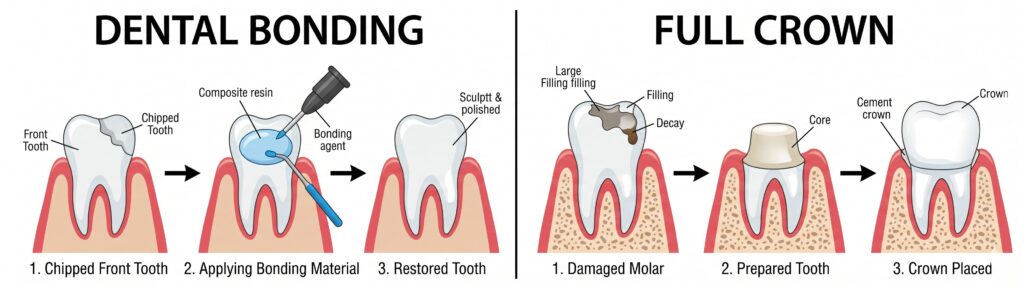
DENTAL BONDING
Fast, conservative, same-day — for smaller chips and cosmetic repairs
- Front teeth with visible edge chips or small corner fractures
- Cosmetic smoothing or reshaping after a small chip
- Tooth structure is essentially intact — chip confined to enamel or a small portion of dentin
- Patients who want a conservative option without removing significant healthy tooth structure
- Cases where same-day repair is clinically appropriate
DENTAL CROWN
Full-coverage protection — for structurally compromised teeth
- A significant portion of the tooth is missing — too structurally unstable for bonding alone
- A cracked cusp where the chip is part of a larger fracture pattern
- A back tooth under heavy bite load where chewing forces would stress a bonding repair
- An existing large filling with limited healthy tooth structure remaining
- A tooth previously treated with a root canal — tends to be more brittle
- Imaging findings suggesting deeper compromise beneath the visible chip
Side-by-Side Comparison
| Factor | Dental Bonding | Dental Crown |
|---|---|---|
| Best For | Small to moderate chips, front teeth, cosmetic repairs | Large chips, cracked cusps, weakened teeth, back molars |
| Appointments | Usually one visit, same day | Typically two or more visitsd |
| Anaesthesia | Often not needed for small chips | Local anaesthesia required |
| Tooth Removal | Minimal — conservative preparation | More tooth structure removed to seat the crown |
| Material | Composite resin — colour-matched to tooth | Porcelain, zirconia, or ceramic — highly lifelike |
| Durability | Can last many years; may chip or stain over time | Very durable; highly stain-resistant |
| Stain Resistance | Lower — can stain with heavy coffee, tea, tobacco | Higher — porcelain and zirconia are more stain-resistant |
| Longevity | Several years with proper care; may need touch-up | Often 10–15+ years with good oral hygiene |
| Cost Range | Lower upfront — no lab fabrication for simple repairs | Higher — lab-fabricated restoration, more chair time |
| Natural Appearance | Excellent on front teeth when done skillfully | Excellent — closely matches colour, translucency, texture |
Dental Bonding: A Fast, Conservative Fix for Many Small Chips
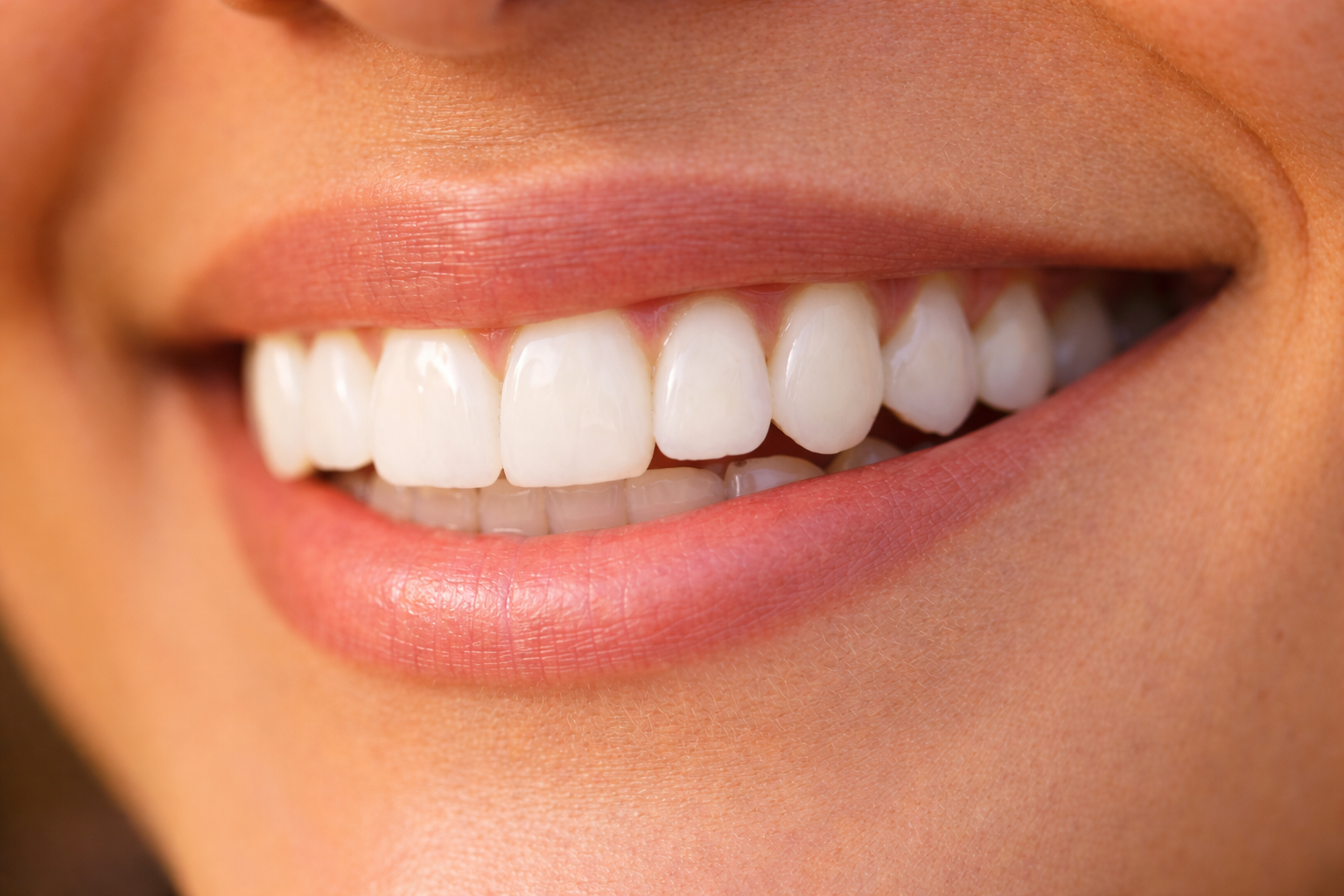
Composite resin bonding is particularly well-suited for front teeth with visible edge chips or small corner fractures — cases where the underlying tooth structure is essentially intact and the chip is confined to enamel or a small portion of dentin.
The entire process for a single tooth often takes 30 to 60 minutes. Composite resin is colour-matched to the natural shade and translucency of your tooth —
which means a well-done bonding repair on a front tooth can be effectively undetectable in everyday conversation and photographs.
What the Bonding Process Involves
SURFACE PREPARATION
The tooth surface is lightly etched to create a surface the composite can bond to. For small chips, local anaesthesia is often not necessary.
RESIN APPLICATION & SHAPING
Tooth-coloured composite resin is applied directly to the prepared surface and carefully sculpted to restore the missing portion and match the natural contours of the tooth.
CURING & HARDENING
The composite is hardened in place using a blue curing light. This takes only seconds per layer and creates a durable bond.
POLISHING & BITE CHECK
The bonded surface is polished to match the sheen of surrounding enamel. The bite is checked and adjusted so the restored tooth feels completely natural.
WHAT TO KNOW ABOUT BONDING GOING IN
Composite resin is durable but not as hard as natural enamel or dental porcelain. It can chip again under hard biting forces, nail biting, or chewing hard objects. It can stain over time with heavy coffee, tea, or tobacco use. With reasonable care, bonding can last many years before needing a touch-up.
When a Crown Makes More Sense for a Broken Tooth
A dental crown covers the entire visible surface of the tooth above the gumline, providing full-coverage protection. It’s recommended when the tooth needs structural reinforcement — not just cosmetic edge repair. A crown typically requires more than one appointment, as the permanent crown is fabricated in a dental laboratory after the tooth is prepared.
SAME-DAY CROWNS
Some offices offer same-day crowns with in-office milling technology (CEREC or similar). Not all practices have this capability — it’s worth asking when you call, especially if you have a time-sensitive event coming up.
Chipped Tooth Repair Cost in NYC

Cost is one of the first questions people ask about chipped tooth repair — and it’s one of the harder ones to answer without more information. The range between a simple bonding repair and a porcelain crown is significant. Several factors determine where a specific case falls:
Extent of the damage:
A small edge chip on a front tooth requiring a small amount of composite resin is priced very differently from a back molar with a cracked cusp requiring a full ceramic crown
Whether imaging is needed:
If the chip is complex or the tooth has prior dental work, X-rays are part of the diagnostic process and may be billed separately
Type of repair recommended:
Bonding, tooth-coloured filling, inlay, onlay, and crown all have different price points reflecting materials, laboratory costs, and procedural complexity
Temporary vs. definitive
If a crown is recommended, a temporary is typically placed while the permanent crown is fabricated — this may affect the overall cost structure
Your specific insurance coverage:
What your plan covers and at what percentage shapes out-of-pocket costs significantly
After the examination, Toothology’s team will walk you through the recommended treatment and associated costs clearly before you commit to anything.
Will Insurance Cover a Chipped Tooth Repair?
The short answer: it depends on your plan and how the repair is classified. Most dental insurance plans distinguish between restorative care — treatment that addresses structural damage — and purely elective cosmetic work. This distinction matters for chipped tooth repairs.
- MORE LIKELY TO BE COVERED
- Bonding or filling that addresses structural damage — classified as restorative rather than cosmetic
- Crown coverage when the tooth is significantly damaged or structurally compromised
- Repairs that prevent further deterioration of a damaged tooth
- Treatment documented as medically/dentally necessary
- VARIES BY PLAN
- Crown coverage typically applies after a waiting period, up to annual maximum, with a co-pay after deductible
- Purely cosmetic bonding on a tooth that was already structurally functional may be treated differently
- Plan may require the tooth meet specific criteria for crown coverage
- Verify benefits before treatment — the dental team can help with this at intake
Why Prompt Repair Matters Even If the Chip Seems Small
A chip that looks small in the mirror is not necessarily small in its clinical implications. Several things can be happening beneath the visible surface that only a clinical exam and imaging can reveal.
The enamel chip may extend into dentin — the sensitive inner layer — making the tooth more vulnerable to temperature sensitivity, decay, and further fracture
The chip may be part of a crack that runs deeper than the visible fracture — one that could extend toward the pulp or root under continued chewing forces
Frequently Asked Questions
What is the difference between dental bonding and a dental crown?
Dental bonding involves applying a tooth-coloured composite resin material directly to the tooth surface, shaping it to restore the missing portion, and hardening it in place. A dental crown is a custom-made cap that covers the entire visible surface of the tooth above the gumline. Bonding is generally appropriate for smaller chips and cosmetic repairs; crowns are typically used when the tooth needs full-coverage structural protection.
When is a dental crown necessary instead of simple bonding? +
A crown is generally recommended when the structural integrity of the tooth is compromised in a way that bonding cannot reliably address over time. Common situations include a large portion of the tooth being missing, a cracked cusp rather than a clean edge chip, a back tooth under heavy bite load, a tooth with an existing large filling that leaves minimal healthy tooth structure, a tooth that has previously undergone root canal treatment, or imaging findings that show deeper compromise beneath the visible chip.
Can a small chip be left untreated?
Technically yes, but it’s generally not recommended. Even a chip that appears minor on the surface can expose dentin, creating sensitivity and a pathway for bacterial penetration and decay. A sharp edge can irritate soft tissue over time. And a visible chip can be part of a larger crack that is not visible without clinical assessment. The safest approach is always an evaluation, even for small chips.
How much does it cost to fix a chipped tooth in NYC?
The cost varies depending on the extent of the chip and how much tooth structure is missing, which type of repair is recommended (bonding, tooth-coloured filling, inlay, or crown), whether diagnostic imaging is part of the visit, and what your dental insurance covers. Bonding for a small front-tooth chip and a full porcelain crown for a significantly damaged back molar represent very different levels of treatment and cost accordingly.
Does dental insurance cover bonding or crowns for chips?
Coverage varies by plan. Many dental insurance plans include restorative coverage that applies to both bonding or fillings and crowns when the treatment is medically or dentally necessary to repair a damaged tooth. Whether your specific chip meets the coverage criteria depends on your plan and how the claim is documented. Toothology’s team can help verify your benefits before treatment so you have an accurate picture of out-of-pocket costs in advance.
Which option looks more natural — composite resin bonding or a porcelain crown?
Both can produce highly natural-looking results in experienced hands. Composite resin bonding is colour-matched to the surrounding tooth and, when applied skillfully, can be effectively invisible on front teeth in everyday situations. Over time, composite can stain more readily than porcelain with heavy coffee, tea, or tobacco use. Porcelain and zirconia crowns are highly stain-resistant and can be fabricated to closely match the colour, translucency, and surface texture of the natural tooth.
CHIPPED A TOOTH?
Book a same-day evaluation at Toothology in Williamsburg. We’ll assess the chip, take any needed X-rays, and give you a clear, honest plan before you commit to anything.
DIRECT LINE
IN THIS GUIDE
QUICK DECISION GUIDE
- BONDING LIKELY
Small front tooth chip · Enamel only · Conservative · Same-day · Cosmetic concern
- CROWN LIKELY
Large chip · Cracked cusp · Back molar · Root canal tooth · Large existing filling
- ALWAYS CONFIRMED AT EXAM
TOOTHOLOGY DENTAL
Williamsburg, Brooklyn, NY
Serving Greenpoint, Bushwick, Bed-Stuy & Downtown Brooklyn
718-678-3800
Emergency line available
Open Hours
Mon – Thu: 10:00 AM – 6:00 PM Friday: 10:00 AM – 2:00 PM Sunday: 10:00 AM – 2:00 PM Saturday: Closed
OUR COMMITMENT
- Board-Certified Pediatric Dentists
- Child-Friendly, Anxiety-Reducing Care
- Same-Day Emergency Slots
- Low-Radiation Digital X-Rays
- Most Major Insurance Accepted