
- Cosmetic Dentistry Guide · Williamsburg
Those dark triangle-shaped gaps between your teeth and gumline? They’re called black triangles — and dental bonding can close them conservatively, often in one to two visits, without touching veneers.
How to Fix Black Triangles Between Teeth & Gums in Williamsburg
You spot them in a photo first — small triangle-shaped gaps between your teeth and the gumline, dark against the brightness of your smile. They weren’t as noticeable a few years ago. Now they seem to show up in every picture, and you find yourself angling your head differently or keeping your lips a little lower when you laugh. Those dark spaces are called black triangles — and dental bonding has become a conservative, effective way to close them.
Often without removing any tooth structure or committing to porcelain veneers. Black triangles are more common than most people realise — particularly in adults whose gums have receded slightly with age, or whose teeth have shifted after orthodontic treatment.
What Are "Black Triangles" and Why Do They Appear?
Black triangles are the open, dark spaces that form in the embrasure — the V-shaped area between adjacent teeth near the gumline — when the gum tissue no longer fills that space completely. In a healthy, younger mouth, the interdental papilla (the small triangular flap of gum between each pair of teeth) fits snugly into that space. When it recedes or is absent, a visible gap forms.
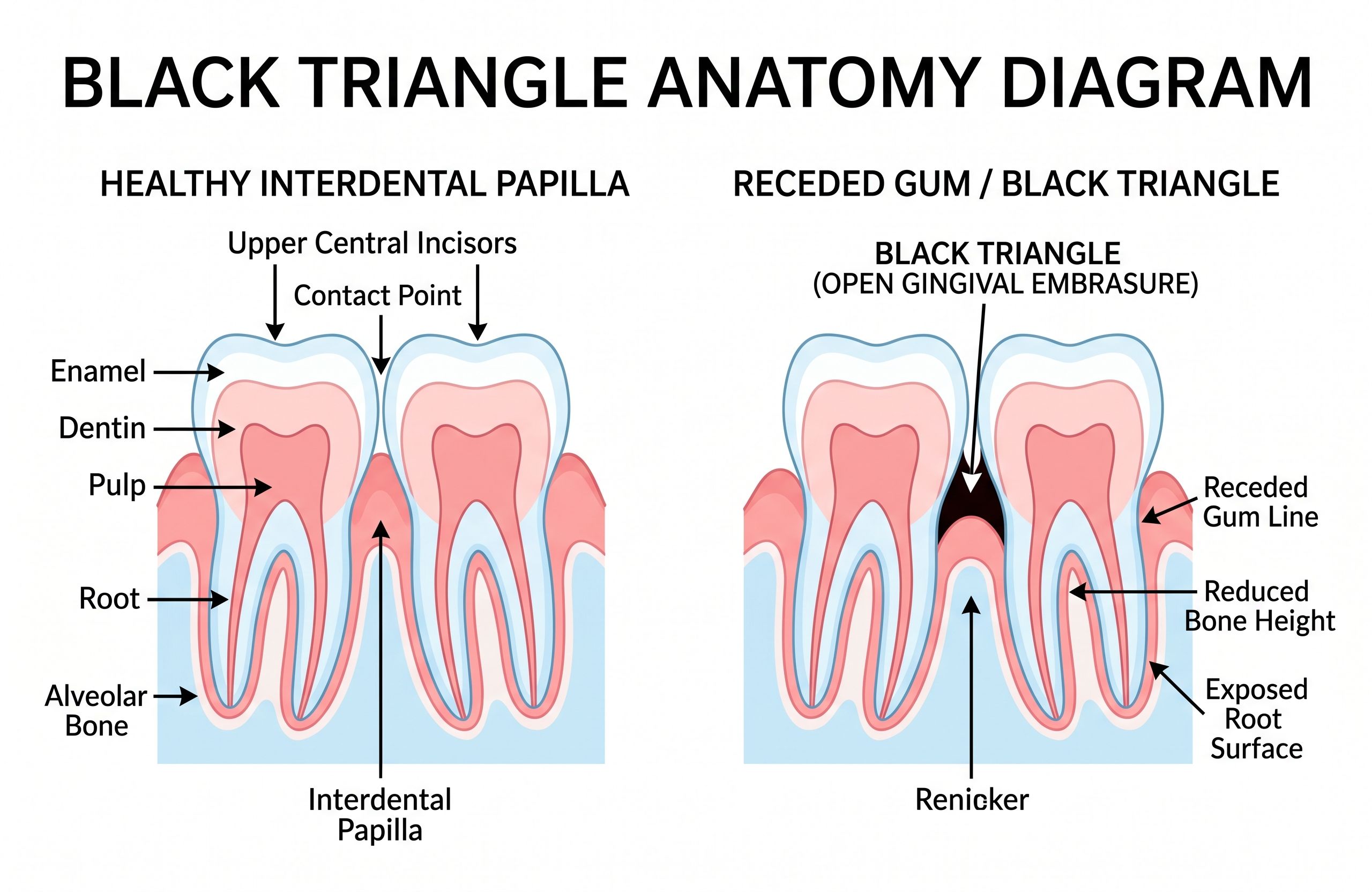
They tend to be most noticeable in the upper front teeth, and are often described as “aging teeth” or as something that “suddenly appeared” after braces came off.
Common Causes of Black Triangles
Gum Recession & Tissue Loss
Gum tissue can recede gradually due to age, previous gum disease, or bone loss — leaving more of the tooth root exposed and the embrasure open.
Triangular Tooth Shape
Some people naturally have teeth that taper toward the gumline. When these teeth sit side by side, the contact point sits high and the gap below is wider — even with perfectly healthy gums.
Post-Orthodontic Movement
Teeth gap closure through braces or aligners can reposition teeth in ways that leave the gum papilla behind, creating visible triangular gaps that weren’t there before.
Aggressive Brushing or Flossing
Repeated trauma to the interdental papilla — from brushing too hard or snapping floss aggressively — can cause it to shrink or recede over time.
Bone Loss from Periodontal Disease
When the bone that supports the teeth is lost, the gum tissue that relies on it follows. This is one of the more progressive causes and requires gum health evaluation and treatment before any cosmetic closure.
A Simple Self-Check
Are you noticing any of the following alongside the gaps?
Dark triangle-shaped spaces between upper or lower front teeth
Food getting trapped more easily in the gaps between teeth
Gum bleeding when you brush or floss
Sensitivity near the gumline
Teeth that look longer than they used to
Recent completion of orthodontic treatment — braces or clear aligners
GUM HEALTH COMES FIRST
If you’re experiencing bleeding, bad breath, or signs of ongoing gum recession alongside these gaps, a periodontal evaluation should come first. Cosmetic closure over active gum disease or untreated bone loss is not the appropriate starting point — and a responsible dentist will assess gum health before recommending any bonding approach.
The Bioclear Method vs. Traditional Bonding
Both the Bioclear method and traditional composite bonding work by adding tooth-coloured composite resin to the tooth surface to widen its profile and reduce or close the triangle-shaped gap. Your consultation will confirm which technique — or combination — is the best fit for your specific tooth shape and gum health.
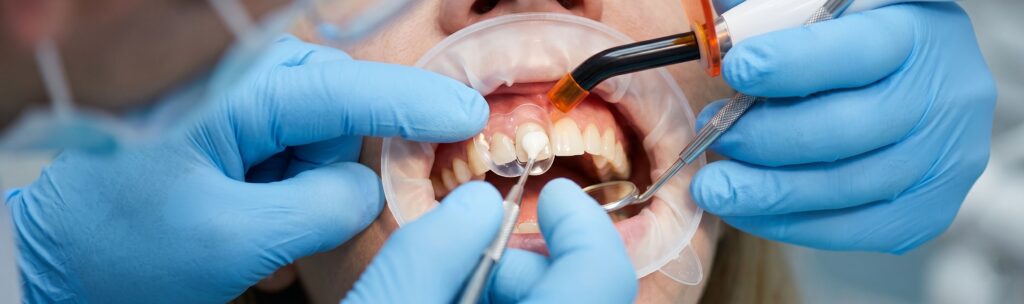
HOW TRADITIONAL COMPOSITE BONDING WORKS
In a conventional composite bonding procedure, the dentist applies composite resin directly to the tooth surface, sculpts it by hand to the desired shape, hardens it with a curing light, and then polishes it smooth. It’s generally completed in a single appointment and requires no drilling on healthy tooth structure.
WHAT MAKES THE BIOCLEAR METHOD DIFFERENT
Bioclear uses a matrix system — a thin, transparent form that wraps around the tooth — combined with heated composite resin that is injected into the space. The goal of this injection-moulding technique is to produce a contiguous, seamless filling that flows fully into the embrasure and creates smooth, rounded tooth contours with fewer surface irregularities.
SIDE-BY-SIDE COMPARISON
Review this as a general guide — your dentist will advise which approach suits your tooth anatomy, gum status, and aesthetic goals.
| Category | Bioclear Method | Traditional Bonding | What It Means for You |
|---|---|---|---|
| How composite is placed | Injection-moulded matrix wraps the tooth for a seamless contour fill | Composite applied freehand and sculpted by the dentist | Bioclear may provide smoother embrasure fill; results depend on the case and clinician |
| Aesthetic outcome | Can produce very natural-looking, rounded contours that mimic tooth anatomy | Results depend heavily on skill and artistry; can look excellent in experienced hands | Both can achieve natural results |
| Stain resistance | Polished surface may resist staining somewhat better; requires maintenance | Standard composite; more susceptible to surface staining over time | Co ee, tea, and smoking a ect both; routine polishing helps either option |
| Plaque retention risk | Smooth sealed margins may reduce plaque trapping in the embrasure | Open or slightly rough margins can harbour plaque if not well-finished | Good oral hygiene and professional cleanings matter with either technique |
| Typical appointment time | Often 1–2 visits depending on the number of teeth treated | Often 1 visit for mild–moderate cases; more teeth require more time | Timeline depends on your case complexity — confirm at consultation |
| Long-term maintenance | Periodic polishing/touch-up; avoid biting hard objects; consider nightguard if grinding | Same maintenance principles apply; bonding can chip or stain over time | Neither option is 'permanent' — lifespan depends on habits, hygiene, and gum stability |
| Best suited for | Multiple adjacent black triangles; patients wanting very seamless closure | Single gaps; mild cases; patients wanting a faster one-appointment option | Your dentist will recommend the approach best matched to your anatomy and goals |
| Not recommended when | Severe bone loss, active periodontal disease, or very large gum recession without prior treatment | Same contraindications apply; cosmetic closure before gum disease treatment is not appropriate | Gum health is evaluated before any cosmetic closure at Toothology |
Can Black Triangles Lead to Gum Disease?
Black triangles themselves are not a disease — they’re a visible change in the relationship between your teeth and gums. But the underlying causes and practical consequences of having them are worth understanding from a gum health perspective.
WHY THE GAPS CAN MAKE ORAL HYGIENE HARDER
When the embrasure is open rather than filled with gum tissue, food debris and plaque have a larger, less defended space to collect. Standard flossing may not reach fully into that space, making thorough cleaning more difficult. Over time, accumulated plaque in these areas can contribute to gum inflammation — which, if left unaddressed, can worsen whatever gum recession is already present.
HYGIENE TOOLS THAT WORK BETTER FOR OPEN EMBRASURES
Interdental Brushes
Small, bristled brushes designed to pass through open embrasures are often more effective than floss alone for cleaning these larger spaces.
Water Flossers
A gentle water flosser can flush debris from open gaps without the frustration of floss that snaps through and misses the space entirely.
Adjusted Brushing Technique
A soft-bristled brush at 45° to the gumline, used with gentle pressure — aggressive brushing near the gumline can worsen recession over time.
Regular Professional Cleanings
A hygienist can clean areas that are harder to reach at home and monitor gum tissue changes between visits — particularly important with open embrasures.
Transforming Your Smile Without Veneers
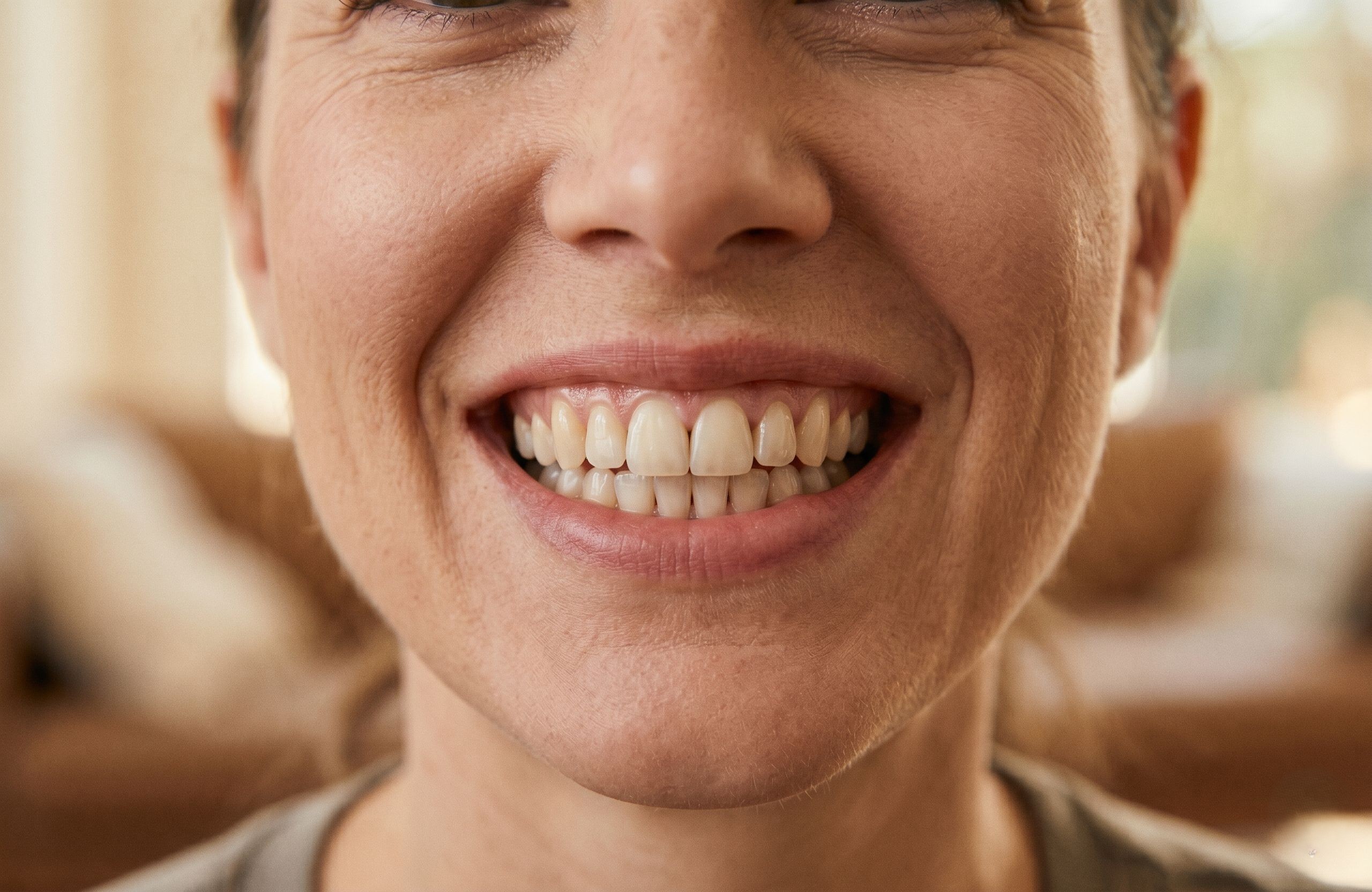
Porcelain veneers are sometimes the first solution people think of when they want to change the look of their front teeth — but for black triangles specifically, veneers are often more intervention than the situation calls for.
- BONDING / BIOCLEAR — USUALLY PREFERRED
- Adds material without removing healthy tooth structure
- More conservative — preserves what you have
- Can be adjusted or replaced more easily if your needs change
- Often completed in one to two visits
- No lab fabrication required for most cases
- Targeted specifically to the gap — not the whole tooth surface
- VENEERS — USUALLY MORE THAN NEEDED
- Requires removing enamel — a permanent change
- More costly upfront; covers the entire front surface
- Designed for broader shape, colour, and symmetry changes
- Appropriate when multiple aesthetic concerns exist across the tooth
- Cannot be easily reversed
Toothology’s approach to aesthetic dentistry prioritises smile rejuvenation that looks natural — not work that looks done.
COMPREHENSIVE EXAM
A review of your gum health, bone support, bite, and the specific anatomy of your black triangle spaces. Gum health is always assessed before any cosmetic closure is planned.
CLINICAL PHOTOGRAPHS
Close-up photographs of your smile at rest and in motion help identify the gap pattern accurately and plan the closure approach before treatment begins.
SHADE MATCHING & AESTHETICS DISCUSSION
Before any treatment, your dentist will discuss your aesthetic goals — how natural you want the result to look, your preference around tooth brightness and shape, and whether you want a conservative match or a subtle enhancement.
TREATMENT PLANNING
A clear treatment plan with options is presented — including whether Bioclear, traditional bonding, or another approach is recommended for your specific gaps, along with honest timelines and cost information.
FOLLOW-UP POLISH & CHECK
After treatment, a follow-up appointment allows for fine-tuning of the composite surface and ensures the result has settled comfortably with your bite and gum contour.
Typical Consultation-to-Result Timeline
WEEK 1
COSMETIC CONSULTATION
Exam, photos, shade match, gum health assessment, and treatment planning discussion.
1–2+ WEEKS
TREATMENT APPOINTMENT
1–2 sessions depending on the number of teeth and the technique chosen. Varies by scheduling and gum health status.
1–4 WEEKS
FOLLOW-UP POLISH & CHECK
Fine-tuning of composite surface and confirmation of bite comfort. Timing as recommended by your dentist.
ONGOING
MAINTENANCE
Routine professional cleanings and periodic assessment of bonding integrity. Polishing during cleanings helps maintain the appearance of bonded teeth.
Is Fixing Black Triangles Permanent?
The results can be long-lasting, but they are not permanent in the way a dental crown or implant might be understood to be. Composite bonding — whether placed using the Bioclear technique or conventional methods — typically lasts several years with proper care, but it can chip, stain, or wear over time and may need occasional touch-up or replacement.
What Affects How Long Results Last
Oral hygiene:
Habits:
Bruxism:
Gum stability:
ON STAINING
Composite is more susceptible to surface staining from coffee, tea, red wine, and smoking than natural tooth enamel. Routine polishing during professional cleanings helps maintain the appearance of bonded teeth over time.
Does Insurance Cover Bioclear?
Coverage for Bioclear and composite bonding varies significantly depending on your dental plan, your employer’s benefits structure, and whether the treatment is coded as cosmetic or restorative. Many dental insurance plans consider black triangle closure to be a cosmetic procedure and may not provide coverage.
However, if there is a documented functional concern — such as food trapping contributing to decay risk, or treatment being part of a periodontal management plan — some plans may cover part of the associated evaluation or treatment.
MOST RELIABLE APPROACH
Request a predetermination (also called a preauthorization or pre-estimate) from your insurer before treatment begins. At your Toothology consultation, the team can advise on what information your plan is likely to need. Specific coverage decisions rest with your individual plan — confirm all details in writing with your insurer before proceeding.
Frequently Asked Questions
What causes black triangles between teeth and gums?
Is Bioclear the best way to fix black triangles?
Are black triangles a sign of gum disease or aging?
How much does it cost to fix black triangles in Brooklyn?
Can black triangles be fixed without porcelain veneers?
How long does the Bioclear treatment for gaps take?
Does insurance cover the cost of fixing black triangles?
Do black triangles get worse over time?
Ready for a Smile That Looks Like You — Just Refreshed?
Black triangles are one of the more emotionally charged dental concerns — not because they’re always a health emergency, but because of how visible they feel in photos and in daily life. The encouraging news is that dental bonding is a conservative, well-tolerated treatment that can close those gaps naturally — often in one to two visits. A consultation is the lowest-commitment first step. You leave with clarity about the cause, your options, realistic timelines, and what a natural-looking result could look like for your specific teeth.
NOTICED BLACK TRIANGLES?
Book a cosmetic consultation at Toothology in Williamsburg — we’ll assess the cause and show you what’s realistic before any treatment begins.
DIRECT LINE
IN THIS GUIDE
QUICK DECISION GUIDE
Gum health must be evaluated before any cosmetic closure begins.
TOOTHOLOGY DENTAL
Williamsburg, Brooklyn, NY
Serving Greenpoint, Bushwick, Bed-Stuy & Downtown Brooklyn
718-678-3800
Emergency line available
Open Hours
Mon – Thu: 10:00 AM – 6:00 PM Friday: 10:00 AM – 2:00 PM Sunday: 10:00 AM – 2:00 PM Saturday: Closed
OUR COMMITMENT
- Board-Certified Pediatric Dentists
- Child-Friendly, Anxiety-Reducing Care
- Same-Day Emergency Slots
- Low-Radiation Digital X-Rays
- Most Major Insurance Accepted