
- Restorative Dentistry · Patient Guide
What you should know about switching from metal to tooth-colored fillings — when it makes sense, what the process looks like, and how to plan for cost and aftercare.
Replacing Silver Amalgam Fillings with Natural Composite
You open wide for a photo and there they are — dark, metallic glints in the back of your mouth that no amount of brightening seems to hide. For many adults, silver amalgam fillings placed years or even decades ago are the most visible reminder that dental materials have changed significantly since those early appointments. If you are considering whether to replace silver fillings with composite resin, you are far from alone — and the reasons people make this decision are more nuanced than a simple aesthetic preference.
Some patients are motivated purely by appearance: they want a smile that looks clean and natural in photographs and on video calls. Others are drawn to metal-free dentistry because of a broader preference for biocompatible materials and a holistic dental approach. If you’re searching for a mercury-free dentist Brooklyn patients trust, the first step is an exam to confirm which fillings truly need replacement. And for a meaningful number of patients, replacement is not elective at all — older amalgam fillings can develop cracks, leaking margins, or recurrent decay underneath that requires attention regardless of material preference.
Why Are People Replacing Their Silver Fillings in 2026?
The motivations behind replacing old amalgam restorations tend to fall into two broad camps: those driven by aesthetics and patient preference, and those driven by clinical necessity.
Aesthetic and Preference-Driven Reasons
Silver amalgam fillings were the standard of care for posterior restorations for most of the twentieth century, and many adults still carry them from childhood or young adulthood. Over time, those fillings change. The dark metal color can deepen and spread, giving surrounding tooth structure a grey or bluish tint that was not there when the filling was first placed.
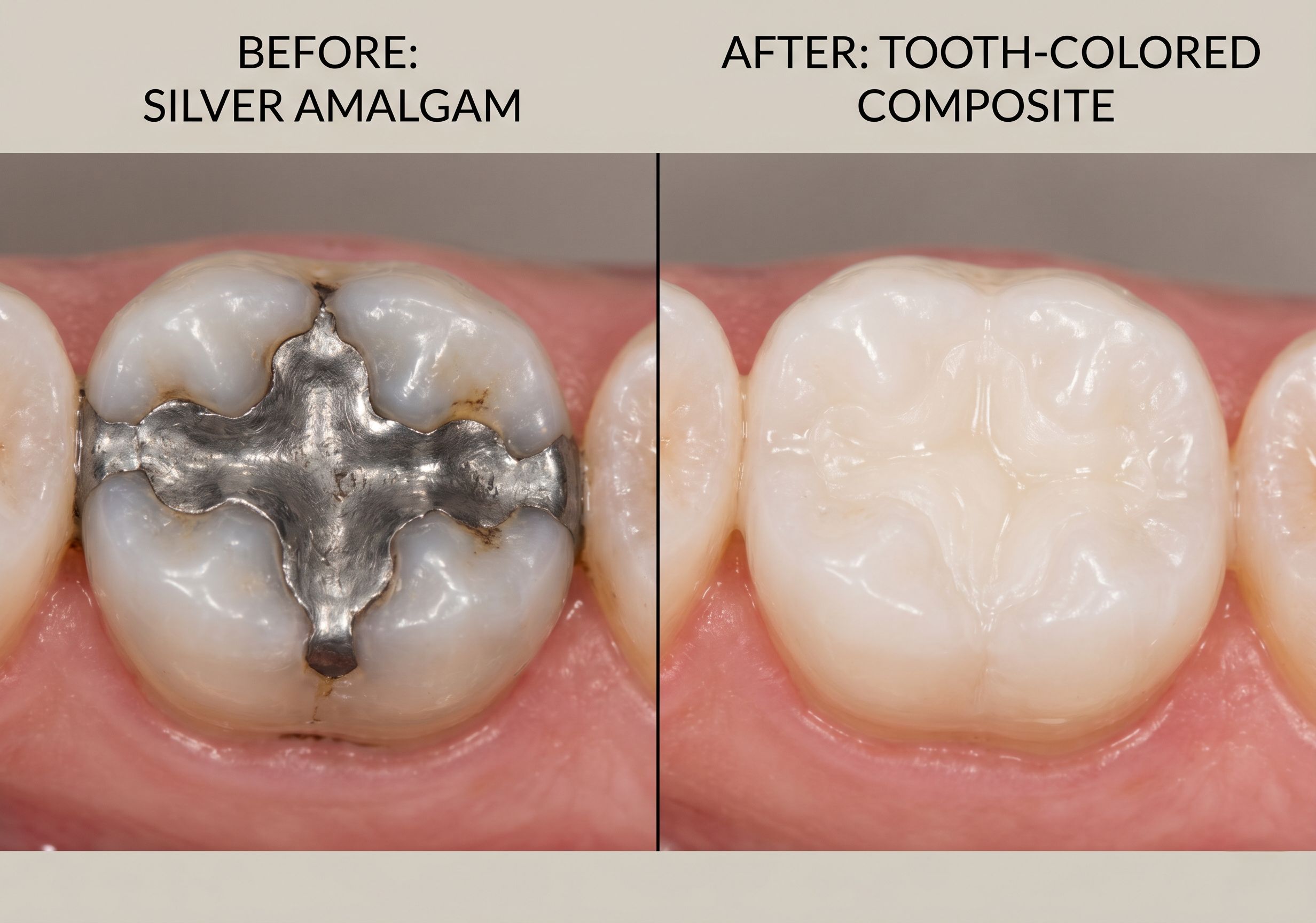
For patients pursuing metal-free dentistry out of personal preference, the desire for a smile that looks consistent and natural at every angle is entirely reasonable. Modern resin composite materials have improved considerably in terms of strength, shade matching, and polish retention, and for many patients, the aesthetic outcome is genuinely excellent.
When Replacement Is Clinically Recommended
Beyond aesthetics, there are situations where replacing an old amalgam filling is the appropriate clinical recommendation rather than simply an elective upgrade:
Cracked or Fractured Margins
Amalgam fillings can develop stress fractures over time as the metal expands and contracts with temperature changes.
Recurrent Decay Underneath
Microleakage — the gradual seepage of bacteria and fluids between filling and tooth — can allow new decay to develop at the margins or beneath the filling, often invisibly.
Leaking or Open Margins
A filling that is no longer sealed against the tooth edge creates a pathway for bacteria and food debris to reach the inner tooth.
Sensitivity or Discomfort
Ongoing sensitivity to cold, pressure, or sweet foods can sometimes trace back to an old filling that has deteriorated or developed stress on the surrounding enamel.
Visible Cracks in the Tooth
In some cases, the forces generated by an ageing amalgam restoration contribute to craze lines or full cracks in the tooth walls.
Important
Replacement should be guided by examination — not reflexive, and not based on general timelines. Your dentist will evaluate each filling individually.
The Benefits of Metal-Free, Biocompatible Composite Resin
Composite resin is the material used for tooth-colored fillings, made from a mixture of glass or ceramic particles within a plastic matrix. When placed correctly, it bonds directly to the tooth surface using a dental adhesive, which changes the mechanical relationship between filling and tooth compared to the mechanical locking used with amalgam.

| Category | Silver Amalgam Filling | Tooth-Colored Composite Resin |
|---|---|---|
| Appearance | Dark grey/silver; visible on molars and premolars; discolors tooth over time | Shade-matched to your natural tooth; virtually invisible in photos and daily life |
| How it attaches to tooth | Mechanically locked into a prepared cavity — requires some healthy structure to be removed for retention | Bonds chemically to the tooth surface — can often preserve more natural tooth structure, especially in smaller restorations |
| Tooth preservation | Conventional cavity preparation may remove more healthy enamel for mechanical retention | Adhesive bonding allows a more conservative preparation in many cases; less healthy tissue removed |
| Thermal expansion | Metal expands and contracts with temperature changes; can stress surrounding tooth structure over time | Composite has similar thermal properties to natural tooth; less ongoing stress on enamel walls |
| Longevity factors | Very durable under heavy bite forces; large amalgam restorations can last many years | Can last many years with good hygiene and appropriate bite management; large restorations may be better suited to onlay/crown |
| Maintenance & staining | Does not stain; may corrode and darken over time; corrosion can protect against microleakage in some older studies | May discolor slightly over time from coffee, tea, or tobacco; regular polishing and routine cleanings help maintain appearance |
| Best suited for | Large posterior restorations with heavy occlusal load; cases where aesthetics are less of a priority | Front and visible teeth; smaller/moderate cavities; patients seeking metal-free, tooth-colored restoration |
| Considerations for replacement | Replacement is indicated for cracks, fractures, recurrent decay, leaking margins, or at patient request after exam | Technique-sensitive; proper moisture control and shade matching matter; large restorations may warrant evaluation for onlay/crown instead |
A Note on Large Restorations
Composite resin is an excellent choice for small to moderate restorations, and in experienced hands it performs well in many posterior situations. However, when an old filling is large, when there is significant underlying decay, or when multiple cusps are involved, an indirect ceramic or composite onlay — or even a crown — may provide better long-term strength and fit than direct composite placement.
Safe Removal: How We Protect Your Tooth During the Switch

When an amalgam filling is drilled out, the process generates heat, vibration, and a fine aerosol that contains both tooth structure and filling material. Safe removal refers to a set of precautionary measures designed to minimize exposure to these particles during the procedure — both for the patient and for the clinical team.
Common Precautions During Amalgam Removal
Isolation and moisture control: A rubber dam — a thin sheet of dental latex placed around the tooth — helps contain debris, protect the surrounding soft tissue, and create a cleaner field.
High-volume evacuation: A well-positioned suction tip captures aerosol and debris as close to the source as possible during removal.
Water cooling and sectioning: Using water irrigation during drilling reduces heat generation and keeps the tooth cool.
Protective barriers: Patients may be given a protective drape, nasal breathing is sometimes encouraged, and clinical staff use appropriate respiratory protection.
Immediate cleanup: Rinsing thoroughly after removal and removing the rubber dam carefully helps limit any residual debris reaching the mouth.
Clinical Prudence, Not Alarm
These precautions are about clinical prudence, not alarm — dental teams have managed amalgam removal safely for decades.
What to Expect After Replacement
Some temporary sensitivity is normal after any filling procedure, including amalgam removal and composite placement. The tooth has been worked on, and the pulp may respond with brief sensitivity to temperature or pressure for a few days to a few weeks. If sensitivity is sharp, spontaneous, or worsening rather than improving, contact the practice — it may indicate that the pulp needs further attention.
Your dentist will also check your bite before you leave the appointment. Composite placed slightly high can cause discomfort when biting and should be adjusted on the day if possible.
A Note on Pregnancy, Children, and Medical Conditions
The FDA notes that certain higher-risk groups (including pregnant people, nursing parents, children under 6, and individuals with certain neurological or kidney conditions) should consider non-mercury alternatives when possible and appropriate.
The FDA also advises that intact amalgam fillings generally should not be removed solely to prevent disease or for general health concerns unless a clinician determines removal is medically necessary. If you’re considering replacement and fall into a higher-risk category, discuss timing and options with your dentist — and, when appropriate, your physician.
Aesthetic Upgrade: Making Your Fillings Invisible
One of the most consistent things patients say after composite replacement is that they had forgotten how many of their back teeth had been filled until they could no longer see the evidence.
What Goes Into Shade Matching and Contouring

Shade selection:
Composite resins come in a wide range of shades. Your dentist will match the composite to the specific section of the tooth being restored — not just the overall tooth color, as enamel and dentin reflect light differently across different layers of the tooth.
Contouring:
The composite is shaped to follow the natural anatomy of the tooth surface, including the ridges, grooves, and cusps that make a back tooth look like a back tooth.
Polishing:
A final polish with fine-grit tools gives the composite a smooth, slightly glossy surface that reflects light similarly to natural enamel.
Maintenance: Keeping Composite Looking Its Best
Rinse After Staining Drinks
Coffee, tea, and red wine all stain composite more readily than natural enamel. A quick rinse after drinking helps.
Avoid Tobacco
Tobacco significantly accelerates staining. Composite restorations will discolor faster in tobacco users.
Routine Professional Cleanings
A hygienist can polish the composite surface at regular appointments, refreshing the appearance and removing surface staining before it becomes embedded.
Periodic Touch-Up
Composite can be polished or minimally re-surfaced in-chair without replacing the entire restoration.
Plan Whitening Before Filling Replacement
Composite resin can be shade-matched at the time of placement — but it cannot be predictably whitened afterward. If you are considering tooth whitening alongside filling replacements, the conventional approach is to whiten first, allow the shade to stabilize (typically two to four weeks), and then match the composite to the new, lighter shade.
Is It Safe to Remove Mercury Fillings?
Amalgam fillings contain mercury as a component of the alloy — combined with silver, tin, and copper to form a stable material. In its set state, dental amalgam is chemically different from elemental mercury or methyl mercury (the form found in certain fish), and established dental and health bodies have assessed it as safe for most patients in the form it takes in a filling.
For most healthy adults, amalgam removal can be performed safely with appropriate precautions, and the decision to replace is guided by clinical condition and patient preference.
An Important Distinction
What should be avoided is the framing that removing amalgam fillings will reliably improve systemic health conditions or reverse specific symptoms — there is not strong clinical evidence to support those claims, and approaching the decision through that lens can lead to unnecessary treatment.
How Much Does It Cost to Replace a Filling?

If you’re comparing amalgam removal cost NYC patients see, the total varies based on tooth, filling size, and whether additional work is needed.
What Affects the Cost of Amalgam Replacement
Number of fillings: Replacing one filling is less expensive than replacing a full quadrant or all posterior restorations.
Size and depth of the restoration: A small single-surface filling costs less than a large multi-surface restoration.
Tooth location: Anterior (front) teeth and visible premolars tend to require more precise shade-matching work.
X-rays and examination: A diagnostic appointment with radiographs may be needed before treatment planning.
Presence of additional decay: If new decay is found under the old filling, it must be removed and the cavity is larger.
Whether an onlay or crown is needed: If a tooth has cracks, a large existing cavity, or compromised cusps, a more comprehensive restoration may be recommended.
Anaesthesia and appointment duration: Standard local anaesthetic is typically included; additional factors like anxiety management may have separate considerations.
Insurance Coverage for Amalgam Replacement
Coverage for amalgam-to-composite replacement varies considerably depending on your plan. Some dental insurance plans cover composite fillings on posterior teeth; others cover them at the amalgam rate and charge the difference as a patient responsibility. If the replacement is medically necessary, coverage is more likely than for a purely elective replacement.
The most reliable step is to request a predetermination (a pre-treatment cost estimate) from your insurer before scheduling. The Toothology team can assist with this process after your examination and treatment plan are established.
Questions to Ask About Coverage and Out-of-Pocket Costs
Does my plan cover composite resin on posterior (back) teeth?
If composite is covered at the amalgam rate, what is the estimated patient responsibility for the difference?
Is a predetermination available for my proposed treatment codes?
Does coverage change if the replacement is medically indicated (decay, failed margins) vs. elective?
Are there frequency limitations — for example, a waiting period between filling replacement on the same tooth?
Is the practice in-network with my plan, and how does that affect my out-of-pocket responsibility?
Frequently Asked Questions
Is it safe to remove old mercury silver fillings?
How much does it cost to replace amalgam with composite?
Are white composite fillings as strong as silver ones?
Why do my silver fillings look dark or grey?
How long do composite resin fillings last?
Does insurance cover the replacement of old silver fillings?
Can silver fillings cause tooth cracks over time?
Is the amalgam removal process painful?
Your Smile, Updated — Without the Guesswork
If you have been thinking about replacing your silver fillings and want a clear, honest picture of where each restoration stands and what your options realistically are, a filling consultation is the lowest-commitment step you can take.
Filling Consultation
Find out which fillings need attention and get a personalized plan for composite replacement.
DIRECT LINE
IN THIS GUIDE
TOOTHOLOGY DENTAL
Williamsburg, Brooklyn, NY
Serving Greenpoint, Bushwick, Bed-Stuy & Downtown Brooklyn
718-678-3800
Emergency line available
Open Hours
Mon – Thu: 10:00 AM – 6:00 PM Friday: 10:00 AM – 2:00 PM Sunday: 10:00 AM – 2:00 PM Saturday: Closed
OUR COMMITMENT
- Board-Certified Pediatric Dentists
- Child-Friendly, Anxiety-Reducing Care
- Same-Day Emergency Slots
- Low-Radiation Digital X-Rays
- Most Major Insurance Accepted