
- Full-Arch Restoration Guide · Williamsburg Brooklyn
An honest comparison — stability, bone health, cost of ownership over 10 years, and who is the right candidate for each option. No overselling either direction.
All-on-4 Dental Implants vs. Dentures: Which Is the Better Investment?
If you are living with dentures — or facing the prospect of significant tooth loss — you have almost certainly heard the term “All-on-4 dental implants” come up in conversation, in advertising, or in a consultation room. The honest answer is that dentures vs. implants is not a simple better/worse question. It depends on your bone health, medical history, financial situation, and what you are actually hoping to change about your current experience.
Neither option should be approached as a one-size-fits-all decision. Dentures can be the right solution for many patients — particularly where surgical contraindications exist or where cost is the overriding constraint. All-on-4 is a surgical procedure with a recovery process and specific candidacy requirements. What follows is an honest account of both.
The Difference Between Removable Dentures and All-on-4 Implants
The most fundamental distinction between the two options is fixed versus removable. Removable dentures sit on top of the gum tissue and are held in place by suction, clasps on remaining teeth, or dental adhesive. They come out at night, require soaking and cleaning in a separate container, and rely on the continued fit of the gum tissue beneath them — which changes as the underlying bone resorbs over time.
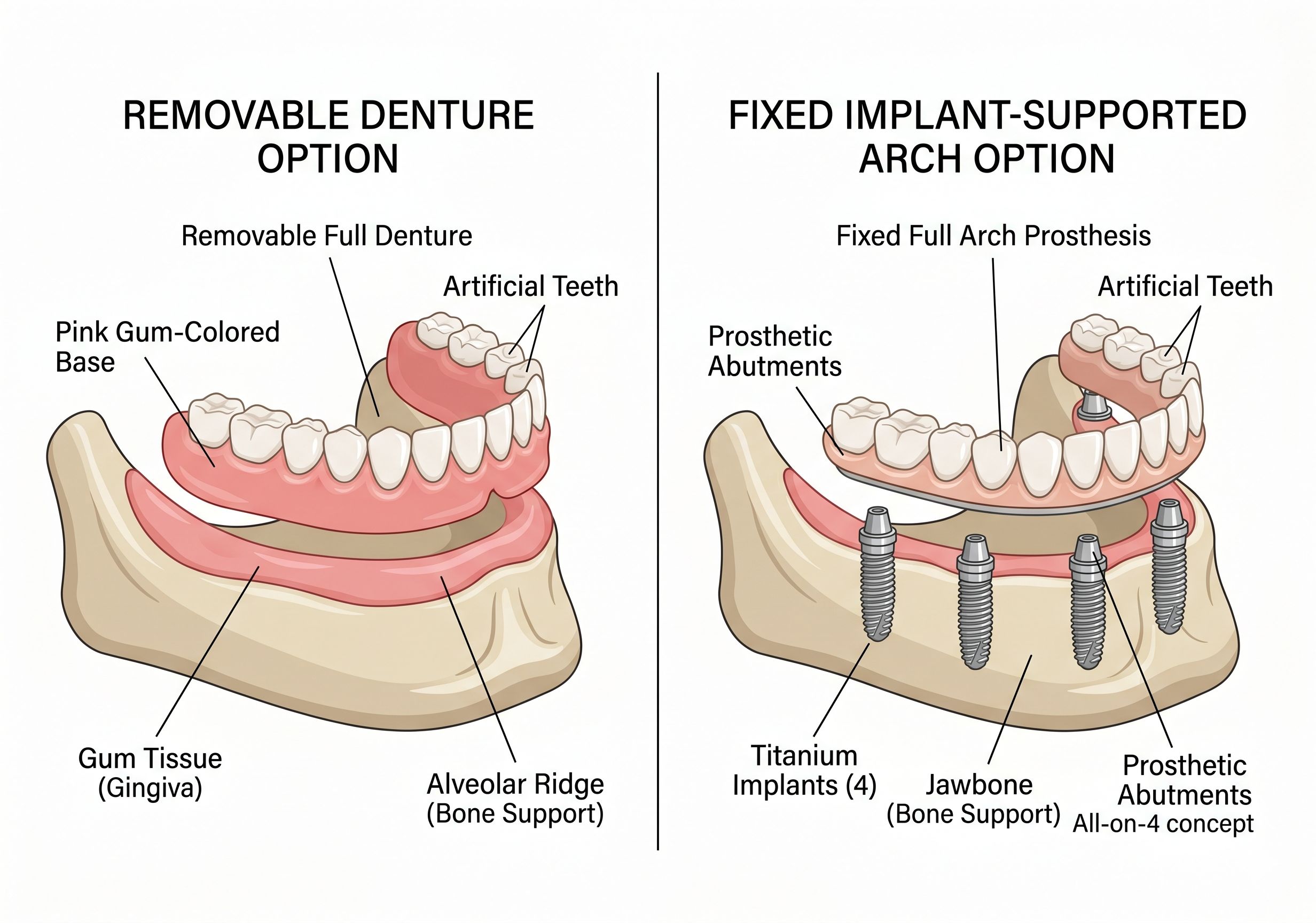
All-on-4 is a full-arch implant concept in which the entire replacement arch of teeth is supported by four implants placed strategically in the jawbone. The prosthetic — often a zirconia bridge or acrylic hybrid on a titanium framework — is fixed to the implants and does not come out for daily cleaning. It does not require adhesive, does not rely on gum suction, and because the implants are embedded in bone, they stimulate it in a way that removable dentures do not.
NOTE ON "PERMANENT DENTURES"
This term is used inconsistently — it sometimes refers to dentures that are implant-supported and non-removable, and sometimes to high-quality conventional dentures intended for long-term use. A fixed implant-supported arch is more accurately described as a full-arch implant bridge rather than a denture in the conventional sense.
Full Side-by-Side Comparison
| Category | Removable Dentures | All-on-4 Implants |
|---|---|---|
| Daily Stability | Relies on suction, adhesive, or clasps; can shift during speaking and eating | Fixed to implants; does not move, slip, or require adhesives during the day |
| Bite Force | Significantly reduced compared to natural teeth; hard foods often avoided | Substantially stronger than removable dentures; allows a wider range of foods (case-dependent) |
| Jawbone Preservation | Does not stimulate bone; continued resorption changes face shape and denture fit over time | Implants stimulate bone similarly to natural tooth roots, helping to slow ongoing resorption |
| Daily Care | Removed nightly, soaked, brushed; adhesive reapplied each morning | Cleaned in place with soft brush, floss tools, water flosser; removed only by clinician |
| Adjustments & Repairs | Periodic relines needed as bone changes; repairs for cracks or fractures; replacement over time | Periodic check-ups; prosthetic may need adjustment or replacement over many years; implants typically remain |
| Comfort Over Time | Fit can worsen as bone shrinks; sore spots and gum irritation are common complaints | No gum pressure from a removable plate; discomfort during healing period is temporary |
| Speech | Initial adjustment period; clicking or slipping can affect speech, particularly without adhesive | Fixed prosthetic closely mimics natural tooth position; most patients adapt quickly |
| Long-Term Appearance | Facial appearance may change over time as underlying bone is resorbed | Implants help preserve bone contour, supporting a more stable facial profile over time |
The phrase “Teeth in a Day” — sometimes described as same-day implants or immediate loading — refers to the possibility of placing implants and attaching a temporary fixed prosthetic within a single surgical appointment. The concept involves strategically angling implants — often tilting the posterior implants to avoid the sinus cavity and areas of reduced bone density — to maximise contact with available bone.
WHAT "SAME DAY" ACTUALLY MEANS
“Same day” refers to the temporary bridge, not the final bridge. The final prosthetic comes after osseointegration is confirmed — typically several months later. And not every patient qualifies for immediate loading — this is determined at consultation with 3D imaging.
What the Full Treatment Process Typically Involves
CONSULTATION & 3D IMAGING
A thorough examination including CBCT (3D cone beam CT) imaging to assess bone volume, bone density, nerve positions, sinus anatomy, and overall jaw suitability for implant placement.
TREATMENT PLANNING
Reviewing options for number of implants, prosthetic materials (zirconia bridge, acrylic hybrid), timeline, and any prerequisite treatment needed — including extractions or bone grafting.
EXTRACTIONS (IF NEEDED)
Remaining failing teeth are extracted — often on the same day as implant placement in qualifying cases, reducing the total number of surgical appointments.
IMPLANT PLACEMENT
Implants are surgically placed into the jawbone under local anaesthesia, with sedation options available. Implants are tested for primary stability before any immediate loading decision is made.
TEMPORARY FIXED BRIDGE (SAME DAY — IF QUALIFIED)
In cases where sufficient primary stability is achieved, a temporary prosthetic is attached to the implants on the same day — allowing you to leave with fixed, functional teeth.
HEALING & OSSEOINTEGRATION
Over several months, the implants fuse with the surrounding bone. Regular monitoring appointments assess integration progress and ensure healing is on track.
FINAL PROSTHETIC
Once osseointegration is confirmed, the temporary bridge is replaced with the final restoration — often a full-arch zirconia bridge or similar durable prosthetic designed for long-term wear.
Long-Term Benefits: Bone Health and Dietary Freedom
Jawbone Preservation: Why It Affects Your Face, Not Just Your Teeth
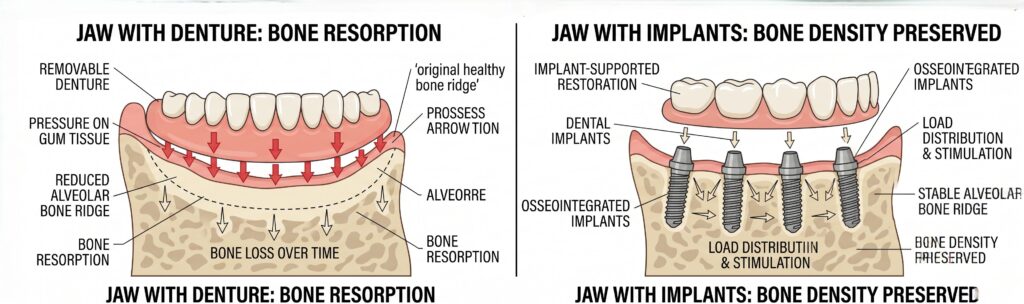
When natural teeth are lost, the bone that previously surrounded their roots no longer receives the stimulation it needs to maintain its density and volume. Without that stimulation, the jawbone gradually resorbs — it reduces in height and width over time.
Removable dentures rest on the gum tissue and do not transmit functional forces into the bone. Over time, bone beneath a denture continues to resorb — the denture fit worsens as the ridge changes shape, and the face begins to show the characteristic signs of bone loss: reduced lower facial height, a folding of the lips inward, and a more aged appearance around the mouth.
Implants, by contrast, are integrated into the bone and do transmit biting forces in a way that provides stimulation to the surrounding tissue. Clinical evidence suggests that bone resorption is generally slower around implants than in completely edentulous ridges without implants.
Daily Quality-of-Life: The Practical Differences
No Adhesive
Waking up and going through the day without dental adhesive is something many patients describe as more significant than they expected — particularly those who have used it for years.
Dietary Freedom
Biting into an apple, eating steak, or enjoying foods that require real chewing force becomes possible in a way that removable dentures — even well-fitted ones — often do not allow comfortably.
Speaking Confidence
Fixed teeth that do not shift provide a stable platform for the tongue and lips — eliminating the clicking or movement that can make some denture wearers self-conscious in conversation.
Oral Hygiene Routine
Cleaning a fixed arch requires different tools than a removable denture — a soft-bristle brush, water flosser, and interdental brushes — but does not require nightly removal and soaking.
No Sore Spots
The pressure points and gum irritation that commonly develop with removable dentures — particularly as fit changes over time — are not a feature of fixed implant-supported prosthetics.
Preserved Facial Profile
By slowing bone resorption, implants help maintain lower facial height and support the natural contour around the mouth — which can change noticeably over a decade with dentures alone.
Comparing the Total Cost of Ownership Over 10 Years
The upfront cost of full-arch implant treatment is typically higher than conventional dentures. But the cost of dentures over a decade — when you account for all of the associated expenses across ten years — is often more than patients expect when they make the initial decision.
| Cost Category | Removable Dentures | All-on-4 Full-Arch Implants |
|---|---|---|
| Initial Procedure | Lower upfront cost; varies by type (complete, partial, immediate) | Higher upfront surgical investment; varies by case, materials, and arch count |
| Pre-Surgical Imaging | Standard X-rays typically; minimal imaging cost | CBCT / 3D imaging typically needed; adds to initial cost |
| Extractions (if needed) | May be required before fitting; additional cost | Often included in treatment plan; verify with provider |
| Bone Grafting | Typically not required | May be required if bone volume is insufficient; adds cost and healing time |
| Temporary Prosthetic | Immediate dentures sometimes used during healing | Temporary fixed bridge often placed same day in qualifying cases |
| Final Prosthetic Materials | Acrylic or porcelain teeth on acrylic or metal base | Zirconia bridge or acrylic hybrid over titanium; material choice affects cost and durability |
| Relines & Adjustments | Periodic relines needed as bone changes (every few years); adds ongoing cost | Periodic check-ups; prosthetic adjustment possible but less frequent than denture relines |
| Repairs & Replacements | Cracks, fractures, and full replacement over time; cost accumulates | Prosthetic may eventually need replacement; implants typically long-lasting if well-maintained |
| Adhesives & Daily Products | Ongoing monthly cost for adhesives, soaking tablets, and cleaners | Minimal; standard dental hygiene products plus specific interdental tools |
| Professional Maintenance | Regular check-ups; more frequent if fit is changing | Regular implant hygiene visits; monitoring of peri-implant tissue health |
THE 10-YEAR PICTURE
The total cost of ownership over ten years — accounting for denture relines, repairs, replacements, adhesives, and the potential for changing fit as bone resorbs — narrows the gap between dentures and implants considerably for many patients. A consultation makes it possible to estimate both paths more accurately for your specific situation.
A Realistic Decision Guide: Who Is Better Suited to Each Option?
DENTURES MAY BE MORE APPROPRIATE
when one or more of these apply to your situation
- Bone loss is significant and bone grafting carries high medical risk or is not feasible
- Medical conditions — uncontrolled systemic disease, certain medications, recent radiation to the jaw — increase surgical risk substantially
- Budget constraints make the upfront investment of implant surgery currently unworkable with no suitable financing available
- Personal preference strongly favours a non-surgical approach after thorough counselling on the long-term trade-offs
- Age, health, or life expectancy make a multi-phase surgical investment less appropriate clinically
FULL-ARCH IMPLANTS MAY BE THE BETTER INVESTMENT
when one or more of these apply to your situation
- Bone health is adequate or can be addressed with bone grafting to support implant placement
- Current denture use is consistently uncomfortable, unstable, or significantly limiting diet and social confidence
- Long-term facial bone preservation is a priority
- You are medically suitable for the surgical procedure and committed to the healing process and aftercare
- You have explored financing options and the long-term investment is manageable
- You want a fixed, non-removable result and understand the full scope of treatment involved
Questions to Ask at Your All-on-4 Consultation
A good consultation gives you specific, personalised answers rather than generic ones. These questions are worth asking before you commit to any treatment plan
Frequently Asked Questions
Are All-on-4 dental implants better than dentures?
How long do All-on-4 dental implants last?
What is the cost difference between All-on-4 and dentures?
Can you eat normally with All-on-4 dental implants?
Is the All-on-4 procedure painful for seniors?
How do I clean my All-on-4 permanent bridge?
Do All-on-4 implants look like natural teeth?
How many implants are needed for a full arch of teeth?
The Investment That Fits Your Life
There is no universal answer to whether All-on-4 dental implants or dentures are the right choice — but there is a right answer for your specific jaw, your health history, and your daily life. At Toothology in Williamsburg, an implant consultation includes the imaging and clinical assessment needed to give you a concrete, personalised picture — not a general one. If you’ve been considering this decision, a consultation is the most useful next step.
CONSIDERING ALL-ON-4 IN BROOKLYN?
Book an implant consultation at Toothology in Williamsburg — we’ll assess your bone health, walk through your options, and give you a realistic picture.
DIRECT LINE
IN THIS GUIDE
QUICK DECISION GUIDE
IMPLANTS
DENTURES
IMPLANTS
DENTURES
IMPLANTS
DENTURES
IMPLANTS
DENTURES
TOOTHOLOGY DENTAL
Williamsburg, Brooklyn, NY
Serving Greenpoint, Bushwick, Bed-Stuy & Downtown Brooklyn
718-678-3800
Emergency line available
Open Hours
Mon – Thu: 10:00 AM – 6:00 PM Friday: 10:00 AM – 2:00 PM Sunday: 10:00 AM – 2:00 PM Saturday: Closed
OUR COMMITMENT
- Board-Certified Pediatric Dentists
- Child-Friendly, Anxiety-Reducing Care
- Same-Day Emergency Slots
- Low-Radiation Digital X-Rays
- Most Major Insurance Accepted