
- Urgent Dental Guide · Williamsburg Brooklyn
Something shifted while eating — your tooth feels rough, hollow, or sharply different. Here’s exactly what to do right now, when it’s a same-day emergency, and what to expect at the repair visit.
Lost a Filling? What to Do Before Seeing an Emergency Dentist
You’re eating, something hard shifts in your mouth, and suddenly a tooth feels rough, hollow, or sharply different than it did a moment ago. Sometimes the filling comes out in one piece. Sometimes there’s a sharp edge or sudden sensitivity. Either way, the question is the same: how serious is this, and what do you do right now?
A lost filling can range from uncomfortable to genuinely urgent depending on your symptoms. Mild sensitivity may be manageable until the next urgent appointment with some short-term protection. But biting pain, throbbing, swelling, or a larger fracture should not wait. Whatever the severity, a missing filling should be checked promptly — the tooth underneath is now exposed, and what starts as manageable sensitivity can become a bigger problem if decay, a crack, or nerve involvement is left untreated.
The first priority is to protect the exposed tooth and keep it comfortable until you can be seen.
Rinse gently with warm water to clear away debris without disturbing the area or surrounding tissue.
Save the filling if you find it and bring it to your appointment — it helps the dentist understand what came out and why.
Do not use household glue or any adhesive to try to stick it back in — they’re not designed for oral use and can complicate treatment.
Avoid chewing on that side to prevent additional damage, fracture, or further loss of tooth structure.
Avoid very hot, cold, or sweet foods and drinks that trigger sensitivity — these stimulate the exposed dentin directly.
Use over-the-counter pain relief if needed and only as directed on the label or by your pharmacist.
A pharmacy temporary filling kit may help short-term — but it is only a bridge measure. It does not repair the tooth and should not delay seeking dental care.
Call a dentist promptly. A lost filling will not fix itself, and the exposed tooth needs professional evaluation — not a wait-and-see approach.
When a Lost Filling Becomes a Same-Day Dental Problem
Not every lost filling is a same-day emergency — but some are. The pattern of your symptoms is the key indicator.
| What You Notice | What It May Suggest | Urgency | What to Do |
|---|---|---|---|
| Rough or hollow feeling; mild sensitivity to cold or air; no pain at rest | Filling lost, dentin exposed — manageable for a short window with temporary protection in place | Next Available |
Use a temporary filling kit as a bridge; call for the next available urgent appointment — do not delay beyond a few days |
| Cold or heat sensitivity that lingers more than a few seconds after the trigger is removed | More significant dentin exposure; possibly early pulp involvement; needs evaluation to rule out nerve involvement | Same/ Next Day |
Book a same-day or next-day urgent appointment; avoid further temperature triggers until seen |
| Sharp pain when biting or releasing bite pressure | Possible crack extending into the tooth — the old filling may have been holding the tooth together under load | Same Day | Book a same-day urgent appointment; avoid biting on that side entirely until evaluated by a dentist |
| Spontaneous throbbing at rest, bad taste, swelling of gum or cheek, or fever | Advanced infection, abscess, or significant structural failure — requires immediate professional attention | Today — Urgent |
Call the practice immediately or visit urgent dental care today; go to the ER if swelling spreads toward the jaw, neck, or throat |
Go to the ER Immediately If:
Swelling is spreading to the jaw, throat, or neck — or if you have difficulty breathing or swallowing. This is a medical emergency, not a dental appointment situation.
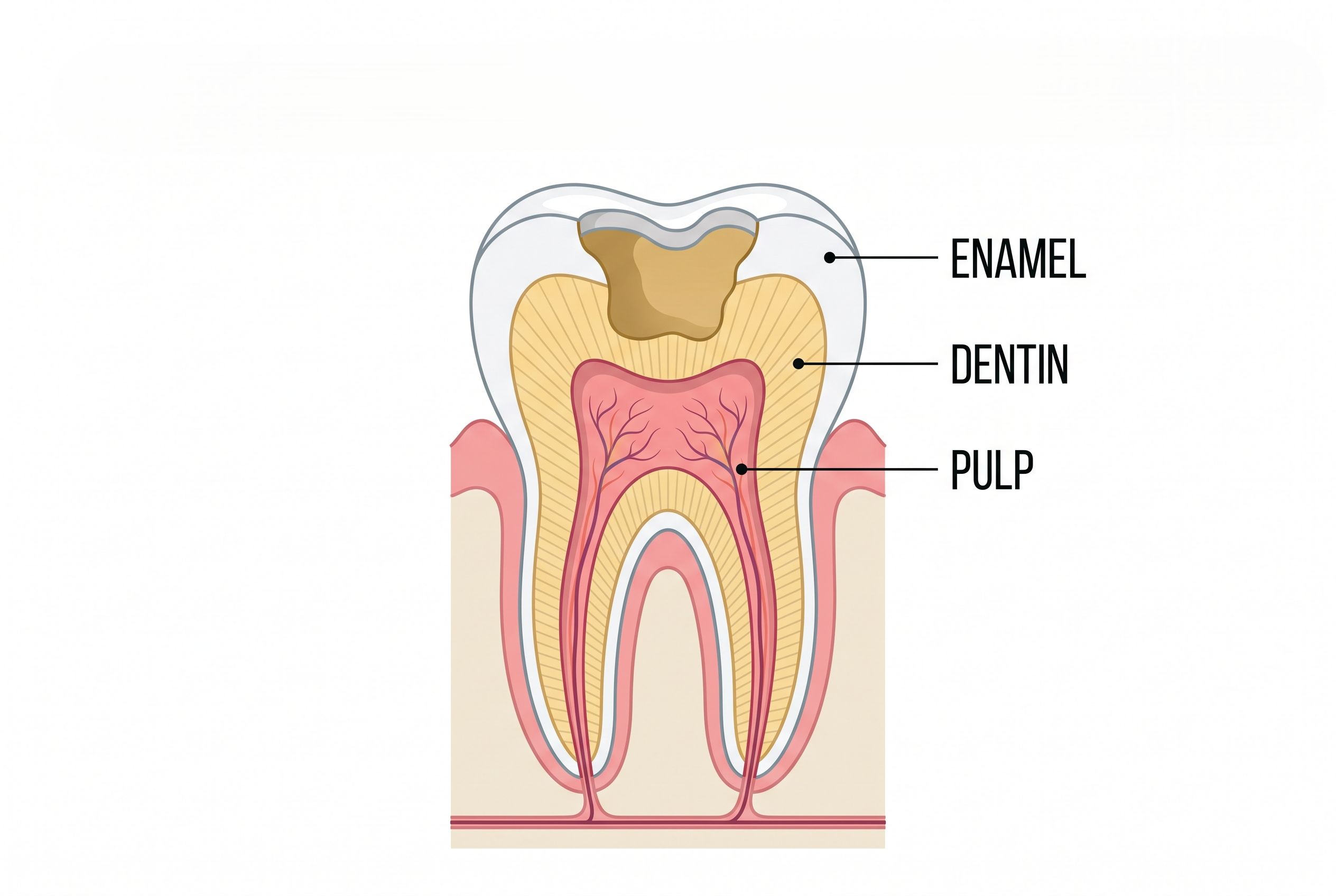
A filling seals and protects the inner part of the tooth. When it falls out, the dentin beneath becomes exposed. Dentin contains tiny microscopic channels — dentinal tubules — that connect toward the nerve. That’s why cold water, hot drinks, sweets, or even air can suddenly cause sharp sensitivity that wasn’t there before.
COLD VS HEAT SENSITIVITY
Cold is often the strongest trigger, but hot foods and sweets can also cause discomfort depending on how much tooth is exposed and how close the area is to the nerve. Sensitivity to heat in particular can suggest the nerve is more significantly involved and warrants same-day evaluation.
Why Biting Pain After a Filling Falls Out Matters More
Sensitivity to temperature is common after a filling falls out — but pain when biting is more concerning. That kind of pain can suggest the tooth is cracked. In some cases, the old filling was helping hold part of the tooth together. Once it’s gone, the cracked area can move slightly under biting pressure and irritate the nerve. Biting pain after a lost filling should not be managed with OTC medication alone — it should be evaluated the same day or next morning.
What Happens If the Tooth Underneath Is Cracked
- A smaller crack may be repairable with a new filling or a crown
- A deeper crack may require a root canal before the final restoration
- If the crack extends too far below the gumline , the tooth may not be restorable
THE SOONER A CRACK IS FOUND, THE MORE OPTIONS THERE ARE
A crack identified early may be a simple filling or crown. The same crack identified weeks later may require extraction. This is one of the most important reasons to get a lost filling evaluated promptly rather than managing it at home.
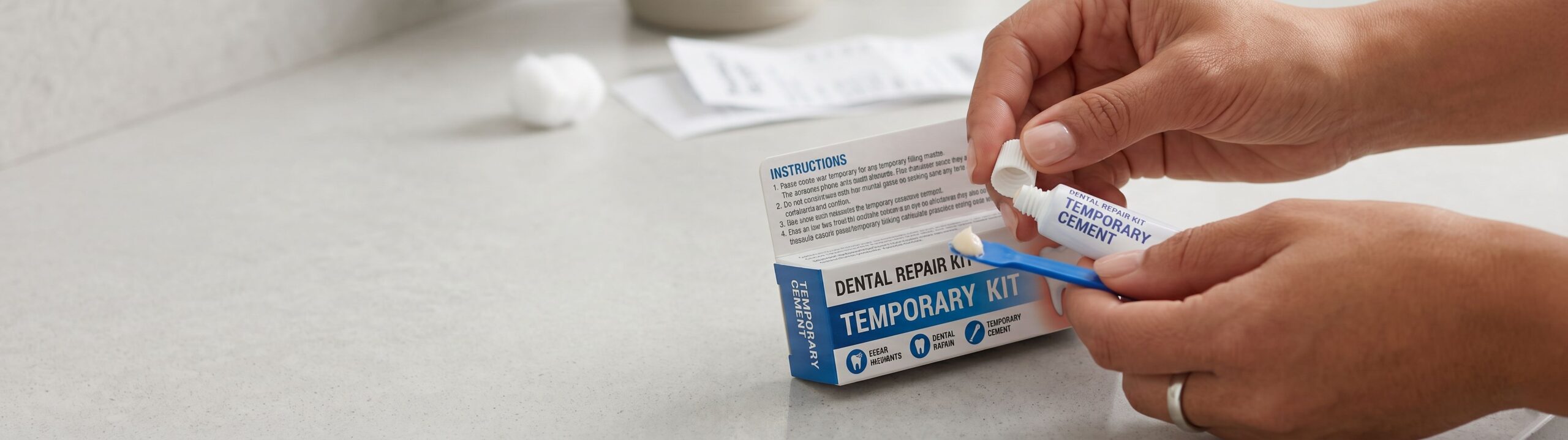
Temporary filling kits — available at pharmacies without a prescription — contain zinc oxide-based or similar materials that can be pressed into the space left by a missing filling to provide a short-term protective barrier. They work like a short-term bandage: covering the area, reducing sensitivity, and protecting the exposed surface while you arrange proper treatment.
- A KIT MAY BE REASONABLE WHEN:
- It's after hours or on a weekend and a dental appointment cannot be arranged until the next business day
- Your symptoms are mild — cold sensitivity only, no biting pain, no swelling, no spontaneous throbbing
- You will be seen by a dentist within one to two days
- DO NOT RELY ON A KIT IF:
- The tooth is painful even at rest — not only when triggered
- Visible swelling of the gum, cheek, or jaw near the tooth
- A bad taste or drainage that doesn't clear with rinsing
- Fever alongside dental symptoms
- Large fracture with a sharp edge cutting your tongue or cheek
- Biting pressure produces significant or worsening pain
WHAT A TEMPORARY KIT DOES NOT DO
It buys time — nothing more. It does not remove decay under the old filling, repair a crack, protect a tooth that needs a crown, or tell you whether the nerve is at risk. Use it as a bridge to a proper appointment, not a substitute for one.
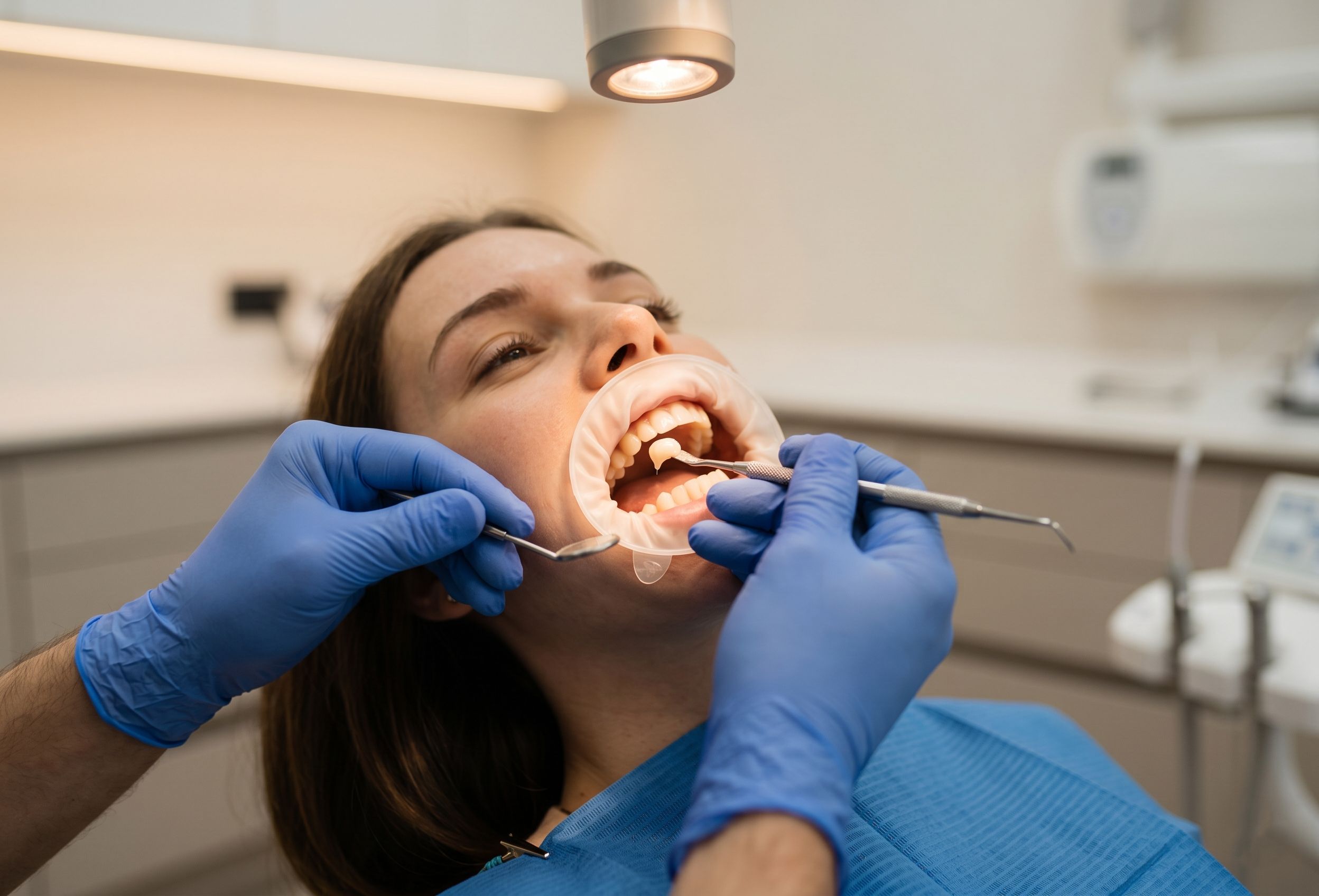
When you come in with a lost or broken filling, the first step is not simply replacing what was there before. The tooth has to be evaluated to determine whether the problem is limited to the filling — or whether there is also decay, a crack, or nerve involvement that needs addressing first.
What the Dentist Checks During an Urgent Filling Exam
Possible Treatment Depending on What the Exam Shows
Smooth a Sharp Edge
If damage is minor, smoothing the edge may prevent soft tissue irritation while the tooth is monitored or restored at a follow-up.
Direct Composite Filling
If the tooth can be restored with a new bonded filling, this is usually completed in the same appointment — same-day repair is possible in most straightforward cases.
Larger Bonded Repair
If more of the tooth needs rebuilding due to additional decay or a larger fracture, a more extensive composite restoration may be needed.
Crown or Onlay
If the tooth has lost too much structure for a filling alone, a crown or onlay may be recommended to fully protect and seal what remains.
Root Canal Before Restoration
If the nerve is inflamed or infected, a root canal may be needed before the final restoration can be placed.
Silver Replaced with Composite
If an old silver filling breaks or fails, it can often be replaced with tooth-coloured composite — which bonds directly to the tooth and allows a more conservative repair.
Frequently Asked Questions
Is a lost filling considered a dental emergency?
How long can you go with a missing filling?
What can I put in my tooth if a filling falls out?
Can a cavity form after losing a filling?
Why does my tooth hurt when I bite down after a filling fell out?
Does it hurt to replace a broken silver filling?
Can an emergency dentist fix a filling the same day?
The Right Next Step Is a Dental Exam — Not a Wait-and-See
Don’t ignore a lost filling just because the sensitivity feels manageable right now. The tooth underneath is exposed, and delaying care can turn a simple composite filling into a root canal — or a root canal into an extraction. At Toothology in Williamsburg, we can assess the tooth, identify the cause of the failure, and repair it in the same appointment in most cases.
Lost a Filling in Brooklyn?
CALL US RIGHT NOW
Same-day urgent appointments for lost and broken fillings. Describe your symptoms when you call.
IN THIS GUIDE
QUICK DECISION GUIDE
TOOTHOLOGY DENTAL
Williamsburg, Brooklyn, NY
Serving Greenpoint, Bushwick, Bed-Stuy & Downtown Brooklyn
718-678-3800
Emergency line available
Open Hours
Mon – Thu: 10:00 AM – 6:00 PM Friday: 10:00 AM – 2:00 PM Sunday: 10:00 AM – 2:00 PM Saturday: Closed
OUR COMMITMENT
- Board-Certified Pediatric Dentists
- Child-Friendly, Anxiety-Reducing Care
- Same-Day Emergency Slots
- Low-Radiation Digital X-Rays
- Most Major Insurance Accepted