
- Tooth Sensitivity Guide · Williamsburg Brooklyn
That sharp zing when you sip cold water isn’t just annoying — it’s a signal. Cold sensitivity is a symptom, not a diagnosis. Here’s what’s actually behind it and what fixes it.
Why Are My Teeth Suddenly Sensitive to Cold Water? Causes & Treatment
You take a sip of iced coffee and feel a sharp zing in your tooth. Cold air hits your teeth on a winter morning and you wince. A glass of cold water suddenly feels different than it did a few months ago. Cold sensitivity is one of the most common dental complaints — but also one of the most misunderstood.
Some people assume it’s normal and reach for a desensitising toothpaste. Sometimes that helps. Other times, it only masks a bigger issue like a cavity, crack, gum recession, or failing filling. The key thing to understand is that cold sensitivity is a symptom, not a diagnosis. Mild sensitivity across several teeth is different from sharp, lingering pain in one tooth — and those differences matter when deciding what to do next.
What Triggers Sharp, Sudden Temperature Sensitivity?
When cold water causes a sharp zing, the problem is usually not the enamel itself. Enamel is the hard outer layer of the tooth and does not contain nerves. Beneath it is dentin, which contains tiny channels called dentinal tubules that connect toward the inner nerve of the tooth.
When dentin becomes exposed — from enamel wear, gum recession, a crack, or a cavity — cold water or air can trigger movement inside those tubules. That movement stimulates the nerve and creates the quick, sharp pain people describe as tooth sensitivity.
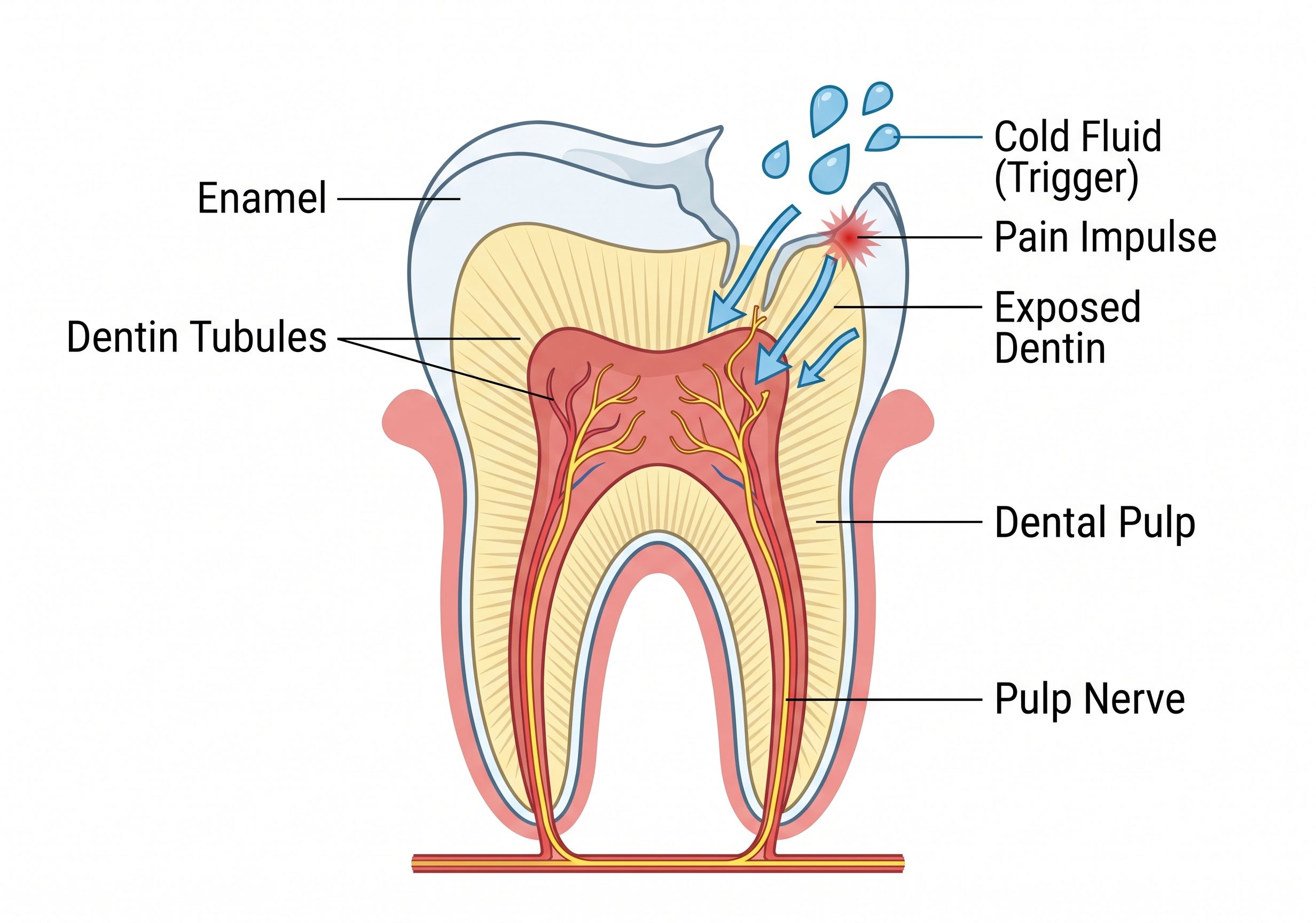
UNDERSTANDING TOOTH LAYERS — WHY COLD REACHES THE NERVE
- ENAMEL — OUTER SHELL
The hardest substance in the body. Contains no nerves. When intact, it fully insulates the dentin and pulp. When worn or eroded, dentin sits closer to the surface.
- DENTIN — THE SENSITIVE LAYER
Contains dentinal tubules — microscopic channels running toward the nerve. Exposed dentin is the direct cause of cold sensitivity. Root surfaces have no enamel — only thinner cementum — making them especially reactive.
- PULP & NERVE — INNER CORE
Soft tissue containing the tooth’s nerve supply. Pain that lingers several seconds after the cold trigger is gone may suggest the nerve is significantly involved.
WHY COLD WATER HURTS MORE THAN ROOM-TEMPERATURE WATER
Cold water triggers a stronger response because it causes a faster fluid shift inside exposed dentinal tubules. That sudden movement stimulates the nerve and produces the sharp, immediate pain people notice. The same response can happen with cold air — particularly when root surfaces or worn enamel are exposed. Acidic foods and drinks can make this temporarily worse by softening the surface and opening tubules further.
WHY "SUDDEN" SENSITIVITY MATTERS
When sensitivity feels sudden or is noticeably worsening, it often means something has changed. Gum recession may have exposed more root surface. Enamel may have worn further. A crack may have formed. Or a filling may no longer be sealing the tooth properly. Sensitivity that appears recently or escalates quickly deserves more attention than sensitivity that has stayed mild and stable over a long period.
Enamel only covers the crown of the tooth — the visible portion above the gumline. Below the gumline, the root surface is covered by cementum: a thinner, far less protective material. When gum tissue recedes — pulling away from the tooth and exposing part of the root — that exposed surface produces a much more pronounced sensitivity response than comparable dentin exposure on the crown.
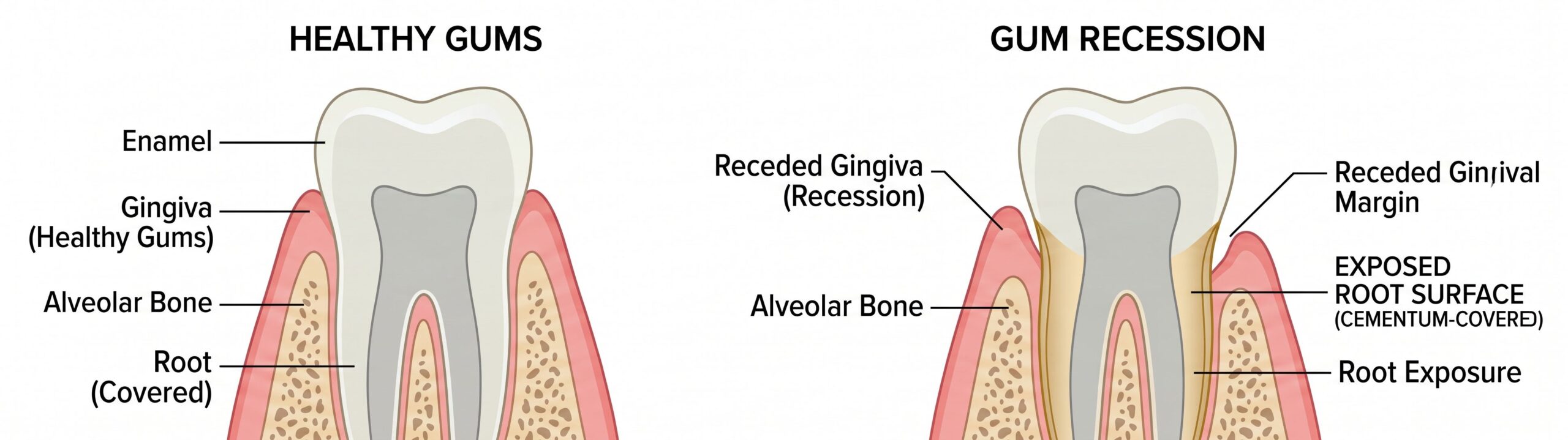
Gum recession is one of the most common causes of cold sensitivity. It often develops slowly — which is why the pain can feel sudden once enough root surface finally becomes exposed.
Aggressive Brushing
Brushing too hard or using a medium or hard-bristle toothbrush can gradually wear the gumline and expose sensitive root surfaces over months to years.
Abrasive Toothpaste
Some whitening or “heavy-cleaning” toothpastes can increase gumline wear — particularly when combined with forceful brushing technique.
Periodontal Disease
Gum disease causes the gums and supporting bone to pull away from the tooth, leading to more significant recession — often across multiple teeth simultaneously.
Naturally Thin Gum Tissue
Some people naturally have thinner gum tissue, which makes recession more likely over time regardless of hygiene habits.
PRODUCT CHANGES AREN'T ENOUGH
Switching to a softer toothbrush and less abrasive toothpaste can help prevent further damage — but it won’t restore gum tissue that has already receded, address gum disease if that’s the cause, or tell you how severe the recession is or whether it’s still progressing. A dental evaluation is more useful than relying on a product change alone.
Sensitive teeth treatments range from over-the-counter toothpaste to in-office desensitising procedures. The right option depends on the cause and severity of the sensitivity.
When Sensitivity Toothpaste Is a Reasonable Starting Point
Sensitivity toothpastes with ingredients like potassium nitrate or stannous fluoride can help reduce mild, generalised sensitivity by calming the nerve response or blocking exposed dentinal tubules. They can be a reasonable first step for minor enamel wear or temporary post-whitening sensitivity.
THE LIMITATION OF TOOTHPASTE ALONE
Toothpaste only helps manage the symptom. It does not treat the underlying cause if the problem is gum recession, a crack, a failing filling, or early decay. If sensitivity is worsening, localised, or persistent — relying on toothpaste alone can delay the right diagnosis and allow the underlying issue to worsen.
How Treatment Options Compare
| Treatment Option | What It Does | Best Suited For |
|---|---|---|
|
At-Home
Sensitivity Toothpaste
Potassium nitrate / stannous fluoride
|
Calms nerve endings in dentin tubules over repeated use; gradual improvement over several weeks of consistent use | Mild diffuse dentin hypersensitivity; ongoing maintenance for sensitivity-prone patients; first step for minor enamel wear |
|
In-Office
Fluoride Treatment or Varnish
Concentrated mineral application
|
Concentrated fluoride or mineral varnish creates a temporary protective layer over exposed dentin; also helps remineralise early enamel erosion | Moderate dentin hypersensitivity at specific sites; combined with home care; early enamel erosion |
|
In-Office
Desensitising Agent
Bonding resin / sealant
|
Thin layer of bonding resin physically seals dentinal tubules at the exposed surface — more targeted and durable than toothpaste or varnish alone | Persistent sensitivity at specific gumline or root surface sites not responding adequately to toothpaste |
|
Restorative
Composite Bonding or Restoration
Filling, bonding, or surface repair
|
Fills a cavity, covers an exposed root, or repairs a cracked or worn surface that is directly causing sensitivity | Sensitivity caused by decay, a failing filling, enamel loss, or recession with significant root surface exposure |
|
Protective
Night Guard / Occlusal Splint
Custom-fitted appliance
|
Protects teeth from the grinding and clenching forces that gradually wear enamel and stress the supporting gum and bone structures | Sensitivity associated with bruxism; enamel wear visible on biting surfaces; attrition patterns identified on dental exam |
DIAGNOSIS COMES BEFORE TREATMENT CHOICE
Before choosing treatment, a dentist first needs to identify the cause. The goal is to determine where it’s coming from, what part of the tooth is affected, and whether there’s an underlying issue like decay, a crack, gum recession, or a failing filling. Depending on the cause, treatment might involve fluoride, bonding, a filling, a night guard, or gum treatment. Sensitivity toothpaste may help, but it should not replace a proper diagnosis.
When Is Sensitivity a Sign of a Cracked Molar or Deep Cavity?
Most cold sensitivity is caused by dentin hypersensitivity — mild and manageable. But some patterns suggest a deeper problem and should be checked by a dentist promptly rather than managed with toothpaste alone.
One tooth hurts much more than others
— this may point to a cavity, crack, or failing filling in that specific tooth
Pain lingers after the cold is gone
— brief sensitivity suggests dentin exposure; lingering pain suggests nerve irritation inside the tooth
Heat also causes pain
— sensitivity to both cold and heat is more concerning than cold alone
Pain when biting or releasing a bite
— this can be a sign of a cracked tooth
Whitening sensitivity not improving
— temporary sensitivity after whitening is normal; pain that lingers, worsens, or is focused in one tooth should not be ignored
Sensitivity that is new or rapidly worsening
— rather than stable and mild over a long period
What a Dentist Checks During a Sensitive Teeth Exam
A sensitive teeth exam is about finding the cause, not just giving quick symptom relief. A thorough evaluation typically includes:
General vs. localised sensitivity:
Visual inspection:
X-rays:
Gum measurements:
Pressure and tapping tests:
Habit and history review:
WHAT THIS DETERMINES
This is what distinguishes mild sensitivity that responds to toothpaste from a problem that needs bonding, a filling, a night guard, or gum treatment. The exam is the starting point — not the treatment guess.
Frequently Asked Questions
Why are my teeth suddenly sensitive to cold water?
Can receding gums cause intense tooth sensitivity?
What can a dentist do to stop tooth sensitivity fast?
Does teeth whitening cause permanent tooth sensitivity?
How do I know if my tooth sensitivity is caused by a cavity?
Why do my teeth hurt when I breathe in cold winter air?
Does brushing too hard wear away tooth enamel?
Cold Sensitivity That Keeps Coming Back Deserves a Real Answer
Mild, brief sensitivity across several teeth may improve with a softer toothbrush and a desensitising toothpaste. For many people, that is enough. But sensitivity that is worsening, focused on one tooth, lingering after cold contact, or appearing suddenly with other changes deserves an exam — not more guessing. At Toothology in Williamsburg, we can evaluate whether the issue is exposed dentin, gum recession, enamel wear, or something more significant — and recommend the right treatment.
TEETH SENSITIVE TO COLD?
Book a sensitivity diagnostic exam at Toothology in Williamsburg — we’ll identify the actual cause and recommend the right treatment, not just a toothpaste.
DIRECT LINE
IN THIS GUIDE
WHEN TO GET CHECKED
Any of these patterns deserves an exam — not more toothpaste.
TOOTHOLOGY DENTAL
Williamsburg, Brooklyn, NY
Serving Greenpoint, Bushwick, Bed-Stuy & Downtown Brooklyn
718-678-3800
Emergency line available
Open Hours
Mon – Thu: 10:00 AM – 6:00 PM Friday: 10:00 AM – 2:00 PM Sunday: 10:00 AM – 2:00 PM Saturday: Closed
OUR COMMITMENT
- Board-Certified Pediatric Dentists
- Child-Friendly, Anxiety-Reducing Care
- Same-Day Emergency Slots
- Low-Radiation Digital X-Rays
- Most Major Insurance Accepted