
- Wisdom Teeth Guide · Brooklyn
Signs, what to expect during evaluation and extraction, recovery tips, dry socket prevention, and what it costs in Brooklyn — answered honestly.
Do Your Wisdom Teeth Need to Come Out?
That dull ache at the back of your jaw. The swollen patch of gum behind your last molar. The pressure that builds when you try to open your mouth wide. If any of those sound familiar, you’re probably looking up wisdom teeth — and you’re not alone.
Pain or pressure at the back of the mouth is a common reason people seek dental care in their late teens and twenties. In many cases, the cause is a wisdom tooth that doesn’t have enough room to come in normally. An evaluation is the right first step when those symptoms start showing up.
What Wisdom Teeth Are and When They Become a Problem
Wisdom teeth — also called third molars — are the last teeth to develop. They usually appear in the late teens or early twenties, though some people never develop them and some never have trouble with them.
Problems tend to happen when there isn’t enough room for the tooth to emerge or grow normally. That’s what dentists and oral surgeons mean when they describe a wisdom tooth as impacted. An impacted wisdom tooth may stay partly under the gum, remain trapped under bone, grow at an angle, or press against the neighbouring molar.
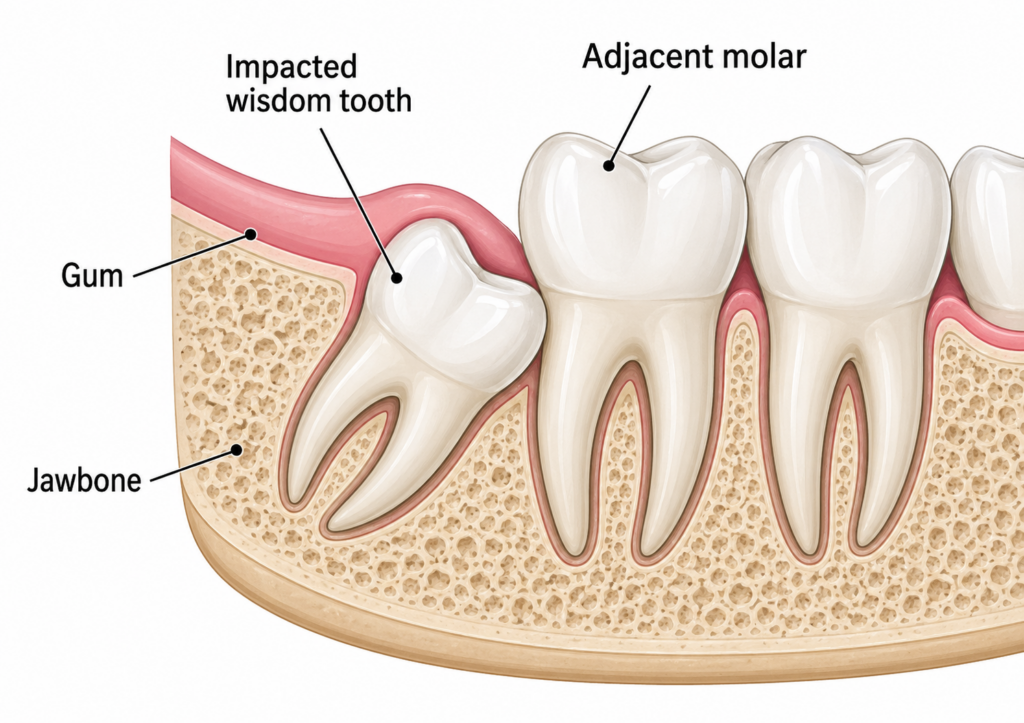
Impacted teeth can contribute to pain, swelling, infection, food trapping, bad breath, or damage to adjacent teeth. The American Association of Oral and Maxillofacial Surgeons (AAOMS) also notes that retained third molars can be associated with conditions such as pericoronitis, caries, periodontal problems, root resorption, and other pathology — which is why ongoing evaluation matters even when symptoms are mild or intermittent.
NOT ALWAYS IMMEDIATE
Not every impacted wisdom tooth needs to be removed immediately. Some can be monitored with regular exams and imaging, while others are better removed because they’re already causing trouble or are likely to do so. An evaluation determines which applies to you.
Signs Your Wisdom Teeth May Need to Come Out
Pain or Pressure at the Back of Your Mouth
Pain behind the last visible molar is one of the most common warning signs. It may feel dull and constant, or it may come and go in waves. Some people notice pressure before they notice sharp pain — don’t dismiss it as nothing.
Swollen, Red, or Bleeding Gums
If the gum behind the last molar looks puffy, irritated, or tender, the area may be inflamed around a partially erupted wisdom tooth. That tissue can trap food and bacteria, increasing the risk of infection over time.
Jaw Stiffness or Difficulty Opening Wide
When the area around a wisdom tooth becomes inflamed or infected, the surrounding muscles can tighten as well. Difficulty opening the mouth fully is a recognised symptom in impacted wisdom tooth guidance and warrants an evaluation.
Bad Taste, Bad Breath, or Food Getting Trapped
A partially erupted tooth can create a pocket that’s very hard to keep clean. Food, plaque, and bacteria collect there, leading to a persistent bad taste, bad breath, and recurring irritation — even with diligent brushing.
Pressure on Neighbouring Teeth
Wisdom teeth that are angled or crowded can press against adjacent molars. Sometimes that’s only visible on X-ray — but it can contribute to discomfort, damage, or hygiene problems around the neighbouring tooth over time.

At Toothology, the process starts with evaluation — not with a rushed decision. A thorough evaluation considers your symptoms, the eruption status of the tooth, position, function, periodontal and bone status, and imaging findings before any management decision is made.
Symptom review:
A conversation about what you’re experiencing — pain, swelling, food trapping, difficulty opening wide, or bad breath near the back of your mouth.
Clinical examination:
Visual and tactile assessment of the gum tissue, surrounding teeth, and the area around the wisdom tooth.
Dental X-rays
Imaging to assess tooth position, root anatomy, bone levels, and proximity to adjacent teeth and nerves. Additional imaging may be needed for treatment planning in complex cases.
Monitor or remove decision
An honest discussion of whether the tooth can be safely monitored, or whether removal is the better option — and why.
Simple vs. surgical assessment
A clear explanation of whether the case looks like a straightforward extraction or a surgical extraction, and what that means for your appointment, recovery, and cost.
Simple vs. Surgical Extraction
Not all wisdom tooth extractions are the same. The distinction between simple and surgical matters for your appointment length, aftercare, recovery timeline, and cost.
- Simple Extraction
- The wisdom tooth has erupted enough to be grasped and removed in a straightforward way
- Shorter appointment time
- Recovery is typically faster
- Less involved aftercare in most cases
- Generally less complex to plan
- Surgical Extraction
- The tooth is partly trapped under gum or bone, angled awkwardly, or more complex anatomically
- Longer appointment time
- More involved aftercare and monitoring
- Recovery window is typically longer
- May involve a specialist referral for complex cases
WHICH ONE APPLIES TO YOU?
The distinction is determined at evaluation — after the dentist has reviewed your X-rays, tooth position, and anatomy. You cannot reliably know which applies from symptoms alone.
Sedation and Comfort Options
A lot of people are less worried about the diagnosis than they are about the procedure itself. That’s understandable — and it’s worth discussing before you decide to put off an appointment that could prevent a bigger problem.
Nitrous Oxide (Laughing Gas)
A common lighter option for anxiety management. Helps patients feel relaxed and calm while remaining fully conscious. Wears off quickly — you can typically drive yourself home after.
Oral Sedation
A deeper relaxation option for patients who need more help feeling calm during treatment. Medication is taken before the appointment. You will need someone to drive you home and should plan to rest for the remainder of the day.
DON'T LET ANXIETY BE THE REASON YOU WAIT
Not everyone needs sedation — but it’s worth discussing if dental anxiety has been keeping you from booking the appointment. Mention it when you call, and the team will walk you through what’s available before you commit to anything.
Recovery Timeline and What to Expect
Recovery depends on how many teeth are removed, whether the extraction is simple or surgical, and how your body heals. The following is a general framework — your dentist’s specific post-op instructions always take priority.
Day 1
First 24 Hours — The Most Demanding Period
Tenderness, light bleeding in the early hours, and the beginning of swelling are all normal. The most important priority is protecting the blood clot that forms in the extraction site — this clot is essential for proper healing and preventing dry socket.
Day 2-3
Swelling Often Peaks
Swelling and soreness typically peak during this period rather than on day one. Some jaw stiffness is common. Most people stick to softer foods and keep physical activity lighter during this window.
Week 1
First Week — Meaningful Improvement
Many people notice significant improvement within five to seven days. If stitches were placed, they may dissolve on their own or be checked at a follow-up. Day-to-day function often improves before the extraction site is fully healed.
Full Heal
Full Healing — Several Weeks to Months
Soft-tissue healing continues after the first week, and deeper bone healing takes longer. Feeling better is not the same as being fully healed — which is why follow-up instructions matter even after symptoms resolve.
How to Reduce Dry Socket Risk
One of the more common and uncomfortable complications after wisdom tooth extraction is a condition called dry socket. After an extraction, a blood clot forms in the empty socket — acting as a protective layer over exposed bone and nerve endings while healing begins.
Dry socket occurs when that clot is dislodged or dissolves before the tissue has had time to heal. The result is a distinctive, intensifying pain that typically develops two to four days after extraction and often radiates toward the ear or jaw.
WATCH FOR THIS SIGN
If pain becomes worse instead of better after the second or third day — especially if it radiates toward the ear or jaw — call the office. That pattern is the primary reason dentists evaluate for dry socket after extraction. Early attention makes management much easier.
Do's and Don'ts to Protect the Clot
- Follow your dentist's post-op instructions closely — they're specific to your procedure
- Rest and keep activity lighter for the first 24–48 hours
- Keep the area clean as instructed — gentle rinsing when directed
- Eat soft, non-irritating foods during early recovery
- Avoid straws for the first several days — suction can dislodge the clot
- Avoid smoking or any tobacco use during the healing period
- Avoid forceful spitting or vigorous rinsing in the early days
- Don't probe the extraction site with your tongue or fingers
Wisdom Tooth Extraction Cost in Brooklyn

Cost depends on the actual procedure — not just the name of the service. Several variables shape the final number:
- Simple vs. surgical extraction:
A fully erupted tooth removed simply is priced differently from a surgical extraction of an impacted tooth
- Number of teeth:
Removing one wisdom tooth is different from removing all four at once
- Imaging required:
Standard X-rays are typically included; CBCT (3D imaging) for complex anatomy may be billed separately
- Imaging required:
Standard X-rays are typically included; CBCT (3D imaging) for complex anatomy may be billed separately
- Sedation:
Whether nitrous oxide, oral sedation, or no sedation is part of the plan affects the total
- Case complexity:
Deep impaction, curved roots, proximity to nerves — all affect time and complexity.
The most accurate way to understand your cost is through an evaluation — once the dentist has reviewed tooth position, imaging, and treatment complexity.
Does Insurance Cover Wisdom Tooth Removal?
Coverage varies by plan. Many dental plans provide some level of benefit for wisdom tooth removal when it’s clinically necessary — but deductibles, annual maximums, waiting periods, and coverage percentages vary widely.
DON'T ASSUME COVERAGE
The safest approach: have the office verify your benefits before treatment begins. Toothology’s team can assist with insurance verification as part of the intake process — so you have a clear picture of expected out-of-pocket costs before your appointment.
When to Call the Dentist After Extraction
Most wisdom tooth recoveries follow a predictable pattern — gradual improvement day by day. But certain symptoms warrant a call to the office rather than a wait-and-see approach.
WHEN IN DOUBT — CALL
Early attention to a complication is almost always easier to manage than waiting. Calling the office never results in a charge, and your dentist would always rather hear from you sooner.
Frequently Asked Questions
What are the most common signs that my wisdom teeth need to be removed?
Common signs include pain or pressure at the back of the mouth, swollen or bleeding gums, bad
taste, bad breath, difficulty opening wide, or repeated food trapping near the last molar.
How much does wisdom tooth extraction cost in Brooklyn, NY?
The cost of wisdom tooth extraction depends on several factors: how many teeth are being
removed, whether each extraction is simple or surgical, the complexity of impaction, the type of
imaging needed, whether sedation is part of the plan, and your specific insurance coverage.
Does dental insurance usually cover wisdom tooth removal?
Coverage varies by plan. Many dental insurance plans include a surgical or oral surgery benefit
that covers wisdom tooth extraction when it is deemed medically or dentally necessary — such
as removal of an impacted tooth, management of infection, or protection of adjacent teeth.
Elective removal of wisdom teeth that are not currently causing documented problems may be
treated differently under some plans. Coverage percentages, annual maximums, deductibles,
and waiting periods all vary
How long is recovery after wisdom tooth extraction?
Recovery timelines vary, but a general framework for many patients: the first 24 to 72 hours
typically involve the most swelling and discomfort; meaningful improvement is noticed by most
patients within five to seven days; and many people return to normal daily activity within a
week, though this depends on job type, the extent of the procedure, and individual healing. Full
tissue healing of the socket can take several weeks to a couple of months. Surgical extractions
involving impacted teeth generally involve a longer recovery than simple extractions.
What can I eat after wisdom tooth extraction?
Most people do best with soft, non-irritating foods at first. Avoid straws early on, and follow the
office’s specific instructions because those are tailored to your procedure and healing progress.
Dry-socket guidance consistently warns against suction in the early recovery period.
WISDOM TOOTH PAIN?
Don’t wait until it gets worse. Book an evaluation at Toothology in Williamsburg — same-day slots available for acute symptoms.
CALL US DIRECTLY
IN THIS GUIDE
TOOTHOLOGY DENTAL
Williamsburg, Brooklyn, NY
Serving Greenpoint, Bushwick, Bed-Stuy & Downtown Brooklyn
718-678-3800
Emergency line available
Open Hours
Mon – Thu: 10:00 AM – 6:00 PM Friday: 10:00 AM – 2:00 PM Sunday: 10:00 AM – 2:00 PM Saturday: Closed
OUR COMMITMENT
- Board-Certified Pediatric Dentists
- Child-Friendly, Anxiety-Reducing Care
- Same-Day Emergency Slots
- Low-Radiation Digital X-Rays
- Most Major Insurance Accepted