
Oral Surgery · Williamsburg, Brooklyn
Wisdom Teeth Removal In Williamsburg, Brooklyn
Assessment and surgical removal of impacted, painful, or repeatedly infected wisdom teeth. Planned with 3D imaging and performed by a specialist oral surgeon.
By appointment only.
Consultation and imaging are required before surgery can be scheduled. Patients in significant pain should call the office for an urgent assessment.

Treatment Summary
Wisdom teeth removal at Toothology, Williamsburg
Procedure
Simple or surgical extraction of third molars (wisdom teeth)
Performed by
Specialist oral surgeon
Assessment & planning
Toothology clinical team, Williamsburg office
Imaging
3D CBCT scan to map root position and nerve proximity
Anesthetic
Local anesthetic. Sedation options available
Appointments
Consultation, then a separate surgical appointment
Booking
Prior appointment required. Not available on a walk-in basis
Cost
Written estimate provided before treatment is scheduled
When Removal Is Recommended
Not all wisdom teeth require removal. Teeth that erupt straight, have sufficient room, and can be cleaned properly are generally retained. Removal is indicated where a tooth is impacted, symptomatic, or causing damage to adjacent structures.
Indications for removal
- Impaction preventing normal eruption
- Persistent pain or pressure at the back of the jaw
- Recurrent infection (pericoronitis)
- Decay in the wisdom tooth or adjacent molar
- Gum inflammation that does not resolve
- Cyst formation identified on imaging
- Damage to the second molar
Teeth generally retained
- Fully erupted in correct position
- Sufficient space behind the second molar
- Accessible for brushing and flossing
- No decay or gum inflammation present
- Normal occlusion with opposing teeth
- No history of pain, swelling, or infection
Further Reading
Our clinical team has written a detailed guide covering when wisdom tooth removal is indicated, what the assessment involves, and what to expect.
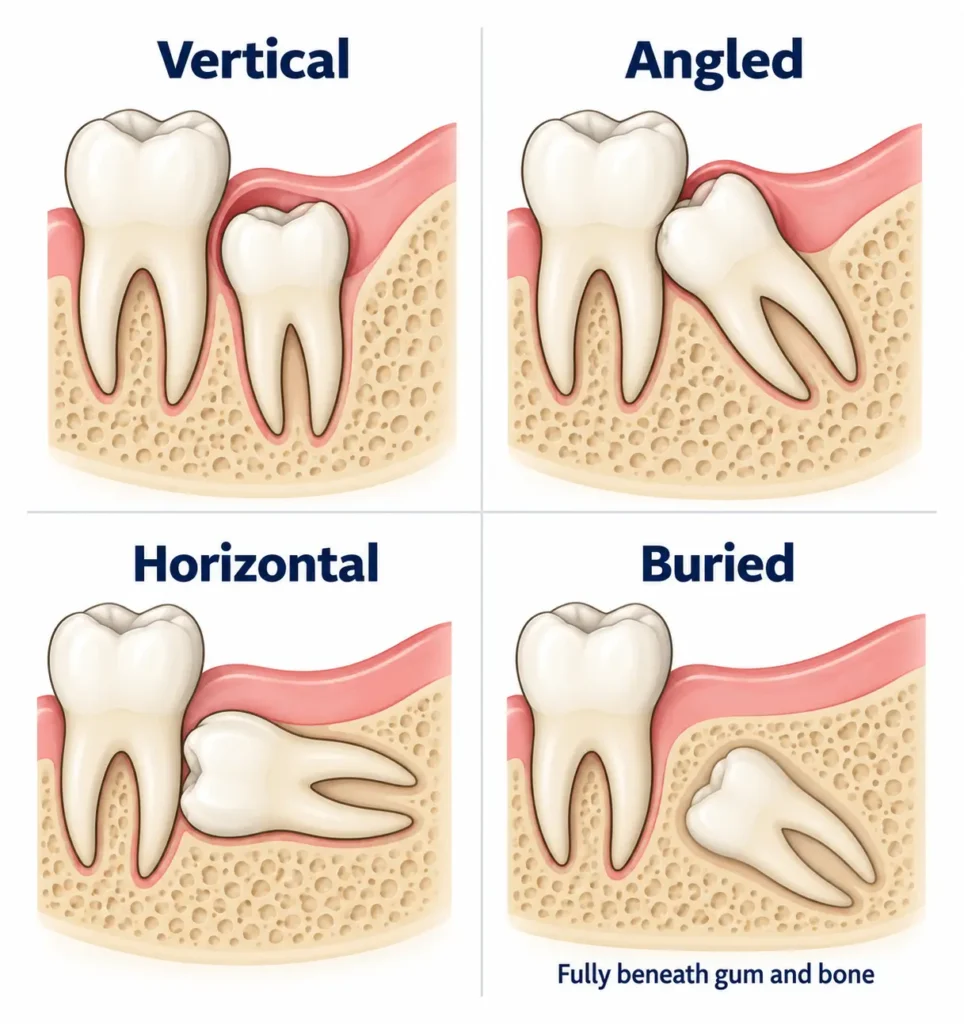
IMPACTION
Impacted Wisdom Teeth
A wisdom tooth is impacted when it cannot erupt into a normal position — blocked by the adjacent molar, angled, or retained within the jawbone. Impaction is the most common indication for removal.
Impaction is not invariably problematic; some impacted teeth remain asymptomatic for decades. Partial impaction carries higher risk, as the overlying gum flap traps debris and cannot be cleaned effectively.
Presenting symptoms
- Ache or pressure Persistent discomfort at the posterior jaw, occasionally referred toward the ear
- Gum inflammation Red, swollen, or tender tissue overlying a partially erupted tooth
- Restricted opening Reduced range of mouth opening, or discomfort on opening
- Bad taste or odor Persistent, not resolved by brushing
- Pain on biting Discomfort chewing on the affected side
- Swelling Along the jawline or in adjacent lymph nodes
PAIN & INFECTION
Wisdom Tooth Pain and Pericoronitis
A partially erupted wisdom tooth retains a flap of gum tissue that traps food and bacteria and cannot be cleaned effectively. The resulting infection — pericoronitis — presents with swelling, pain, bad taste, and sometimes restricted mouth opening.
Infection frequently follows a recurring pattern: it settles with debridement and antibiotics, then returns weeks or months later, as the underlying anatomical cause is unchanged. Recurrent infection at the same site is a clear indication for removal.
Assessment is more straightforward during a quiescent period than during an acute flare, and treatment planning is more accurate when tissues are not inflamed.
Seek urgent care for:
- Spreading facial swelling
- Swelling involving the eye or neck
- Difficulty swallowing or breathing
- Fever alongside dental pain
- Inability to open the mouth beyond a small gap.
Unsure whether removal is necessary?
A consultation with 3D imaging establishes whether treatment is indicated, with a written estimate before scheduling.
- Clear pricing estimates before the treatments
- Treatment options explained before you commit
- Cleaning or exam recommendations discussed upfront
- Available payment options reviewed with our team
How Treatment Is Delivered
01
Consultation
Examination, review of medical history and medications, and discussion of symptoms. Active infection is settled first.
02
3D imaging
Composite is matched to the natural shade of your surrounding teeth. This step is what determines whether the finished result looks like a repair or looks like your tooth.
03
Plan and estimate
Written treatment plan setting out what is recommended, what is involved, and the cost — before booking.
04
Surgical appointment
Performed by the oral surgeon under local anesthetic, sedation available. Impacted teeth may require incision and sectioning.
05
Aftercare
Written post-operative instructions, analgesia guidance, and a contact number for concerns.
06
Review
Follow-up appointment confirms the socket is healing as expected.
COST & INSURANCE
Fees, Insurance and Financing
Fees depend principally on surgical complexity. A fully erupted upper third molar removed whole sits at one end of the range; a horizontally impacted lower third molar requiring incision and sectioning sits at the other.
Additional factors include the number of teeth treated, whether 3D imaging is required, use of sedation, and any adjunctive procedure such as bone grafting.
A written estimate is provided before treatment is scheduled.
Financing for Larger Treatments
For treatments like wisdom teeth removal, Invisalign, veneers, crowns, and dental implants, we work with trusted financing partners. Promotional financing options may be available for qualified applicants.

Healthcare credit line that can be used to split treatment costs over time. Promotional terms subject to approval.

Fast application process for flexible monthly payment plans. Subject to approval.

In-house dental payment plans available for select treatments. Speak with our office about a payment arrangement that fits your situation.
- Our team will review available financing options with you before the treatment.
FAQ
FAQs About Wisdom Teeth Removal
How do I know if I need my wisdom teeth removed?
Not everyone does. Wisdom teeth that erupt straight, have sufficient room, and can be cleaned properly are usually retained. Removal is indicated when a tooth is impacted, causing pain or recurrent infection, developing decay, damaging the adjacent molar, or associated with cyst formation. Examination and 3D imaging determine which applies.
What are the symptoms of an impacted wisdom tooth?
Common signs include persistent ache or pressure at the back of the jaw, swollen or tender gum over the tooth, restricted mouth opening, persistent bad taste or odor, pain on biting, and swelling of the jaw or adjacent lymph nodes. Some impacted wisdom teeth are asymptomatic and identified only on radiographs.
Who performs wisdom teeth removal at Toothology?
Surgery is performed by a specialist oral surgeon. Consultation, 3D imaging, treatment planning, and follow-up care are provided by the Toothology team at our Williamsburg office, led by Dr. Michael Shaffer, DDS.
Can I walk in to have a wisdom tooth removed?
No. A prior appointment is required. Consultation and imaging must precede surgery so root position and proximity to the inferior alveolar nerve can be assessed and a treatment plan prepared. Patients in acute pain should call the office for an urgent assessment.
Is wisdom tooth removal painful?
The procedure is performed under local anesthetic, so patients feel pressure rather than pain. Sedation options are available for anxious patients and more complex cases. Post-operative discomfort is expected and typically managed with prescribed or over-the-counter analgesia, easing over the first several days.
Can a wisdom tooth get infected?
Yes. A partially erupted wisdom tooth retains a flap of gum tissue that traps food and bacteria and cannot be cleaned effectively. The resulting infection, pericoronitis, produces swelling, pain, bad taste, and sometimes restricted mouth opening. Infection may be settled with debridement and antibiotics, but recurrence is a clear indication for removal.
Why is 3D imaging used before wisdom tooth removal?
A conventional radiograph shows the tooth in two dimensions only. A 3D CBCT scan shows exact position, angulation, and root morphology, along with the relationship to the inferior alveolar nerve and maxillary sinus. This allows the surgical approach to be planned and identifies cases where roots lie close to the nerve.
Does dental insurance cover wisdom teeth removal?
Many dental plans provide partial coverage where removal is medically necessary rather than elective, though coverage percentage, waiting periods, and annual maximums vary by plan. Some cases involve medical insurance. Benefits are verified and a written estimate provided before treatment is scheduled. See plans accepted.
Book a Wisdom Teeth Consultation
Assessment establishes whether removal is indicated, with 3D imaging where appropriate and a written estimate before scheduling. Surgery is arranged as a separate appointment with the oral surgeon.
Toothology Dental · 42A Broadway, Williamsburg, Brooklyn, NY 11249