
- Restorative Dentistry Guide · Williamsburg Brooklyn
Both options replace a missing tooth. Both can look and feel natural. But they work in completely different ways — and the differences affect your neighboring teeth, your jawbone, your timeline, and what you’ll actually pay over time.
Dental Bridge vs. Implant: A Patient's Guide
One dentist mentions a bridge. Another mentions an implant. A family member had one experience; a colleague had another. And somewhere in the middle of all that input, you are sitting with a missing tooth — or an extraction coming up — trying to make a decision that involves surgery, cost, timeline, and something called osseointegration. The answer genuinely depends on your individual circumstances.
Both options can effectively replace a missing tooth. Both can restore the appearance, function, and confidence that come with a complete smile. But they solve the same problem in very different ways — and those differences have direct implications for your neighboring teeth, your jawbone, your long-term treatment plan, and what you will actually pay over time, not just upfront.
Replacing a Missing Tooth: Bridges vs. Implants
Both a bridge and an implant can replace a missing molar, restore chewing, and close the space. The main difference is how they are supported.
A fixed dental bridge uses the teeth on either side of the gap as anchors. Those neighboring teeth are usually shaped for crowns, and the artificial tooth is attached between them as one cemented unit.
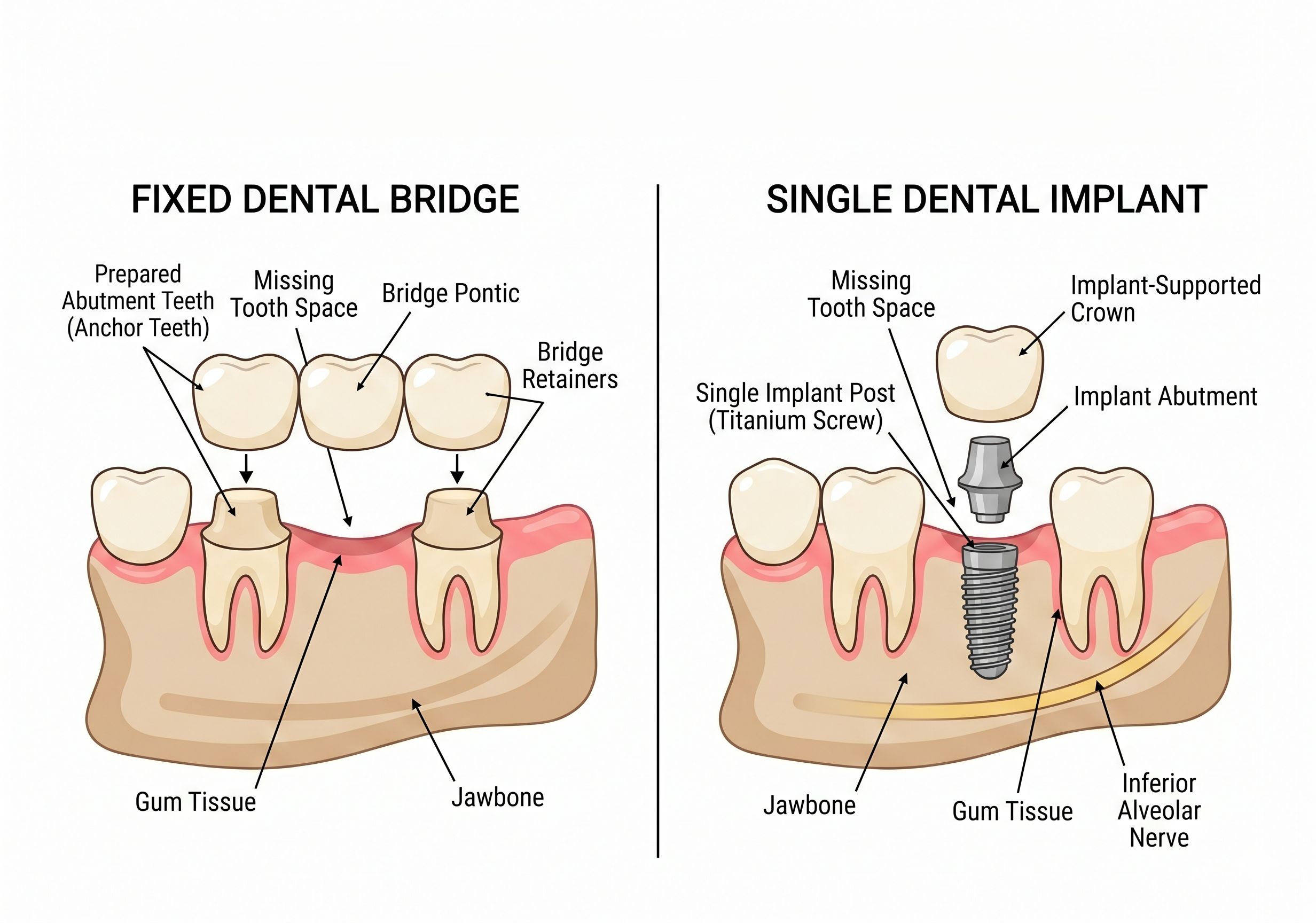
A single tooth implant replaces the missing root with a titanium post placed in the jawbone. After healing, a crown is attached on top — so the new tooth functions independently of the teeth next to it.
FIXED DENTAL BRIDGE
Faster · No surgery · Relies on adjacent teeth
- Uses neighboring teeth as anchors — those teeth are shaped down for crowns
- Artificial tooth is cemented between them as one fixed unit
- No surgery — conventional dental work only
- Completed in 2–3 visits over a few weeks
- Generally lower upfront cost
- Does not replace the missing root in the bone
SINGLE TOOTH IMPLANT
Longer timeline · Surgical · Stands independently
- Titanium post placed in the jawbone — replaces the missing root
- Crown attached on top after healing — functions independently
- Surgical placement under local anaesthesia
- Several months total — accounts for osseointegration
- Higher upfront cost; potentially lower total cost over time
- Helps preserve bone at the missing-tooth site
Side-by-Side: The Key Differences at a Glance
| Factor | Fixed Dental Bridge | Single Tooth Implant |
|---|---|---|
| Upfront Cost | Generally lower; bridge + abutment crowns completed in one treatment phase | Higher; accounts for surgery, implant fixture, healing period, and final crown |
| Treatment Timeline | Typically 2–3 appointments over 2–4 weeks total | Several months; accounts for osseointegration and possible bone grafting |
| Surgery Required | No surgery — conventional dental work only | Yes — surgical placement of titanium post under local anaesthesia |
| Effect on Neighboring Teeth | Adjacent teeth prepared as abutments; involves reshaping healthy tooth structure if not already crowned | No impact on neighboring teeth — stands completely alone in the jaw |
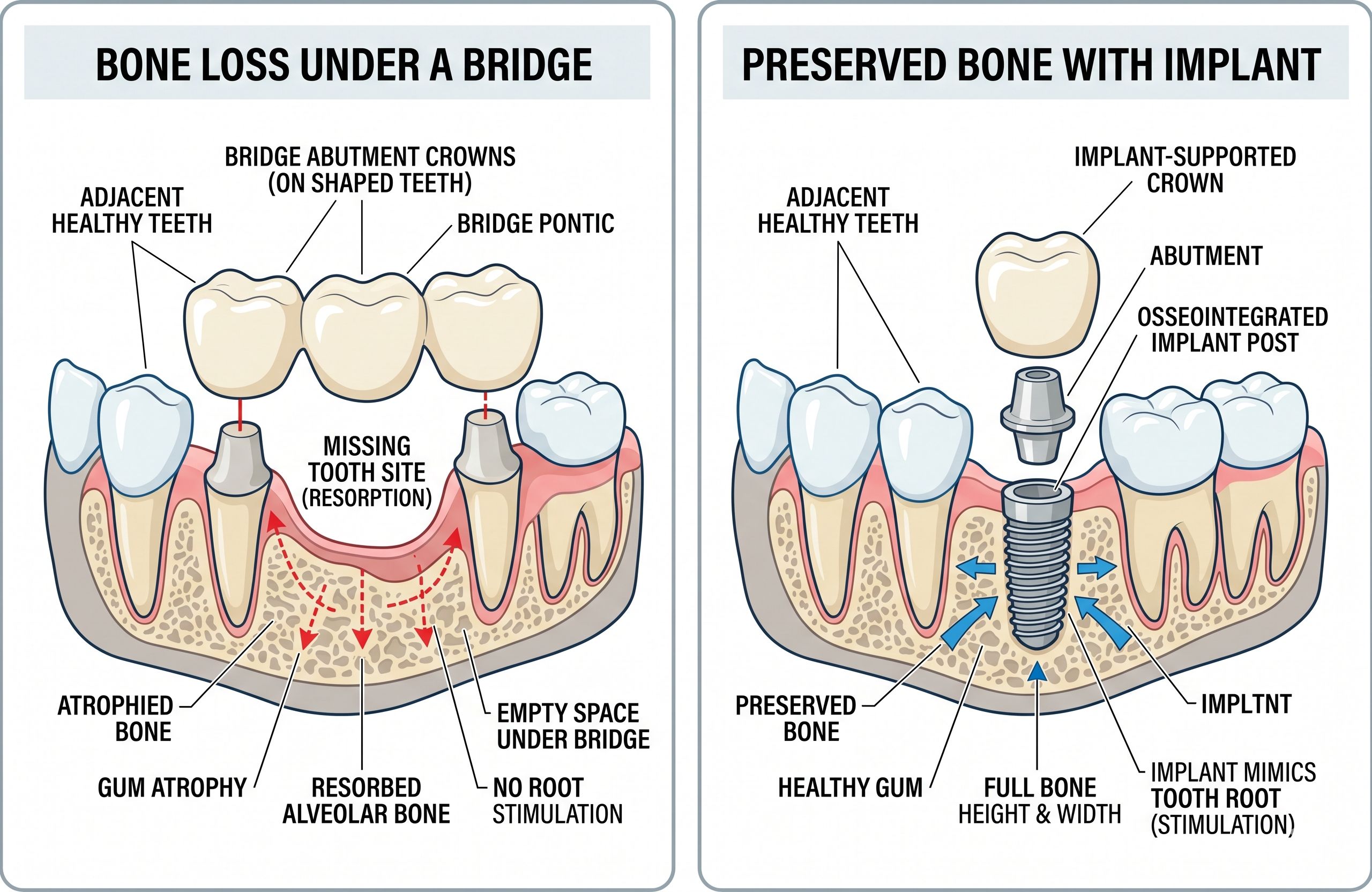
| Bone at Missing-Tooth Site | Not directly loaded; some bone resorption at the edentulous site may occur gradually over time | Implant post stimulates the bone it integrates with, helping preserve bone volume at the site |
| Maintenance | Requires floss threaders or interdental aids to clean under the bridge — cannot be flossed conventionally | Brushed and flossed like a natural tooth; professional monitoring of peri-implant tissue at cleanings |
| Long-Term Replacement Risk | Abutment teeth can develop problems over time; bridge may eventually need replacing as a complete unit | Implant post designed to be long-lasting; crown on top may eventually need replacement independently |
An implant is a surgical treatment — and that matters in the decision. It involves anaesthesia, healing time, and a longer overall process than a bridge. For many patients, the long-term benefits make that worthwhile. For others — those with limited bone, medical concerns, tight timelines, or strong hesitation about surgery — a bridge may be the more practical option.
How Long Each Option Actually Takes
A fixed dental bridge is usually completed in two to three visits over a few weeks. The neighboring teeth are prepared, a temporary is often placed while the lab fabricates the bridge, and the final unit is cemented once ready.
A single tooth implant usually takes several months, depending on healing and whether extra procedures are needed first.
CONSULTATION & 3D IMAGING
Exam and imaging to assess bone volume, nearby anatomy, and implant suitability. CBCT 3D imaging is often used for precise surgical planning.
BONE GRAFTING (IF NEEDED)
Some patients need grafting first if bone has been lost at the site — either from the extraction or time elapsed. This adds time and cost but makes implant placement viable in cases that otherwise wouldn't qualify.
IMPLANT SURGERY
The titanium post is surgically placed into the jawbone under local anaesthesia. Sedation options are available for anxious patients.
OSSEOINTEGRATION — HEALING PHASE
The bone gradually bonds to the implant over several months. This is the longest phase — and it cannot be rushed. Regular monitoring confirms integration is progressing correctly.
ABUTMENT & FINAL CROWN
Once healing is confirmed, the abutment connector and final custom crown are attached. The result is a fully functional, natural-looking tooth.
MANAGING THE GAP WHILE HEALING
If timing or appearance during the healing phase is a concern, temporary options can often be discussed. Ask about temporary solutions at your consultation — leaving a visible gap for several months is not usually necessary.
Why a Bridge Requires Altering Healthy Neighboring Teeth
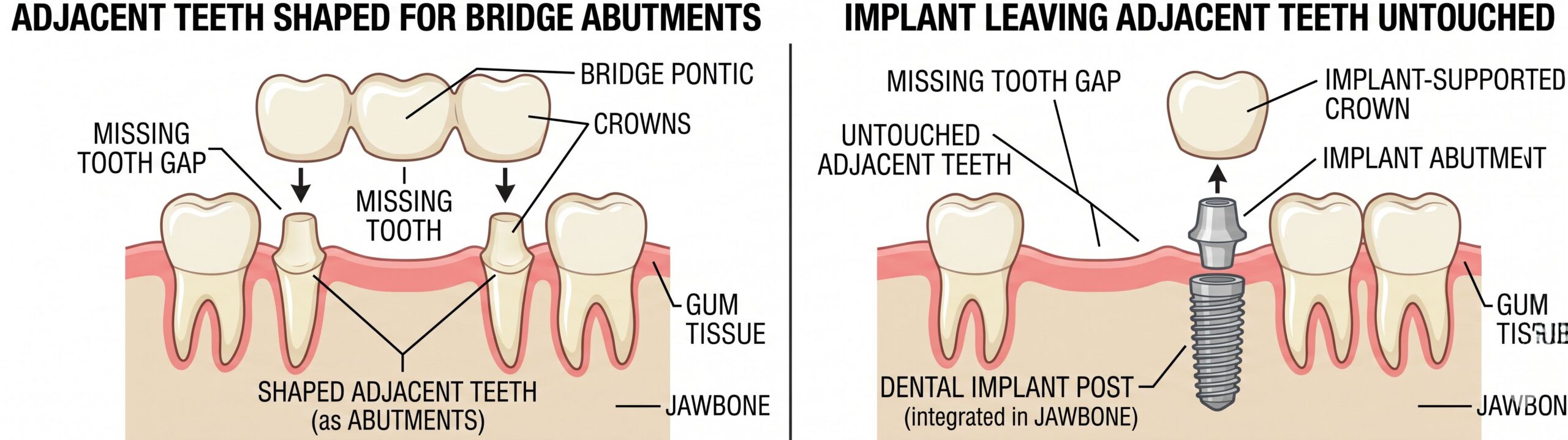
This is often the factor that pushes the decision toward an implant when the teeth next to the gap are still healthy and intact. A traditional fixed bridge usually requires those neighboring teeth to be shaped down so crowns can support the replacement tooth between them.
When Altering Neighboring Teeth May Be a Reasonable Trade-Off
Neighboring Teeth Already Need Crowns
If they already have large fillings, old crowns, or significant damage, using them as bridge supports is a reasonable decision — you're crowning teeth that needed it anyway.
Implant Is Not Viable
If bone is not adequate and grafting isn't realistic due to medical, financial, or timeline constraints, a bridge may simply be the more practical option.
Speed and Avoiding Surgery
A bridge restores function and appearance without implant surgery, recovery, or a multi-month timeline — which matters to many patients with legitimate time or medical constraints.
Budget Constraints
For patients where the upfront cost difference is genuinely significant, a bridge may be the right decision for the present, with an implant reconsidered later if circumstances change.
When Adjacent-Tooth Preparation Becomes a Significant Factor
If the neighboring teeth are healthy and unrestored, preparing them is a bigger decision — because it permanently changes teeth that did not otherwise need treatment.
Loss of healthy tooth structure:
Crown preparation removes enamel and dentin that cannot be replaced — a permanent, irreversible change to otherwise intact teeth
Added long-term stress on abutment teeth:
Those teeth now support both themselves and the replacement tooth — more load than they would otherwise carry
More complex future treatment:
If one support tooth later develops decay, fracture, or needs a root canal — the whole bridge may be affected, potentially requiring a more extensive and costly restoration
THIS DOESN'T MAKE A BRIDGE WRONG
It means the condition of the neighboring teeth should be weighed carefully before deciding. The right question is: are those teeth already compromised — or are they healthy teeth that would be prepared specifically for this bridge?
Long-Term Financial Value: Lifespan and Bone Preservation
The dental bridge vs. implant cost question is not just about the first price quote. A bridge may cost less upfront, but over time it may involve maintenance, replacement, or treatment of the supporting teeth. An implant usually costs more at the start, but may remain functional for many years without the entire restoration needing to be replaced.
Why One Price Quote Never Tells the Whole Story
Extraction and site preparation: Whether the tooth still needs to be removed and how the site heals can change the plan and the timeline significantly.
Bone grafting: If there isn’t enough bone for an implant, grafting adds cost and healing time before surgery can proceed.
Crown material: Different prosthetic materials affect both upfront cost and long-term durability — zirconia, porcelain-fused-to-metal, and other options have different performance profiles.
Condition of neighboring teeth: If those teeth are healthy and uncrowned, a bridge may require more preparation than patients expect — and that has a cost, both financial and structural.
Future replacement needs: Bridges can last many years, but they may eventually need replacing as a complete unit — and replacement can become more complex over time as bone changes.
Insurance coverage: Some plans cover bridges more predictably than implants. Out-of-pocket cost can vary significantly — always request a predetermination for both options before deciding.
The Bone Preservation Question
After a tooth is lost, the jawbone in that area can gradually shrink because the root is no longer there to transmit chewing forces into the bone. A fixed bridge restores the tooth above the gumline but does not replace the missing root. An implant places a titanium post into the bone — which is why it is often discussed as the better option for preserving bone at that site over time.
WHY THIS MATTERS BEYOND AESTHETICS
For younger patients, patients concerned about long-term jaw structure, or anyone who may need future restorative work in that area — bone preservation is an important part of the decision, not just a cosmetic consideration.
Questions Worth Asking at a Bridge or Implant Consultation
Frequently Asked Questions
Is it better to get a dental bridge or an implant?
Why are dental implants more expensive than fixed bridges upfront?
How long does a porcelain bridge last compared to an implant?
Does an implant look and function like a natural tooth?
Can a dental bridge cause bone loss in the jaw?
Is implant surgery painful under local anaesthesia?
Does dental insurance cover bridges or implants?
The Right Answer Is the One That Fits Your Specific Situation
There is no universal winner in the bridge vs. implant decision. A bridge often wins on upfront cost and speed. An implant may offer better long-term independence and bone support. Which matters more depends on your bone, your neighboring teeth, your health history, and your priorities. If you’re deciding between the two, the next step is a case-specific evaluation at Toothology in Williamsburg — where we can assess the site, review your bone and neighboring teeth, and explain which option makes the most sense for your situation.
BRIDGE OR IMPLANT?
Book a case-specific evaluation at Toothology in Williamsburg — we’ll assess your bone, neighboring teeth, and give you an honest recommendation for your situation.
DIRECT LINE
IN THIS GUIDE
QUICK COMPARISON
BRIDGE
IMPLANTS
BRIDGE
IMPLANTS
BRIDGE
IMPLANTS
BRIDGE
IMPLANTS
TOOTHOLOGY DENTAL
Williamsburg, Brooklyn, NY
Serving Greenpoint, Bushwick, Bed-Stuy & Downtown Brooklyn
718-678-3800
Emergency line available
Open Hours
Mon – Thu: 10:00 AM – 6:00 PM Friday: 10:00 AM – 2:00 PM Sunday: 10:00 AM – 2:00 PM Saturday: Closed
OUR COMMITMENT
- Board-Certified Pediatric Dentists
- Child-Friendly, Anxiety-Reducing Care
- Same-Day Emergency Slots
- Low-Radiation Digital X-Rays
- Most Major Insurance Accepted