
- Gum Disease & Periodontal Care · Williamsburg Brooklyn
You came in for a routine cleaning and left with a different recommendation. Here’s what scaling and root planing actually is, how it differs from a regular cleaning, and what to expect.
Deep Cleaning vs Regular Cleaning: When Do You Need Scaling & Root Planing?
You came in for what you thought was a routine cleaning. Your dentist or hygienist measured your gum pockets, took X-rays, and told you the cleaning you need is not a regular cleaning — it is a deep cleaning. You’re sitting in the chair wondering what exactly that means, whether it is going to hurt, and why this feels different from every other dental appointment you’ve had.
The distinction between a regular dental cleaning and a deep cleaning — properly called scaling and root planing — matters because they serve genuinely different clinical purposes. A regular cleaning is preventive care designed to keep healthy gums healthy. A deep cleaning is gum disease therapy designed to address inflammation, tartar buildup, and bacterial accumulation that extends below the gumline into the pockets between teeth and gums. They are not the same procedure delivered in different intensities — they are different procedures with different clinical indications.
Regular Cleaning vs. Deep Cleaning: The Core Difference
REGULAR DENTAL CLEANING
Preventive care · Dental prophylaxis
- Removes plaque and tartar from visible tooth surfaces above the gumline
- Appropriate for patients with healthy or stable gums
- Usually includes exam, X-rays, basic pocket measurements, polishing and flossing
- No anesthesia typically needed
- Goal: maintain gum health and prevent disease from developing
DEEP CLEANING (SRP)
Gum disease therapy · Scaling & Root Planing
- Removes plaque and tartar from below the gumline, inside periodontal pockets, and along root surfaces
- Recommended when gum pockets are deep, tartar is below the gumline, or periodontitis is diagnosed
- May be completed in sections (quadrants) over multiple visits
- Local anesthesia used for comfort when needed
- Goal: reduce bacterial load, allow gum tissue to heal, and stabilise gum disease
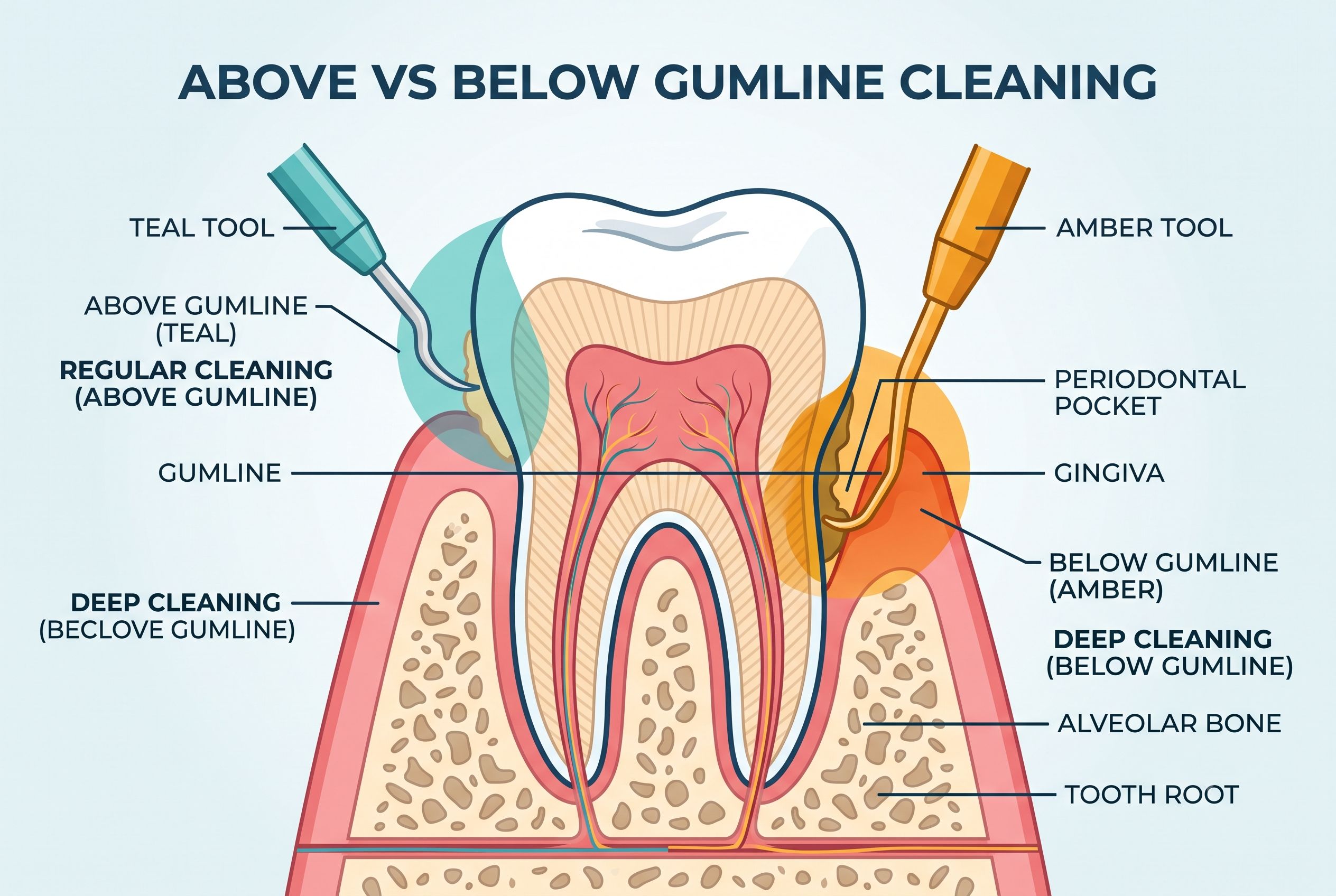
NOT AN UPSELL — A DIFFERENT TREATMENT
A recommendation for a deep cleaning is not an upsell. It is a different clinical treatment based on gum measurements, X-rays, and signs of periodontal disease. A regular cleaning cannot reach the areas a deep cleaning addresses.
Deep Cleaning vs Regular Cleaning: A Quick Comparison
| Factor | Regular Dental Cleaning | Deep Cleaning / Scaling & Root Planing |
|---|---|---|
| Main Purpose | Preventive cleaning for generally healthy or stable gums | Gum disease therapy for inflammation, gum pockets, and bacterial buildup below the gumline |
| Where It Cleans | Above the gumline and around visible tooth surfaces | Below the gumline, inside gum pockets, and along root surfaces |
| Used When | Routine care and maintenance; no active periodontitis diagnosis | Periodontal charting shows deep pockets, bleeding, tartar below the gumline, or bone loss on X-ray |
| Comfort | Usually no anesthesia needed | Local anesthesia may be used if areas are tender or gum pockets are deep |
| Follow-Up | Usually routine recall schedule — every 6 months for most patients | Re-evaluation 4–8 weeks later; may move to periodontal maintenance every 3–4 months |
Signs You May Need Scaling and Root Planing
Gum disease often develops more quietly than patients expect. Bleeding gums are commonly overlooked or attributed to brushing technique rather than recognised as a potential clinical sign worth investigating. By the time gum disease causes noticeable symptoms — recession, loose teeth, or visible bone changes on X-ray — it has typically been active for some time.
Gums that bleed regularly when brushing or flossing — not just occasionally
Swollen, tender, or puffy-looking gum tissue
Gums that appear to be pulling away from the teeth (recession)
Persistent bad breath that does not resolve with brushing and rinsing
Tartar buildup visible at the gumline even with regular brushing
A dentist noting gum pocket depths of 4mm or greater during charting
Bone loss noted on dental X-rays
Teeth that feel or look loose without a clear dental explanation
Scaling and root planing is a non-surgical treatment. It does not involve incisions or stitches — but it goes deeper than a regular cleaning. Understanding what happens makes the procedure far less intimidating than the description might suggest.
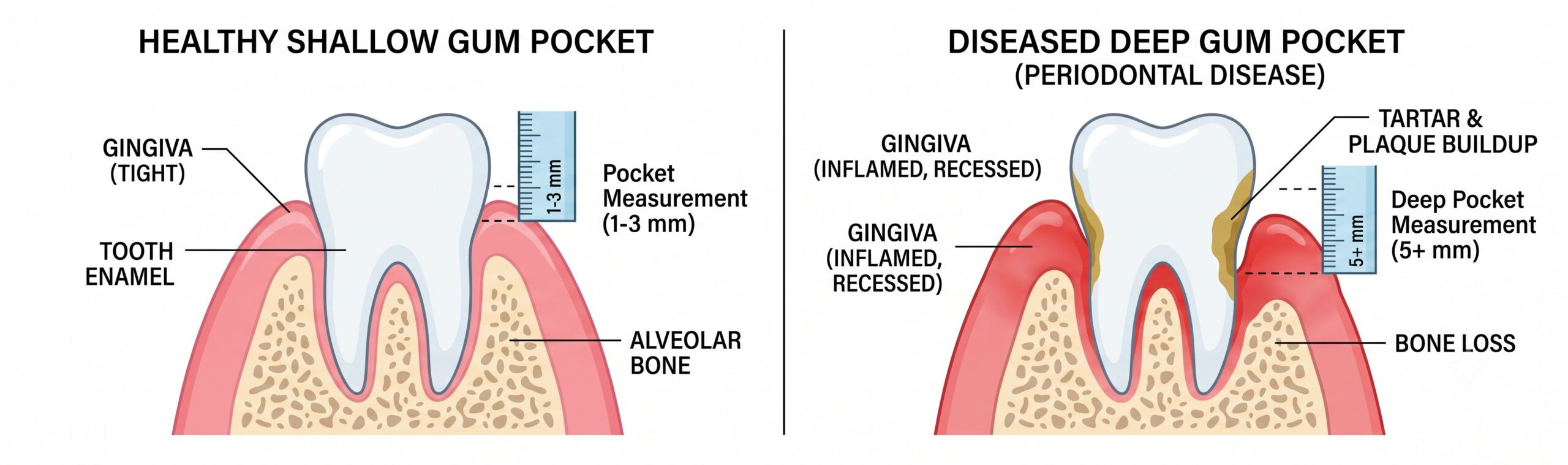
PERIODONTAL CHARTING
Gum pocket depths are measured around each tooth. Pockets 4mm or deeper in combination with other findings are a key indicator for SRP.
LOCAL ANESTHESIA
The area being treated is numbed for comfort. Deep cleaning can be performed in quadrants — one section per visit — so anesthesia is focused on the area being treated that day.
SCALING (TARTAR REMOVAL)
Ultrasonic instruments and/or hand scalers remove bacterial plaque and tartar from below the gumline and inside periodontal pockets. The ultrasonic device uses vibration and water to loosen and flush out buildup.
ROOT PLANING (SMOOTHING THE ROOT)
The tooth root surfaces are smoothed so bacteria are less likely to reattach. Smoother root surfaces also allow the gum tissue to heal more closely around the tooth.
IRRIGATION AND COMPLETION
The area is rinsed and any adjunctive medication may be applied depending on the clinical situation. Post-care instructions are reviewed before you leave.
Concern about discomfort is one of the main reasons patients hesitate after being told they need scaling and root planing. Most patients tolerate SRP well — and discomfort during the procedure is usually managed with local anesthesia.
Before treatment begins, the area may be numbed, especially when gum pockets are deep or the tissue is tender. During the procedure, patients usually feel pressure and movement rather than sharp pain. The level of numbing depends on patient comfort and the clinical situation.
Common Mild Side Effects in the Days After
MILD BLEEDING
Light bleeding while brushing may happen during the first day or two after treatment
GUM TENDERNESS
Some soreness is normal — the tissue has been cleaned below the gumline
TEMPERATURE SENSITIVITY
Teeth may feel more sensitive to hot or cold for one to two weeks
IF YOU HAVE DENTAL ANXIETY
Let the dental team know before treatment so they can discuss comfort options and help the appointment go more smoothly. Most patients find recovery more manageable than they expected.
What Happens After a Deep Cleaning?

Scaling and root planing is a treatment — not a one-time cure. After the procedure, your gums need time to heal, and your dentist will need to check how well the tissue responds.
THE RE-EVALUATION APPOINTMENT
A re-evaluation is usually scheduled about four to eight weeks after scaling and root planing. At this visit, the dentist or hygienist checks gum pocket depths, bleeding, and tissue healing. If your gums respond well, you may move into a periodontal maintenance schedule. If deep pockets remain, additional treatment or a referral to a periodontist may be discussed.
How Periodontal Maintenance Protects Your Gums Long-Term
Periodontal maintenance is not the same as a regular cleaning. After gum disease treatment, the gums remain more susceptible to recurring inflammation, so twice-yearly cleanings may not be enough.
REGULAR CLEANING (PROPHYLAXIS)
For patients with healthy or stable gums. Usually recommended every 6 months. Focus is on above-gumline cleaning, polishing, and preventive monitoring to maintain gum health.
PERIODONTAL MAINTENANCE
For patients who have had gum disease treatment. Usually needed every 3–4 months. Focuses on areas where gum disease was previously active — including pocket measurements, targeted below-gumline cleaning, and checks for recurring inflammation.
WHY MAINTENANCE FREQUENCY MATTERS
Skipping periodontal maintenance can allow bacteria to rebuild in gum pockets. Regular maintenance helps protect the progress made through gum disease therapy and reduces the risk of the condition progressing further.
Frequently Asked Questions
What is the difference between deep cleaning and regular cleaning?
How do I know if I need a deep cleaning?
Is scaling and root planing painful?
How often do you need periodontal maintenance?
Can deep cleaning stop gum disease?
Deep cleaning can reduce inflammation, remove bacterial buildup, and improve gum pocket depths. However, gum disease can return, so ongoing periodontal maintenance and consistent home care are important to protect the progress made through treatment.
Take the Next Step Toward Healthier Gums
Being told you need a deep cleaning can feel unexpected, but it simply means your gums need treatment beyond a routine cleaning. The recommendation is based on clinical findings like gum pocket depths, bleeding, tartar buildup, and X-rays. Scaling and root planing is a common, non-surgical gum disease treatment that helps reduce bacteria and inflammation below the gumline. If you have bleeding gums, gum inflammation, or were told you may need SRP, Toothology in Williamsburg can evaluate your gum health and explain your treatment options clearly.
BLEEDING GUMS OR TOLD YOU NEED A DEEP CLEANING?
Book a gum health evaluation at Toothology in Williamsburg — we’ll measure your pockets, review X-rays, and explain your options clearly.
DIRECT LINE
IN THIS GUIDE
SIGNS WORTH CHECKING
These signs don't confirm gum disease — but they confirm an evaluation.
TOOTHOLOGY DENTAL
Williamsburg, Brooklyn, NY
Serving Greenpoint, Bushwick, Bed-Stuy & Downtown Brooklyn
718-678-3800
Emergency line available
Open Hours
Mon – Thu: 10:00 AM – 6:00 PM Friday: 10:00 AM – 2:00 PM Sunday: 10:00 AM – 2:00 PM Saturday: Closed
OUR COMMITMENT
- Board-Certified Pediatric Dentists
- Child-Friendly, Anxiety-Reducing Care
- Same-Day Emergency Slots
- Low-Radiation Digital X-Rays
- Most Major Insurance Accepted