
- Urgent Dental Care · Emergency & Evaluation · Brooklyn
If an adult tooth feels loose — even slightly — it should be taken seriously. A loose permanent tooth usually does not resolve on its own, and early evaluation gives the dentist more options.
Loose Adult Tooth: Causes, Treatment Options, and When It's Urgent
If an adult tooth feels loose — even slightly — it should be taken seriously. A loose permanent tooth usually does not resolve on its own, and early evaluation gives the dentist more options to identify and treat the cause. While waiting for your appointment, avoid chewing on that tooth and do not keep testing it with your finger or tongue.
Adult teeth can become loose because of gum disease, bone loss, dental injury, infection, bite pressure, or a failing restoration. The exact cause can only be confirmed with a dental exam and X-rays — and the cause determines whether the tooth can be stabilised.
IF YOU HAVE SWELLING, SEVERE PAIN, OR TRAUMA
If the looseness started after an injury, or you have swelling, fever, pus, or severe pain, contact Toothology right away at 718-678-3800. Do not wait to see if symptoms improve.
Common Causes of a Loose Permanent Tooth
A loose permanent tooth can happen for several reasons, and more than one issue may be involved at the same time. A dental exam and X-rays are needed to identify the specific cause and how advanced it is.
Gum Disease
Periodontal disease can damage the bone and ligament that support the tooth over time, causing it to feel loose or shift position.
Dental Injury or Trauma
A fall, sports impact, or biting something hard can damage the tooth, root, or surrounding ligament — even without obvious pain.
Infection or Abscess
Infection near the root or in the surrounding bone can progressively weaken the tissue and bone that keep the tooth stable.
Bite Trauma or Grinding
Clenching, grinding, or uneven bite pressure can overload the tooth and its supporting structures over time.
Failing Restoration
A cracked crown, failing bridge, or large damaged filling can affect how the tooth is loaded and supported.
Bone or Health Factors
Some medical conditions or medications can affect bone density or support. A full health history is part of the evaluation.
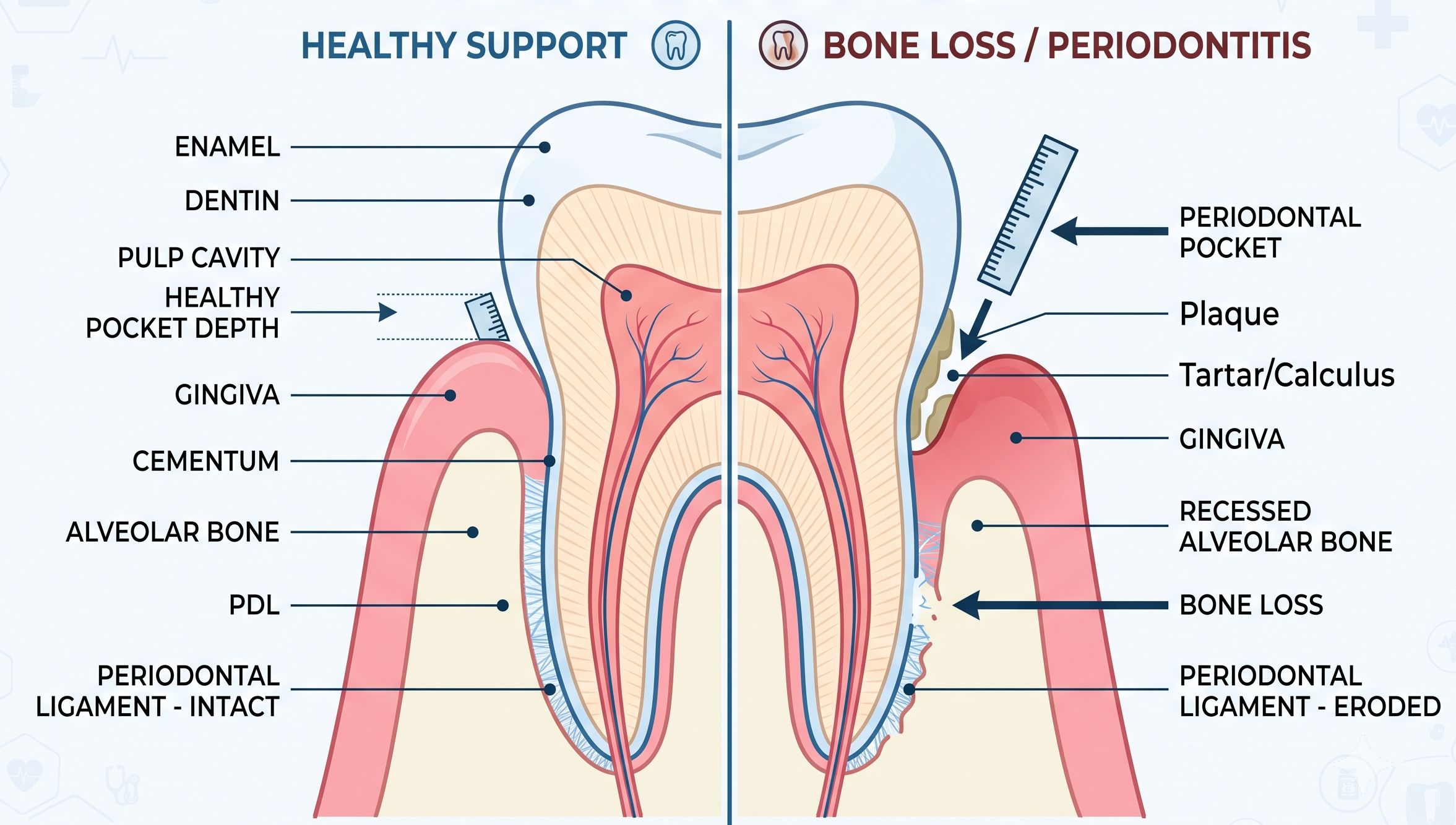
Loose Tooth From Gum Disease
The link between gum disease and loose teeth is significant. Periodontal disease is an infection that affects the gums, ligament, and bone that support the teeth. As it progresses, those structures can weaken — causing teeth to shift or become loose. The warning signs are often gradual and easy to overlook.
Bleeding gums when brushing or flossing
Red, swollen, or receding gum tissue
Persistent bad breath that does not resolve with brushing
New spaces appearing between teeth
Pus at the gumline or a persistent bad taste
Teeth that feel tender, loose, or have visibly shifted
WHAT GUM DISEASE TREATMENT CAN AND CAN'T DO
Treatment depends on how much bone and ligament support remains. A dentist may recommend scaling and root planing, periodontal maintenance, antibiotics when infection is active, tooth splinting in selected cases, or referral to a periodontist. Deep cleaning does not guarantee that a loose tooth will tighten — especially if there is significant bone loss. However, treating the infection can help stop further damage and give the tooth the best chance of stabilisation.
Loose Tooth After Injury or Trauma
A loose tooth after dental trauma should be checked as quickly as possible. Sports injuries, falls, collisions, or biting something hard can stretch the ligament around the tooth, move the tooth in its socket, fracture the root, or damage the surrounding bone. Even if the pain is mild, the injury may be more serious than it appears.

- AFTER TRAUMA — DO THIS
- Avoid chewing on the affected side
- Contact a dentist as soon as possible — same day if you can
- Get X-rays to check for root, bone, or ligament damage
- Keep a knocked-out tooth moist in milk, saliva, or a tooth-preservation product
- AFTER TRAUMA — AVOID THIS
- Do not keep touching or testing the tooth with your finger or tongue
- Do not try to push the tooth back into position yourself
- Do not chew on the affected side
- Do not wait to see if it improves without being seen
A KNOCKED-OUT PERMANENT TOOTH IS A DENTAL EMERGENCY
Keep the tooth moist in milk, saliva, or a tooth-preservation product. Do not let it dry out and do not scrub the root. Seek emergency dental care immediately — time matters significantly for reimplantation. Call Toothology at 718-678-3800.
Can a Loose Adult Tooth Be Saved?
Sometimes. Whether a loose adult tooth can be saved depends on the cause, how much bone and gum support remains, whether infection is present, and how quickly treatment begins. Some loose teeth can be stabilised with the right care — others may not be predictable to keep long-term. Only an exam and X-rays can give you a realistic picture.

| Treatment Option | When It May Apply | Important Note |
|---|---|---|
|
🪥
Deep Cleaning / Scaling & Root Planing
|
Gum disease, tartar buildup, or periodontal pockets are contributing to tooth mobility | May help control infection — does not guarantee the tooth will tighten back up |
|
🗓
Periodontal Maintenance
|
After gum therapy, to monitor and keep infection controlled over time | Ongoing care is needed to protect the progress made through treatment |
|
🔗
Tooth Splinting
|
When stabilisation during healing may be clinically appropriate | Only suitable for selected cases — not a universal option for every loose tooth |
|
😬
Bite Adjustment / Night Guard
|
Grinding, clenching, or uneven bite pressure is contributing to the mobility | Bite problems must be clinically diagnosed before treatment can be planned |
|
🩺
Root Canal Therapy
|
Infection or trauma affects the nerve, but the tooth is still structurally restorable | Treats the infection inside the tooth — does not address bone or gum loss around it |
|
🔄
Extraction & Replacement
|
The tooth cannot be predictably saved or stabilised long-term | Replacement options may include a dental implant, bridge, or partial denture |
THE EARLIER, THE MORE OPTIONS
The earlier a loose tooth is evaluated, the more treatment options are typically available. Waiting allows the underlying cause — gum disease, infection, or structural damage — to progress and reduce what can be done.
When a Loose Tooth Becomes an Emergency
Not every loose adult tooth requires same-day care, but some situations do. Contact a dentist right away — or seek emergency care — if any of the following apply.
A tooth was knocked out or pushed out of position
The tooth is suddenly very loose or moves in multiple directions
Facial or gum swelling is present
Fever, pus, or a persistent bad taste
Significant or uncontrolled bleeding
Severe pain — especially when biting down
Looseness started after a fall, collision, or impact
You cannot bite normally because of the tooth's position
NEED AN EMERGENCY DENTIST IN BROOKLYN?
Toothology in Williamsburg can help when a tooth is injured, suddenly loose, painful, or showing signs of infection. Call 718-678-3800 for urgent next steps — 42A Broadway, Williamsburg, Brooklyn.
How Dentists Diagnose Tooth Mobility
A dental exam for a loose tooth is focused on finding the cause before recommending treatment. The first visit is not automatically about extraction — it is about understanding what is causing the mobility and what options are appropriate.
Symptoms and history: When the looseness started, whether there was trauma, pain, swelling, sensitivity, or past dental issues
Tooth mobility assessment: How much the tooth moves and in which direction — helps classify the severity
Gum pocket measurements: Whether periodontal pockets suggest active gum disease or bone loss around the tooth
X-rays: Bone levels, root fractures, infection, and the remaining support structure around the tooth
Bite pressure assessment: Whether grinding, clenching, or uneven bite forces are contributing to mobility
Trauma and infection signs: Any active injury or infection that affects treatment planning and urgency
SPECIALIST REFERRAL WHEN NEEDED
Depending on what the exam reveals, the dentist may refer you to a periodontist for advanced gum disease, an endodontist for root canal evaluation, or an oral surgeon for complex extraction or implant planning.
Frequently Asked Questions
Why is my adult tooth loose?
Can a loose adult tooth tighten back up?
Is a loose tooth a dental emergency?
Can gum disease make teeth loose?
When should I see a dentist for a loose tooth?
As soon as possible. Contact a dentist the same day if the looseness followed trauma, includes swelling, fever, severe pain, or significant movement. Even mild looseness should be checked promptly — adult teeth should not move, and waiting allows the underlying cause to progress.
Do Not Wait on a Loose Permanent Tooth
LOOSE OR INJURED TOOTH?
CALL TOOTHOLOGY NOW
Same-day urgent appointments. Exam, X-rays, and treatment options explained clearly.
IN THIS GUIDE
EMERGENCY — CALL NOW
TOOTHOLOGY DENTAL
Williamsburg, Brooklyn, NY
Serving Greenpoint, Bushwick, Bed-Stuy & Downtown Brooklyn
718-678-3800
Emergency line available
Open Hours
Mon – Thu: 10:00 AM – 6:00 PM Friday: 10:00 AM – 2:00 PM Sunday: 10:00 AM – 2:00 PM Saturday: Closed
OUR COMMITMENT
- Board-Certified Pediatric Dentists
- Child-Friendly, Anxiety-Reducing Care
- Same-Day Emergency Slots
- Low-Radiation Digital X-Rays
- Most Major Insurance Accepted