
- Preventive Dental Care Guide · Williamsburg Brooklyn
Wondering whether dental sealants are right for your child — or for you? Here’s a clear, practical guide covering cost, safety, the procedure, insurance, and how sealants compare to fillings.
Dental Sealants Cost & Safety: What Brooklyn Patients Should Know
If you are wondering about dental sealants — what they cost, whether they are safe, and whether they are actually necessary for your child or yourself — this guide covers everything you need to know before your next preventive visit. Sealants are not needed for everyone, but for patients with deep molar grooves or higher cavity risk, they are one of the most practical preventive tools available.
A dentist will consider tooth shape, cavity risk, age, oral hygiene, existing decay, and previous sealants before recommending them. Cost depends on the number of teeth treated, insurance coverage, and visit type.
Dental Sealants at a Glance
What They Are
Thin protective coatings applied to the chewing surfaces of back teeth — especially molars — to help reduce cavity risk in deep grooves and pits.
Purpose
Seal off grooves and pits where plaque and bacteria can hide — areas that are hard to reach with a toothbrush.
Procedure
Quick and usually painless. No drilling or numbing needed for preventive placement on healthy teeth.
Who May Benefit
Children and adults with deep molar grooves or higher cavity risk — especially when placed before a cavity has a chance to develop.
Cost
Varies by number of teeth, insurance coverage, and visit type. Often covered for children’s permanent molars under many dental plans.
Longevity
Can last for several years. Should be checked at routine dental visits — can be repaired or replaced if chipped or worn.
How Much Do Dental Sealants Cost?
The cost of dental sealants is calculated per tooth. The total depends on how many teeth are sealed, the patient’s age, insurance coverage, and whether sealants are placed during a cleaning or preventive visit.
Without insurance, sealants are often a lower-cost preventive option compared with treating a cavity later. Toothology does not list a fixed sealant price because each estimate depends on the number of teeth, insurance status, and services included in the visit.
GETTING YOUR COST ESTIMATE
To understand your expected cost, ask Toothology to check your benefits before the appointment or request an estimate when scheduling. The office can confirm which teeth may benefit from sealants, whether they are covered, and what your out-of-pocket amount may be.
What Affects the Cost of Sealants?
A SEALANT CANNOT GO OVER A CAVITY
If decay is found during the exam, the dentist may recommend a filling or another treatment first. This is why a cavity check is a standard part of deciding whether sealants are appropriate — and why a dental exam is always part of the visit.
Are Dental Sealants Safe?
For most patients, dental sealants are safe when placed by a dental professional. They are a well-established preventive treatment with a long history of use in both children and adults.
Some patients ask about BPA in sealant materials. Small trace amounts may be present in some products, but dental sealants have a long and well-established history of safe use. If BPA exposure is a concern for you or your child, ask the dentist which sealant material is used.
Sealants work best when placed on a clean, decay-free tooth. A dentist will check the tooth first to confirm a sealant is appropriate before proceeding.
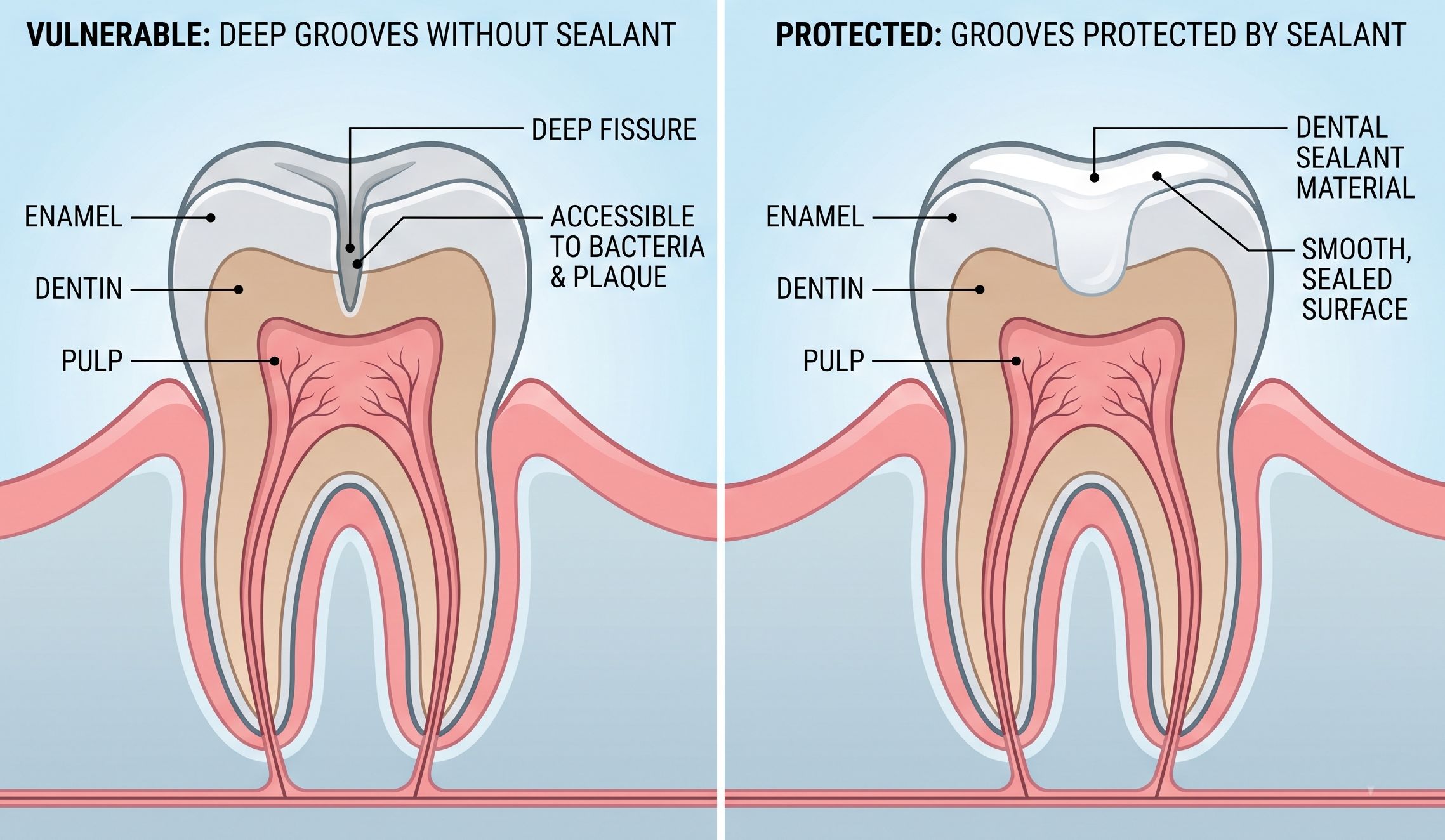
WITH A SEALANT
Deep grooves and pits are sealed off — bacteria and food particles cannot collect where brushing can’t easily reach
WITHOUT A SEALANT
Deep grooves remain open — plaque and bacteria accumulate in the pits, increasing cavity risk on the chewing surface
What Happens During the Sealant Procedure?
The dental sealant procedure is quick, painless, and non-invasive. When placed on healthy teeth for prevention, numbing and drilling are not needed. Each tooth usually takes only a few minutes, and multiple teeth can be sealed in the same visit.
EXAM & CLEANING
The dentist checks the tooth for decay or existing sealants and cleans the chewing surface before proceeding.
DRYING THE TOOTH
The tooth is kept dry so the sealant can bond to the surface properly.
PREPARING THE SURFACE
A gentle conditioning solution helps the sealant attach securely to the enamel.
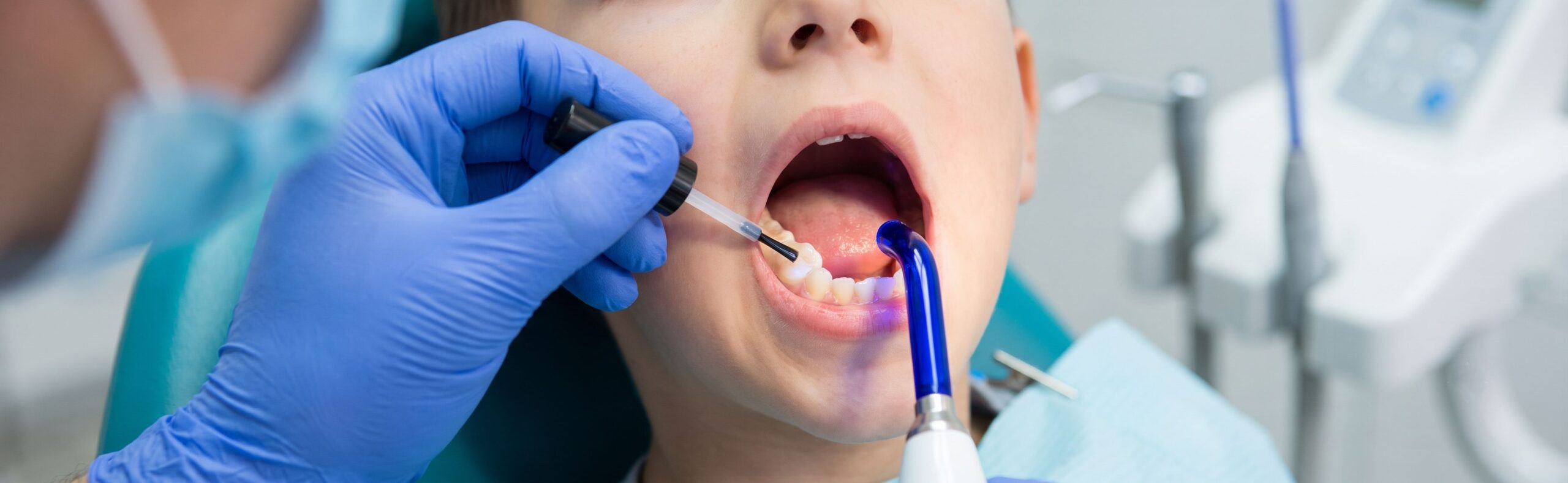
APPLYING THE SEALANT
The liquid sealant is painted into the grooves and pits of the chewing surface.
CURING
A small curing light hardens the sealant in seconds.
BITE CHECK
The dentist checks that the sealant does not affect how the teeth come together. Most patients eat and drink normally afterward.
Dental Sealants vs Fillings: What Is the Difference?
Sealants and fillings are not interchangeable. Sealants are preventive — placed before a cavity forms. Fillings are restorative — used to repair a tooth after decay has already developed.

| Factor | Dental Sealant | Filling |
|---|---|---|
| Purpose | Helps prevent cavities in grooves and pits on healthy teeth | Repairs tooth structure after decay or damage has occurred |
| When Used | Before a cavity forms — while the tooth is still healthy | After a cavity or damage is found on exam or X-ray |
| Procedure | Clean, prepare, paint on, and cure — usually no drilling or numbing | Remove decay, place filling material, shape, and cure |
| Tooth Structure | Minimal to none removed from the tooth | Decayed tooth structure must be removed before filling |
| Can It Replace the Other? | Cannot repair an existing cavity | Cannot protect grooves like a preventive sealant |
THE VALUE OF PLACING SEALANTS BEFORE A CAVITY STARTS
A sealant placed on a healthy tooth costs significantly less than treating the cavity that might develop without it. When cavity risk is high and the tooth has deep grooves, a sealant is a practical, conservative preventive investment.
Are Dental Sealants Covered by Insurance?
Coverage depends on the plan, provider, and the patient’s age. The best step is to ask Toothology to verify your specific benefits before the visit — the office can check whether sealants are covered, whether age limits apply, and what your estimated out-of-pocket cost will be.
Children
Many dental plans cover sealants on permanent molars for children as a preventive benefit — often with strong coverage or no cost to the family.
Adults
Adult coverage is less consistent. Some plans cover sealants; others limit coverage to children or require documented higher cavity risk for approval.
Baby Teeth
Some plans may cover sealants on primary molars, but coverage and clinical need vary by plan and individual case.
Dental sealants can last for several years, but they are not permanent. They should be checked during routine dental cleanings and exams to confirm they are still protecting the tooth effectively.
Chewing forces:
Molars handle heavy pressure, and sealants may wear faster in patients who grind their teeth
Diet habits:
Frequently biting very hard foods can stress or chip the sealant over time
Routine dental visits:
The dentist can check for wear, chipping, or partial loss — and repair or replace the sealant if needed
SEALANTS PROTECT GROOVES — BUT NOT THE WHOLE TOOTH
Sealants help protect the surfaces they cover, but they do not protect the entire tooth. Brushing with fluoride toothpaste, flossing, limiting frequent sugar exposure, fluoride treatments, and regular dental cleanings remain important — sealants work best as part of a complete preventive routine.
Frequently Asked Questions
How much do dental sealants cost?
Are dental sealants safe?
Do dental sealants hurt?
Are sealants cheaper than fillings?
How long do dental sealants last?
Sealants can last for several years, but should be checked at routine dental visits. If a sealant wears, chips, or comes partially loose, the dentist may recommend repair or replacement — usually a quick procedure.
Preventive Care Starts With the Right Conversation
Dental sealants are a practical preventive option for protecting the grooves and pits of back teeth — especially for children and adults with deep molar grooves or higher cavity risk. Whether sealants are right for you or your child depends on an exam, cavity risk, tooth condition, and insurance coverage. Toothology at 42A Broadway in Williamsburg, Brooklyn, can help you understand your options during a preventive dental visit.
QUESTIONS ABOUT SEALANTS?
Book a preventive visit at Toothology in Williamsburg — we’ll check cavity risk, confirm insurance coverage, and answer all your questions before any commitment.
DIRECT LINE
IN THIS GUIDE
QUICK FACTS
Not needed for everyone — candidacy is decided by exam.
TOOTHOLOGY DENTAL
Williamsburg, Brooklyn, NY
Serving Greenpoint, Bushwick, Bed-Stuy & Downtown Brooklyn
718-678-3800
Emergency line available
Open Hours
Mon – Thu: 10:00 AM – 6:00 PM Friday: 10:00 AM – 2:00 PM Sunday: 10:00 AM – 2:00 PM Saturday: Closed
OUR COMMITMENT
- Board-Certified Pediatric Dentists
- Child-Friendly, Anxiety-Reducing Care
- Same-Day Emergency Slots
- Low-Radiation Digital X-Rays
- Most Major Insurance Accepted