
- Preventive Dental Care Guide · Williamsburg Brooklyn
Cold water, ice cream, or cool air causing a sharp zing? Fluoride treatment may help — but only if the right cause is identified first. Here’s what it can and can’t do, and when sensitivity means something more.
Fluoride Treatment for Sensitive Teeth: Can It Help Enamel & Tooth Pain?
If cold water, ice cream, or cool air causes a sharp zing in your teeth, you may be wondering whether fluoride treatment for sensitive teeth can help. The answer is: it may, depending on the cause. Fluoride can help strengthen remaining enamel and may reduce certain types of tooth sensitivity — but sensitivity can also come from cavities, cracked teeth, gum recession, exposed roots, worn enamel, infection, or failing dental work. Each cause needs a different approach.
That is why the first step is a dental exam. A dentist can identify what is causing the sensitivity and recommend the right treatment — whether that is fluoride, a filling, a gum evaluation, a night guard, or another solution.
Fluoride for Sensitive Teeth at a Glance
What It May Help With
Enamel support, early remineralisation, cavity prevention, and some dentin sensitivity linked to enamel thinning or mild gum recession.
What It Cannot Fix
Cavities, cracked teeth, infection, deep decay, failing restorations, or significant gum disease. These need specific dental treatment.
Who May Benefit
Adults and children with cold sensitivity, enamel wear, exposed roots, dry mouth, acidic diet, frequent cavities, or higher cavity risk.
When to See a Dentist
New, worsening, one-sided, or lingering sensitivity; pain when biting; or any sensitivity with swelling, visible damage, or fever.

Why Teeth Become Sensitive
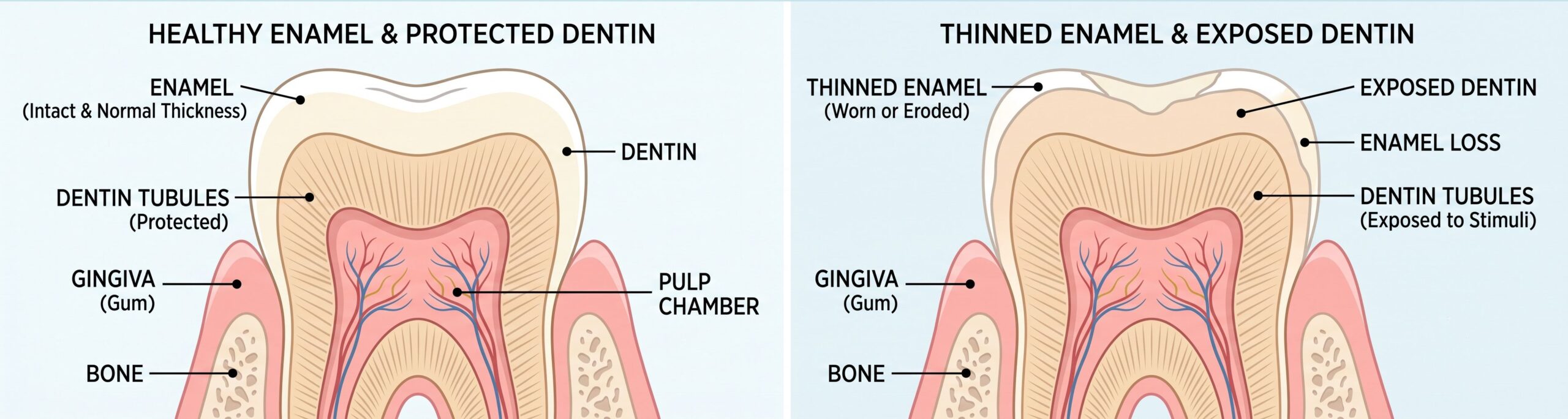
Tooth sensitivity often happens when enamel becomes thin or gums recede, exposing the dentin underneath. Dentin has tiny tubules connected to the tooth nerve — so cold, heat, pressure, or touch can cause a sharp or achy response. But the cause is not always the same, even when the sensation feels similar.
| Possible Cause | Common Pattern | What May Help |
|---|---|---|
| Enamel Erosion | Cold or sweet sensitivity that may worsen over time | Fluoride, remineralisation support, dietary changes, and exam |
| Gum Recession / Exposed Roots | Sensitivity near the gumline | Gum evaluation, fluoride, and desensitising care |
| Cavity or Decay | Sensitivity in one tooth, often worsening with sweet or hot foods | Filling or other dental treatment — fluoride cannot close a cavity |
| Cracked Tooth | Sharp pain when biting or localised sensitivity in one tooth | Dental evaluation and possible restoration |
| Teeth Whitening | Temporary sensitivity during or after whitening treatment | Often improves on its own; fluoride or desensitising products may help |
| Grinding or Clenching | General sensitivity, worn edges, jaw soreness | Night guard evaluation; fluoride may support enamel but does not stop grinding |
SAME SENSATION, DIFFERENT CAUSES
Sensitivity can feel similar even when the underlying cause is very different. A dental exam is the best way to find out whether fluoride is appropriate — or whether another treatment is needed first.
How Fluoride Helps Protect Enamel
Fluoride is a mineral that helps protect teeth against acid attacks that can weaken enamel and lead to cavities. It supports stronger enamel and can help remineralise early weakened areas before they progress into cavities.
A professional fluoride treatment is significantly stronger than regular toothpaste — it is applied directly to the teeth during a dental visit and may be recommended for patients with tooth sensitivity, early enamel weakening, higher cavity risk, dry mouth, or enamel erosion concerns.
- FLUORIDE CAN HELP
- Strengthen remaining enamel
- Support early remineralisation of weakened areas
- Reduce cavity risk
- Protect areas affected by acid exposure
- Support sensitivity care when enamel or dentin exposure is part of the problem
- FLUORIDE CANNOT
- Rebuild enamel that has already been physically lost from erosion or grinding
- Close a cavity that has already formed
- Fix a cracked tooth or failing restoration
- Treat a dental infection or abscess
- Stop teeth grinding or clenching
Can Fluoride Reduce Tooth Sensitivity?
For some patients, yes. Professional fluoride treatment may help when sensitivity is related to enamel weakness, early demineralisation, mild wear, or exposed dentin from minor gum recession.
WHEN FLUORIDE IS MORE LIKELY TO HELP
Fluoride may be most helpful when sensitivity affects several teeth, appears related to enamel thinning or early wear, involves exposed roots without major gum disease, or when sensitivity is mild to moderate and stable rather than focused on one tooth or worsening.
WHEN FLUORIDE IS NOT THE RIGHT SOLUTION
If pain is focused on one tooth, lingers after hot or cold exposure, happens when biting, or comes with swelling — the cause may be a cavity, crack, infection, or structural issue that needs dental treatment rather than fluoride alone.
When Sensitivity Means Something More Serious
Mild, stable sensitivity may be manageable at home with sensitive-tooth toothpaste and good oral hygiene. But certain patterns point to a deeper problem that needs a dental exam rather than toothpaste alone.
Schedule an exam if you notice any of these:
Sensitivity limited to one specific tooth
Pain that lingers after hot or cold exposure is removed
Pain that happens without a clear trigger
Pain when biting down on a specific tooth
Swelling near the gum or jaw
A visible hole, dark spot, crack, or chip
Sensitivity that started after trauma or injury
Symptoms that are getting worse over time
Tooth pain accompanied by fever
THESE SIGNS MAY INDICATE A CAVITY, CRACK, OR INFECTION
The signs above may suggest a cavity, cracked tooth, infection, gum problem, or another issue that fluoride alone cannot fix. A dental exam is the right next step — not more toothpaste or waiting it out.
Fluoride vs Toothpaste for Sensitive Teeth
Sensitive-tooth toothpaste and professional fluoride treatment are not the same thing — but they are not mutually exclusive either. They can work together as part of a complete preventive care routine.

| Option | How It Helps | Best For | Limitations |
|---|---|---|---|
| Daily Sensitive-Tooth Toothpaste | Helps calm sensitivity with consistent daily use at home | Mild, generalised sensitivity as part of a daily routine | Takes time; may not address the underlying cause |
| Professional Fluoride Varnish / In-Office Fluoride | Applies stronger fluoride directly to teeth during a dental visit | Enamel support, cavity prevention, and sensitivity care during a preventive visit | Does not fix cavities, cracks, gum recession, or structural problems |
Who Should Consider Professional Fluoride Treatment?
Professional fluoride may be worth discussing if you have any of the following. Your dentist will review your sensitivity, gum health, cavity history, diet, oral hygiene, and exam findings before recommending it.
PROFESSIONAL FLUORIDE IS NOT AUTOMATIC FOR EVERY PATIENT
A dentist will review your specific situation — sensitivity pattern, gum health, cavity history, diet, and exam findings — before deciding whether professional fluoride should be part of your preventive plan. It is recommended when it fits your individual clinical picture.
When a Filling or Gum Treatment May Be Needed Instead
Fluoride can support preventive dental care, but it cannot fix every cause of tooth sensitivity. Some problems need a filling, gum evaluation, night guard, or restoration instead.
Cavity or tooth decay:
Cracked tooth:
Gum recession:
Grinding or clenching:
Failing filling or crown:
Frequently Asked Questions
Can fluoride help sensitive teeth?
Why are my teeth sensitive to cold drinks?
Is sensitivity always caused by enamel loss?
How long does fluoride treatment last?
When should I see a dentist for sensitive teeth?
Schedule an exam if sensitivity is new, worsening, limited to one tooth, or lingers after hot or cold exposure. Also see a dentist if you have pain when biting, swelling, visible cracks or decay, or if the sensitivity started after trauma. These signs may need treatment beyond fluoride.
Know the Cause Before Choosing the Treatment
Fluoride treatment for sensitive teeth can help when sensitivity is related to enamel weakness, mild dentin exposure, or early demineralisation — but it is not a universal fix for all tooth pain. The right first step is a dental exam to identify the cause. If cold drinks, sweet foods, or brushing cause tooth discomfort, Toothology in Williamsburg can help determine whether professional fluoride treatment is appropriate for your situation.
SENSITIVE TEETH IN WILLIAMSBURG?
Book a sensitivity evaluation at Toothology — we’ll identify the cause and recommend fluoride, a filling, gum care, or the right next step for you.
DIRECT LINE
IN THIS GUIDE
SCHEDULE AN EXAM IF YOU HAVE
These signs need a dental exam — not toothpaste alone.
TOOTHOLOGY DENTAL
Williamsburg, Brooklyn, NY
Serving Greenpoint, Bushwick, Bed-Stuy & Downtown Brooklyn
718-678-3800
Emergency line available
Open Hours
Mon – Thu: 10:00 AM – 6:00 PM Friday: 10:00 AM – 2:00 PM Sunday: 10:00 AM – 2:00 PM Saturday: Closed
OUR COMMITMENT
- Board-Certified Pediatric Dentists
- Child-Friendly, Anxiety-Reducing Care
- Same-Day Emergency Slots
- Low-Radiation Digital X-Rays
- Most Major Insurance Accepted