
- Restorative Dentistry Guide · Williamsburg Brooklyn
If a filling is no longer enough, a crown isn’t automatically the next step. A dental onlay may preserve more tooth structure when the conditions are right. The difference comes down to what the tooth can actually support.
Dental Onlay vs Crown: Which Is Better for a Damaged Tooth?
If your dentist says a filling is no longer enough, you may be wondering whether a crown is your only option. This is where the onlay vs crown comparison matters. A dental onlay can be a more conservative choice when the tooth still has enough healthy structure. A dental crown may be better when the tooth is badly weakened, deeply decayed, or heavily cracked. Neither is automatically better — the right choice depends on the tooth.
Onlay vs Crown: At a Glance
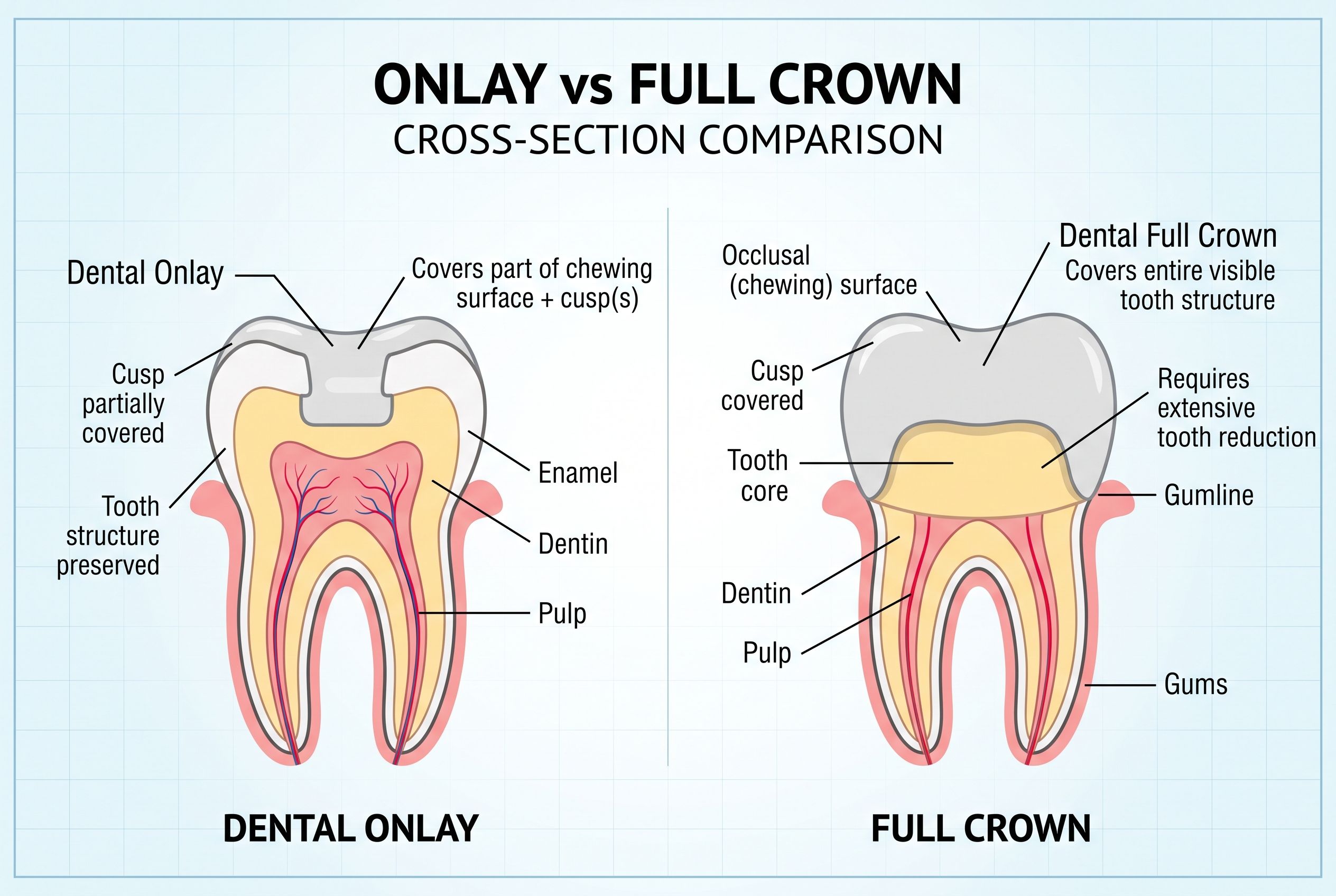
Dental Onlay
Covers part of the tooth and one or more cusps. May preserve more healthy tooth structure when the tooth is suitable for a partial restoration.
Dental Crown
Covers the full visible portion of the tooth from the gumline up. Provides stronger protection when the tooth is severely damaged or weakened.
Neither Is Always Better
The right option depends on the condition of the tooth — not a preference or a cost choice. A dental exam determines what the tooth can safely support.
How the Decision Is Made
Exam findings and X-rays guide the recommendation — the amount of remaining tooth structure, any crack pattern, bite forces, and the size of the damage all matter.
What Is a Dental Onlay?
A dental onlay is a custom restoration used to repair a damaged part of a back tooth. Unlike a standard filling placed directly in the mouth, an onlay is fabricated outside the mouth — either in a dental lab or with digital milling technology — and then precisely bonded to the prepared tooth.
An onlay covers one or more cusps — the raised points of the tooth that handle biting and chewing force. Because of this, it is sometimes called a partial crown. It sits between a large filling and a full dental crown in terms of coverage and preparation.
Onlays are commonly made from ceramic or porcelain for a natural appearance and good durability, though other materials may also be used depending on the case. Each onlay is custom-made to fit the prepared tooth, support the bite, and protect the damaged area.
FILLING
Repairs within the chewing surface only. No cusp coverage.
ONLAY
Covers chewing surface and one or more cusps. Partial coverage.
CROWN
Covers the full visible tooth from the gumline up. Full coverage.
Onlay vs Crown: The Core Difference
The main difference between a dental onlay and a dental crown is how much of the tooth each restoration covers — and how much natural tooth structure is removed to place it.
| Factor | Dental Onlay | Dental Crown |
|---|---|---|
| Coverage | Covers the damaged chewing surface and one or more cusps — partial coverage | Covers the full visible portion of the tooth from the gumline up |
| Tooth Preparation | Preserves more natural tooth structure when the tooth is suitable | Requires reshaping the tooth on all sides for full coverage |
| Best For | Moderate damage, large filling replacement, or fractured cusp when enough healthy tooth remains | Severe damage, extensive decay, little structure left, root canal-treated teeth, or heavy bite forces |
| Material | Often ceramic or porcelain — matched to tooth colour | Porcelain, zirconia, ceramic, or metal-based options depending on the case |
| Process | Exam, preparation, scan or impression, temporary if needed, and final bonded placement | Similar process with full crown preparation, temporary, and final cementation |
| Longevity | Can last many years with good care and regular monitoring at dental visits | Can also last many years — longevity depends on care, material, and bite forces |
IN SIMPLE TERMS
An onlay is more conservative when the tooth can support it. A crown is more protective when the tooth needs full coverage. The exam — not a preference — determines which option is appropriate for that specific tooth.
How Much Tooth Structure Each Option Removes
Preserving natural tooth structure matters because enamel and dentin do not regenerate once they are removed. For that reason, dentists try to use the most conservative restoration that can safely repair the tooth — not the most conservative option regardless of suitability.
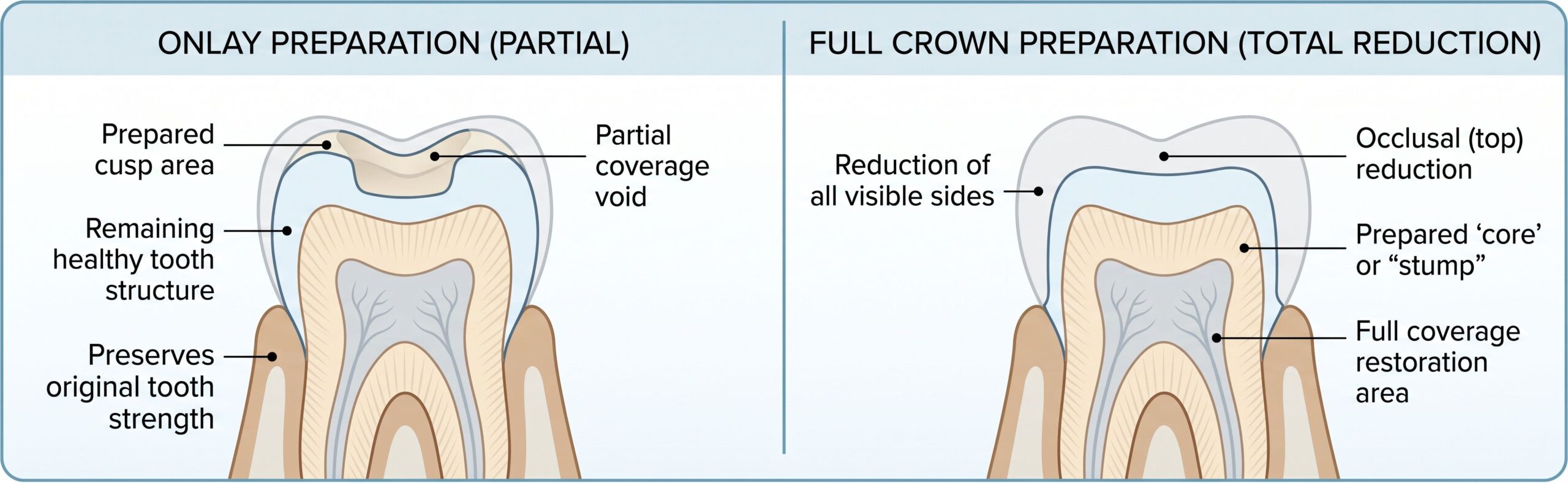
SUITABILITY DETERMINES WHICH IS CONSERVATIVE
An onlay only qualifies as the conservative option when the tooth can safely support it. If a tooth needs full coverage to remain functional and protected, a crown is the safer and more appropriate choice — placing a partial restoration on an unsuitable tooth is not conservative, it is under-treating the problem.
When an Onlay May Be the Better Choice
A dental onlay may be a good option when the tooth is too damaged for a filling but still has enough healthy structure to support a partial restoration safely.
Replacing a large old filling: If an old filling is cracked, worn, or has decay around its margins, an onlay may provide stronger support when enough healthy tooth structure remains.
Fractured cusp: If one cusp is damaged but the rest of the tooth is stable and solid, an onlay can cover and protect that specific area.
Moderate decay: If decay is too large for a filling but not extensive enough to require full crown coverage, an onlay may be a suitable middle option.
Tooth structure preservation: When the tooth is clinically suitable, an onlay can restore strength and function while preserving more natural tooth than a crown would require.
ONLAYS ARE OFTEN USED ON PREMOLARS AND MOLARS
These back teeth handle heavy chewing forces and are common sites for large fillings or cusp fractures. A restorative dental exam confirms whether the remaining tooth is solid enough to support an onlay or whether a crown is the safer option.
When a Crown Is Necessary Instead
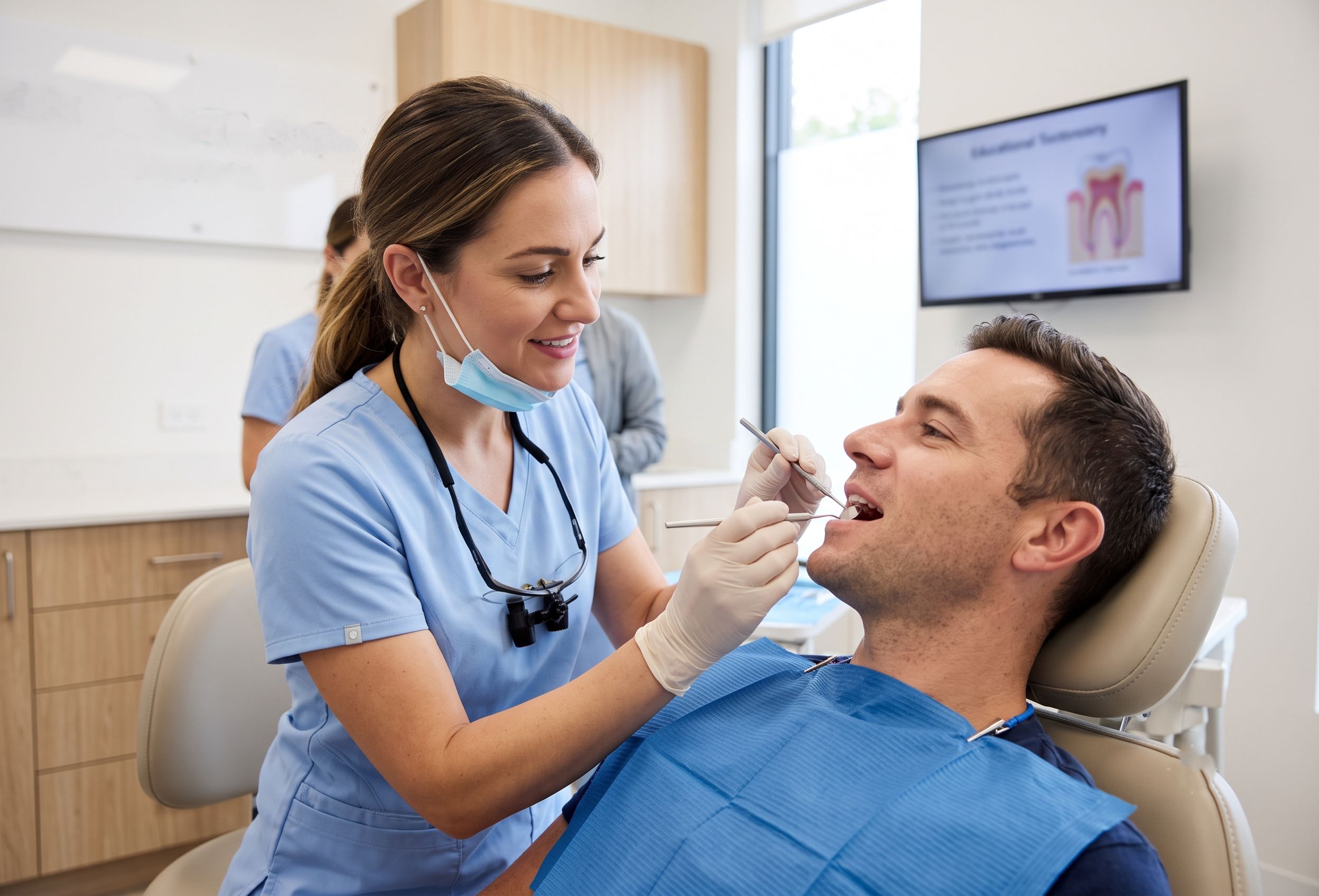
A dental crown may be the better choice when the tooth is too damaged or weakened for an onlay to hold safely and reliably long-term. Full coverage helps protect the remaining structure and reduces the risk of further breakdown or fracture.
Severe decay: When decay affects multiple walls or most of the chewing surface, an onlay may not provide enough coverage to restore the tooth reliably.
Major cracks or fractures: When the crack pattern or extent of fracture means full coverage is needed to help protect the remaining tooth from further splitting.
Very little tooth structure left: When the remaining tooth is too fragile to hold a partial restoration — a crown provides full support and protection.
Root canal-treated teeth: These teeth are typically more brittle and often need the additional structural protection that a full crown provides.
Heavy bite forces or grinding: When a patient clenches or grinds heavily, a crown may provide more durable protection than a partial restoration over time.
Repeated restoration failure: When the same tooth has had multiple failed fillings or restorations, a crown may provide a more stable and lasting solution.
SEVERE PAIN, SWELLING, OR A BROKEN TOOTH
If deep decay is close to the nerve, a root canal evaluation may be needed before the final restoration type is chosen. If you have severe pain, swelling, or a visibly broken tooth, schedule a dental evaluation promptly rather than waiting.
How Long Do Onlays and Crowns Last?
Both dental onlays and crowns can last for many years with proper care, but neither has a guaranteed lifespan. Longevity depends on several factors that vary between patients and teeth.
The material used — ceramic, porcelain, zirconia, or other
Bite forces, grinding, or clenching habits
Oral hygiene and plaque control around the margins
Tooth location — back molars handle heavier chewing pressure
Cavity risk and overall dental health
Regular dental checkups to monitor the restoration over time
IF YOU GRIND OR CLENCH YOUR TEETH
A custom night guard may help protect both the restoration and the natural tooth structure underneath. This is worth discussing with your dentist when planning either an onlay or a crown — grinding significantly increases wear and the risk of restoration failure over time.
What to Expect at Each Appointment
Whether the recommended treatment is an onlay or a crown, the clinical process follows a similar path. Knowing what to expect can make the appointments feel less uncertain.
EXAM & X-RAYS
The dentist checks the damaged tooth, any existing restorations, extent of decay, crack pattern, and remaining healthy tooth structure to guide the treatment decision.
TREATMENT DISCUSSION
Based on exam findings, the dentist explains whether a filling, onlay, crown, root canal, or another option is appropriate — and why.
TOOTH PREPARATION
Damaged or decayed tissue is removed. An onlay preparation preserves more healthy tooth structure; a crown preparation reshapes the full tooth on all sides.
IMPRESSION OR DIGITAL SCAN
A scan or impression is taken so the custom restoration — onlay or crown — can be precisely fabricated to fit the tooth and support the bite.
TEMPORARY RESTORATION IF NEEDED
A temporary onlay or crown may protect the prepared tooth while the final restoration is being made at the lab or milled digitally.
FINAL PLACEMENT
The restoration is checked for fit, bite alignment, and appearance, then bonded or cemented in place. Adjustments are made at the appointment if needed.
Frequently Asked Questions
Is an onlay better than a crown?
How long does a dental onlay last?
Is an onlay cheaper than a crown?
Can an onlay replace a crown?
What is the difference between an inlay and an onlay?
An inlay fits within the chewing surface of the tooth, between the cusps — it does not cover any cusp. An onlay extends further and covers one or more cusps. A crown covers the full visible portion of the tooth from the gumline up.
The Best Restoration Is the One That Fits the Tooth
When comparing onlay vs crown, the decision is not based on preference or cost alone — it depends on what the damaged tooth can safely support after a proper exam. An onlay can be a useful conservative option when the tooth has moderate damage and enough healthy structure remaining. A crown is the better choice when the tooth is too weakened, cracked, or decayed for a partial restoration. Toothology at 42A Broadway in Williamsburg can evaluate your damaged tooth and explain which option is clinically appropriate.
DAMAGED OR WEAKENED TOOTH?
Book a restorative consultation at Toothology in Williamsburg — we’ll examine the tooth and explain whether a filling, onlay, crown, or another option is the right fit.
DIRECT LINE
IN THIS GUIDE
QUICK REFERENCE
ONLAY MAY BE SUITABLE WHEN
CROWN MAY BE NEEDED WHEN
Only a dental exam can confirm which option is right for the tooth.
TOOTHOLOGY DENTAL
Williamsburg, Brooklyn, NY
Serving Greenpoint, Bushwick, Bed-Stuy & Downtown Brooklyn
718-678-3800
Emergency line available
Open Hours
Mon – Thu: 10:00 AM – 6:00 PM Friday: 10:00 AM – 2:00 PM Sunday: 10:00 AM – 2:00 PM Saturday: Closed
OUR COMMITMENT
- Board-Certified Pediatric Dentists
- Child-Friendly, Anxiety-Reducing Care
- Same-Day Emergency Slots
- Low-Radiation Digital X-Rays
- Most Major Insurance Accepted