
- Adult Orthodontic Guide · Williamsburg Brooklyn
Both options can straighten teeth, but they work differently — and the right choice depends on your specific alignment needs, lifestyle, and how closely you can follow the treatment plan.
Invisalign vs Braces for Adults: Cost, Treatment Time, and Results
For adults considering orthodontic treatment, Invisalign and traditional braces both offer effective results — but they work differently, suit different cases, and affect daily life in different ways. The right choice depends on the type and complexity of your alignment or bite problem, your lifestyle, and how consistently you can follow the treatment plan.
INVISALIGN
Clear, removable aligners — discreet and convenient, but require consistent daily wear of around 20–22 hours
BRACES
Fixed brackets and wires — no wear compliance needed, effective for a broad range of cases
AT TOOTHOLOGY
We offer Invisalign clear aligners. This comparison helps adults understand the differences before a consultation
BOTTOM LINE
Neither is automatically better for every adult — the right choice depends on your specific clinical situation
Invisalign vs Braces: Full Comparison
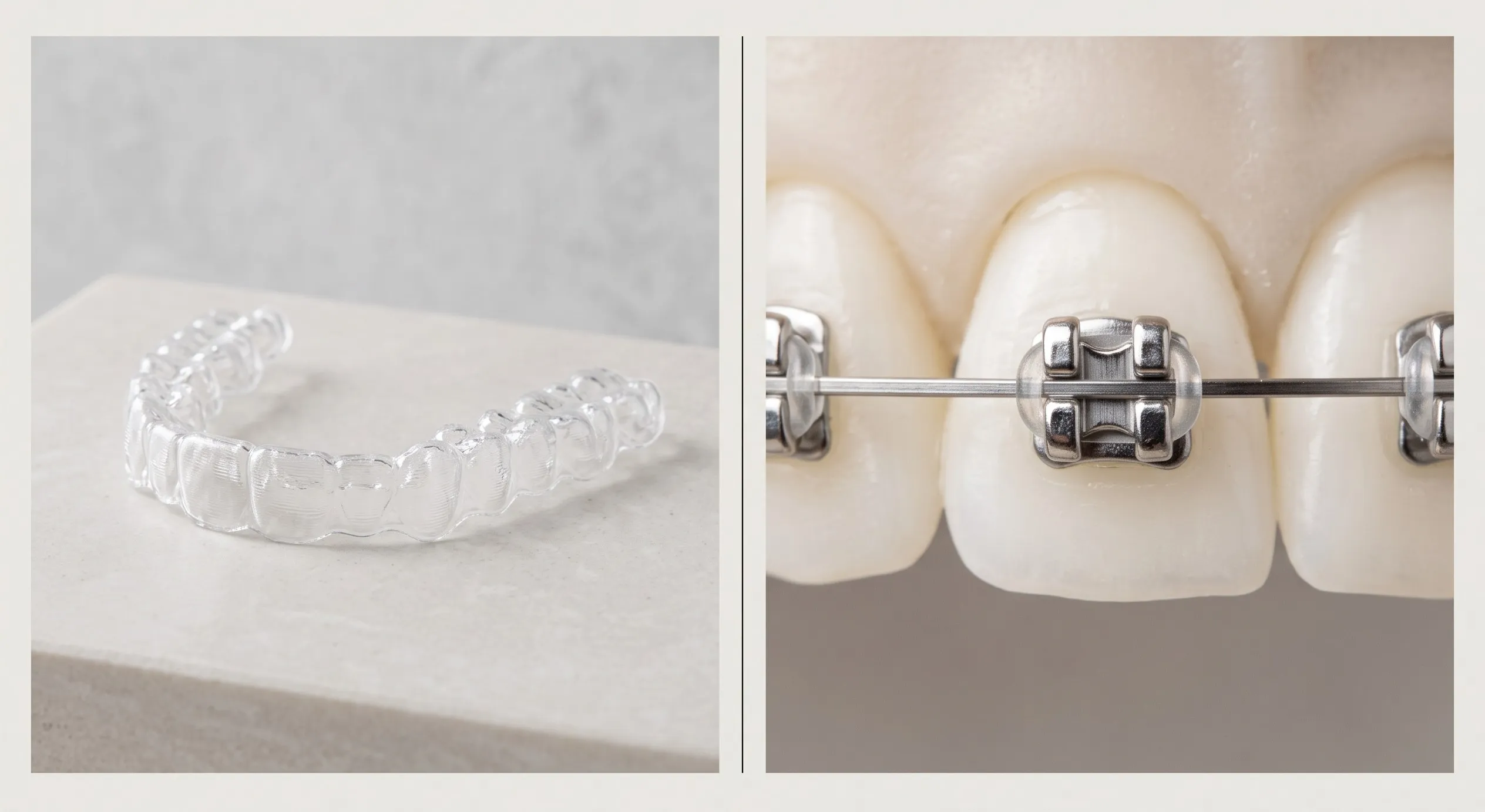
The table below compares both options across eight key factors. This is a starting point — a clinical evaluation is needed to determine which option is more appropriate for your specific case.
| Factor | Invisalign / Clear Aligners | Traditional Braces |
|---|---|---|
| Visibility | Clear trays; tooth-colored attachments may still be noticeable | Brackets and wires are visible; ceramic options may be less noticeable |
| Removability | Removable for meals and oral hygiene | Fixed during active treatment |
| Eating | No appliance-related food restrictions while trays are removed | Hard or sticky foods may need to be limited during treatment |
| Hygiene | Easier brushing and flossing, but trays and teeth must both be cleaned regularly | Requires more careful cleaning around brackets and wires; may need additional tools |
| Compliance | Requires consistent wear, usually around 20–22 hours per day | No aligner-wear compliance — the appliance stays fixed |
| Case Suitability | Suitable for many adult cases, depending on diagnosis and complexity | Can treat a broad range of orthodontic problems, including complex cases |
| Results | Can produce effective results in suitable cases when aligners are worn as directed | Can produce effective results across a broad range of orthodontic cases |
| Retention | Retainers typically needed after treatment to maintain tooth positions | Retainers typically needed after treatment to maintain tooth positions |
Cost Compared: What Adults in Brooklyn Can Expect
INVISALIGN AT TOOTHOLOGY — TYPICAL SELF-PAY RANGE
$4,000 – $7,000
Depending on case complexity and treatment needs. Your exact cost is determined after an evaluation and personalized treatment plan.
The cost of Invisalign versus braces varies based on case complexity, treatment length, provider, insurance benefits, and whether refinements or replacement appliances are needed. Toothology currently offers Invisalign clear aligners rather than traditional braces. Braces are included here for comparison, but their cost varies by provider, appliance type, and treatment complexity.
Factors that may affect your Invisalign cost include:
- Case complexity and bite correction required
- Number of aligners or adjustment visits
- Refinement trays if needed during treatment
- Lost or damaged aligners that need replacement
- Total treatment length
CARECREDIT
Healthcare financing for qualified applicants — pay over time with promotional periods.
CHERRY FINANCING
Another financing option for qualified applicants, with flexible payment plans.
IN-HOUSE PLANS
In-house payment plans available for select treatments. Ask about options at your consultation.
Some dental plans include adult orthodontic benefits, often subject to a lifetime maximum, waiting periods, and network rules. Verify coverage directly with your insurer before scheduling. Toothology can review how your benefits may apply at your consultation.
Treatment Time: How Long Does Each Take?

Neither Invisalign nor braces is consistently faster. Treatment time depends much more on the complexity of your case, the tooth movements required, and how closely you follow the plan. At Toothology, most Invisalign cases take approximately 6–14 months, although individual treatment may be shorter or longer.
Severity of misalignment: Mild crowding or spacing may take less time than complex bite correction or significant rotations.
Type of tooth movement: Some movements naturally require more time, regardless of the appliance used.
Adult tooth movement: Orthodontic movement can be slower in adults than in younger patients.
Compliance: Invisalign only works effectively when aligners are worn as directed — around 20–22 hours per day. Missing wear time can extend treatment.
Refinements or complications: Additional aligners, repairs, or treatment adjustments may extend the timeline for either option.
THE MOST ACCURATE TIMELINE COMES FROM AN EVALUATION
Treatment duration estimates in guides are generalizations. Your actual timeline depends on your specific alignment, bite, and how your teeth respond to movement. A clinical evaluation at Toothology gives you a personalized estimate.
Comfort, Appearance, and Daily Life
For many adults, lifestyle factors are just as important as cost or treatment time. Here is how the two options compare across five everyday considerations.

APPEARANCE
Clear aligners are much less noticeable than metal braces. Tooth-coloured attachments may still be visible, but overall the option is considerably more discreet.
Metal braces are visible. Ceramic braces can be less obvious but are generally more noticeable than aligners.
EATING
Aligners are removed for meals — no food restrictions while eating. Trays must be cleaned before reinserting.
Fixed appliance stays in place — hard, sticky, or chewy foods may need to be limited throughout treatment.
HYGIENE
Brushing and flossing are easier because aligners come out. Both the trays and teeth must be kept clean throughout treatment.
Cleaning around brackets and wires requires more care and may need tools such as floss threaders or interdental brushes.
COMFORT
New aligner trays often feel tight for the first day or two as teeth begin to move. No brackets or wires against soft tissue.
Brackets or wires may occasionally irritate the cheeks or lips. Wax can help. Pressure from adjustments is similar to aligners.
DAILY MANAGEMENT
Aligners must be removed for eating and drinking (other than water), cleaned, and reinserted. Requires discipline to maintain 20–22 hours of daily wear.
No tray to remember — the appliance stays fixed. Oral hygiene and appointment attendance still require consistent effort.
Which Cases Suit Each Option
Invisalign can treat many adult alignment and bite concerns. Whether it is the right choice for you depends on the complexity of your specific case, the tooth movements required, and factors identified during a clinical evaluation.
- INVISALIGN OFTEN HANDLES
- Mild to moderate crowding or spacing
- Certain bite corrections (overbite, underbite, crossbite)
- Relapse after previous orthodontic treatment
- Many complex movements using attachments and elastics
- Cases where discretion and removability are priorities
- MAY REQUIRE FURTHER ASSESSMENT
- Severe rotations or significant vertical tooth movements
- Cases where consistent aligner wear may be difficult to maintain
- Complex bite problems requiring precise force control
- Existing restorations (crowns, bridges, implants) that may affect treatment planning
- Active gum disease or untreated decay — oral health must be addressed first regardless of option
SAME-LOOKING PROBLEMS CAN HAVE DIFFERENT REQUIREMENTS
Two adults with similar-looking crowding can have very different bite relationships and tooth-movement requirements. A clinical evaluation at Toothology helps determine whether clear aligners can predictably achieve your goals — or whether a different approach may be more appropriate for your case.
READY TO FIND OUT IF INVISALIGN IS RIGHT FOR YOU?
A clinical evaluation at Toothology can assess your alignment, bite, and treatment goals — and give you a personalized timeline and cost estimate. Toothology is located at 42A Broadway, Williamsburg, Brooklyn.
Frequently Asked Questions
Is Invisalign better than braces for adults?
Is Invisalign more expensive than braces?
Do braces work faster than Invisalign?
Can Invisalign fix the same problems as braces?
Which is better for crowding — Invisalign or braces?
Both can treat crowding. Invisalign is often suitable for mild to moderate cases. More severe crowding or complex bite problems may be better addressed with fixed braces, though Invisalign can also manage many complex cases using attachments and elastics. Your dentist can evaluate which approach suits your specific crowding pattern.
The Right Choice Depends on Your Specific Case
INVISALIGN CONSULTATION AT TOOTHOLOGY
Find out if Invisalign is right for your case. Evaluation, timeline estimate, and cost discussion included.
$4,000–$7,000
TYPICAL SELF-PAY RANGE
DIRECT LINE
IN THIS GUIDE
AT A GLANCE
INVISALIGN
BRACES
COST
TIMELINE
TOOTHOLOGY
TOOTHOLOGY DENTAL
Williamsburg, Brooklyn, NY
Serving Greenpoint, Bushwick, Bed-Stuy & Downtown Brooklyn
718-678-3800
Emergency line available
Open Hours
Mon – Thu: 10:00 AM – 6:00 PM Friday: 10:00 AM – 2:00 PM Sunday: 10:00 AM – 2:00 PM Saturday: Closed
OUR COMMITMENT
- Board-Certified Pediatric Dentists
- Child-Friendly, Anxiety-Reducing Care
- Same-Day Emergency Slots
- Low-Radiation Digital X-Rays
- Most Major Insurance Accepted