
- Patient Education Guide · Williamsburg Brooklyn
No universal schedule applies to every patient. How often dental X-rays are recommended depends on your oral health, cavity risk, symptoms, and whether recent images are already available.
Dental X-Rays in Brooklyn: How Often Do You Really Need Them?
Do you really need dental X-rays at every visit? Are they safe? These are reasonable questions. There is no single schedule that applies to every patient. How often dental X-rays are recommended depends on your age, oral health history, cavity risk, gum health, symptoms, and whether recent usable images are already available. X-rays help dentists see what a visual exam cannot always show — and they are used to support diagnosis, not as an automatic step at every appointment.
Dental X-Rays at a Glance
How Often
Depends on oral health, symptoms, cavity risk, history, and whether recent usable images are already available — not a fixed schedule.
Why Dentists Take Them
To check for cavities between teeth, bone loss, infections, impacted teeth, and hidden issues a visual exam cannot fully see.
Safety
Dental X-rays use low radiation and should be recommended when they provide useful diagnostic information — following the ALARA principle.
Digital X-Rays
Faster, easier to store and share, and often lower in radiation than older film methods. Toothology uses digital imaging for all X-rays.
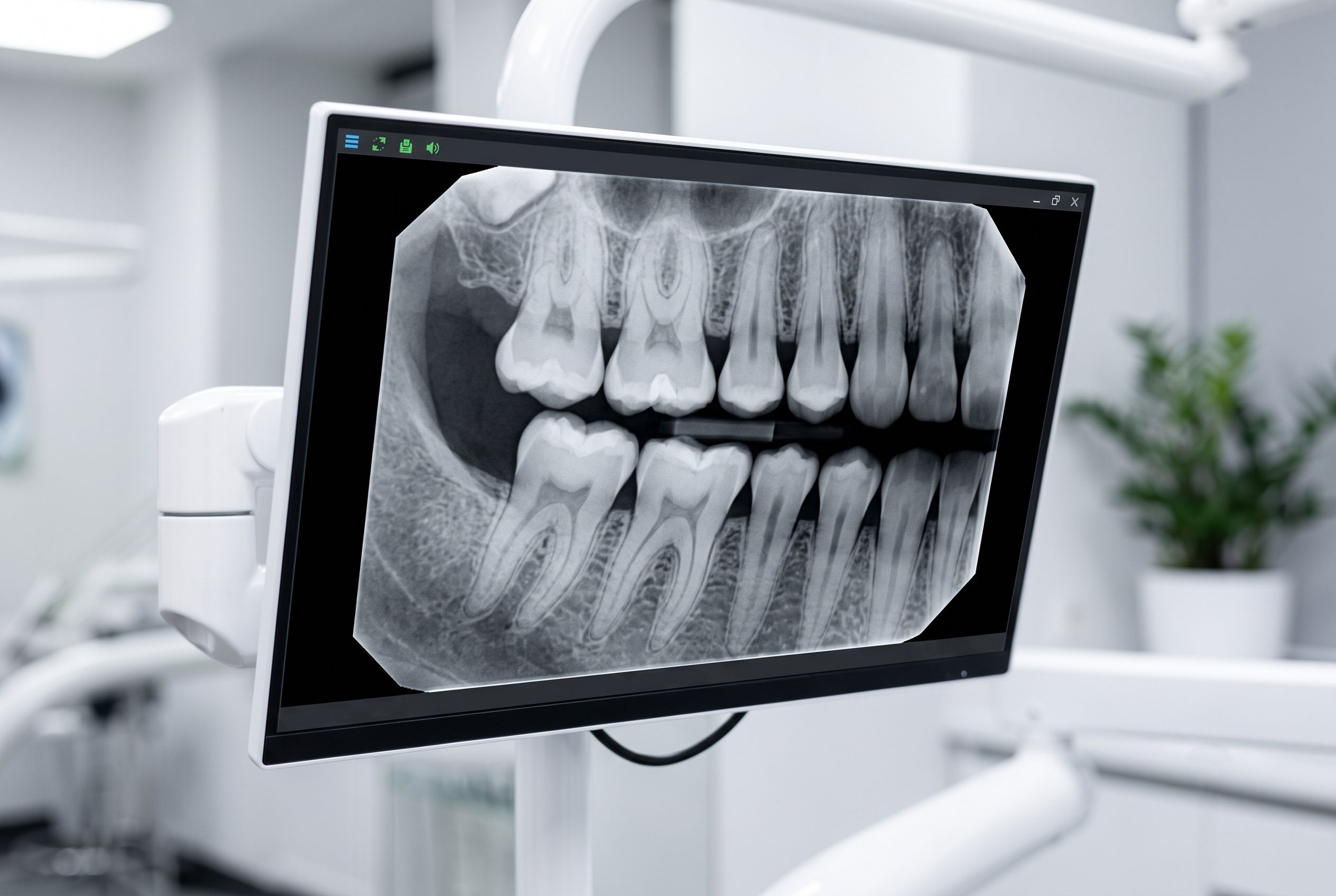
BRINGING RECENT X-RAYS FROM ANOTHER OFFICE
If you are visiting Toothology for the first time, bring or send any recent dental X-rays from your previous dental office. If they are current and clear, they may reduce or eliminate the need for new images at your first visit.
Why Dentists Take Dental X-Rays
A dental exam and a dental X-ray work together, but they do different things. During the exam, the dentist checks what can be seen directly — your gums, visible tooth surfaces, bite, soft tissue, and jaw function. X-rays show what cannot be fully seen from a visual exam alone.
Cavity Detection
Finding small cavities between teeth before they become larger — earlier detection usually means simpler, more conservative treatment.
Bone Level Monitoring
Checking for bone loss around tooth roots related to gum disease — bone changes are invisible to a visual exam.
Tooth Infections
Identifying infection or abscesses near the tooth root — often present without obvious visible signs.
Development & Eruption
Checking how children's permanent teeth or wisdom teeth are developing and whether intervention may be needed.
Treatment Planning
Supporting care such as extractions, root canals, implants, or orthodontic treatment — where spatial detail matters.
Hidden Problems
Detecting issues beneath crowns, fillings, or existing dental work that cannot be evaluated by surface examination alone.
X-RAYS SUPPORT THE EXAM — THEY DON'T REPLACE IT
X-ray findings are reviewed alongside your symptoms, dental history, and exam results. An X-ray showing a finding the dentist cannot confirm clinically still leads to a careful, considered approach — not automatic treatment.
How Often Do Most Patients Need Dental X-Rays?
Two patients at the same practice may receive different X-ray recommendations. One may need bitewing X-rays; another may not. The decision is based on individual clinical need — not a default time-based schedule.
| Patient Situation | What Imaging May Look Like |
|---|---|
|
🆕
New Patient — No Recent X-Rays
|
Baseline images may be needed if no current, clear records are available from a previous dental office |
|
✅
Low-Risk Adult — Stable, No Symptoms, Recent Usable Images
|
X-rays may be needed less often when recent images are usable and no new symptoms or concerns are present |
|
⚠️
Higher Cavity Risk or History of Frequent Decay
|
Bitewing X-rays may be recommended more often to monitor for new decay between appointments |
|
📉
Gum Disease or Bone Loss History
|
X-rays may help monitor bone levels and periodontal changes over time |
|
🔍
Pain, Swelling, Trauma, or Suspected Infection
|
Targeted diagnostic X-rays may be needed to find the cause — regardless of when the last ones were taken |
|
🧒
Children and Teens
|
Timing depends on age, tooth development, cavity risk, and exam findings — not an automatic schedule |
Are Dental X-Rays Safe?
Yes. Dental X-rays are generally safe when taken for a clear clinical reason. Modern digital dental X-rays use low radiation exposure, and dentists aim to keep that exposure as low as reasonably possible.
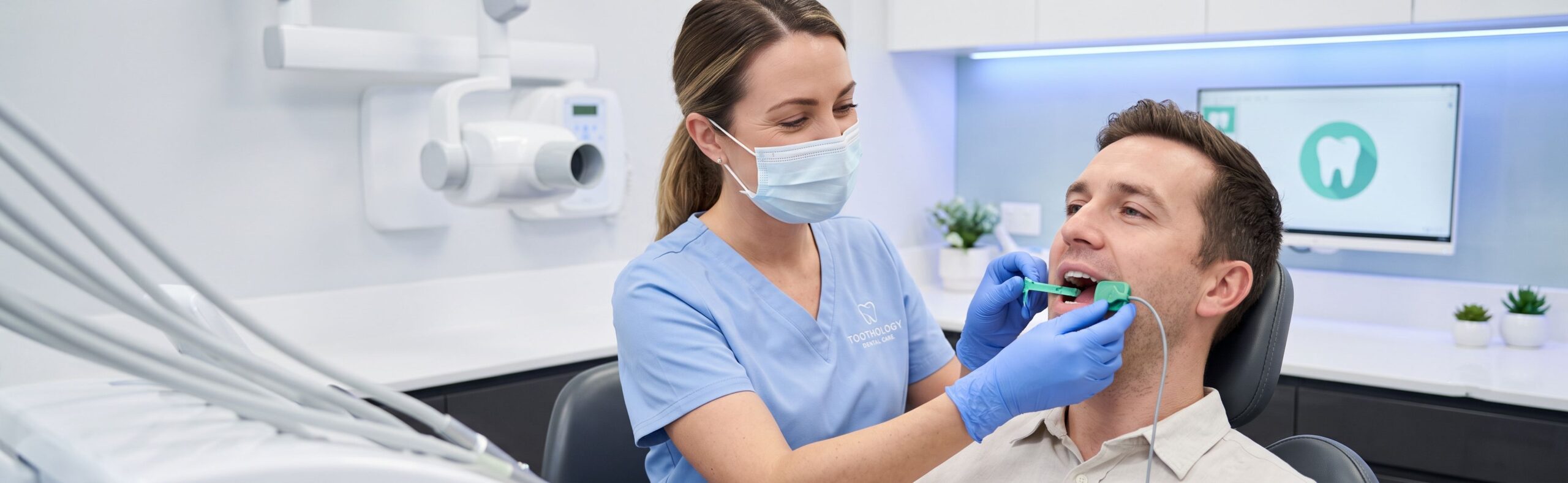
ALARA
“As Low As Reasonably Achievable” — the guiding principle for dental radiation
IF YOU ARE PREGNANT OR MAY BE PREGNANT
Let the dental team know before any X-rays are taken. The dentist can review your situation, discuss whether imaging is clinically necessary, and follow appropriate safety guidance for your care.
Digital X-Rays vs Traditional Film X-Rays
Digital dental X-rays are used at Toothology because they offer practical benefits for both patients and dentists. Even so, the same clinical judgment applies — X-rays should still be taken only when they are clinically needed, regardless of the technology.
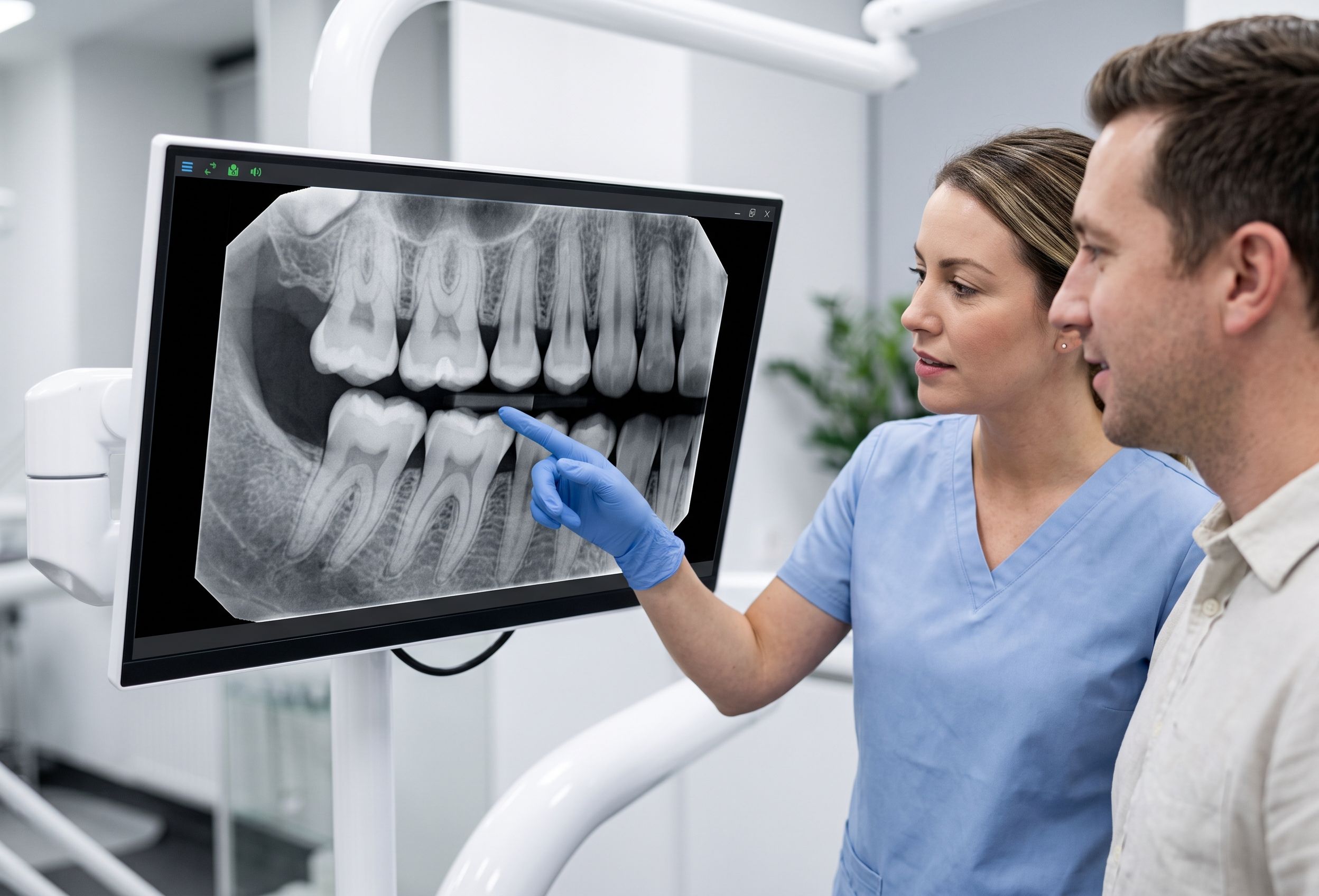
- Digital X-Rays
- Often lower radiation than traditional film
- Images appear on-screen immediately for review
- No chemical processing or film developing
- Easy to store in the patient record and share when needed
- Can be zoomed, enhanced, and contrast-adjusted
- Traditional Film X-Rays
- Higher radiation exposure compared with digital
- Require chemical processing before viewing
- Physical film storage, harder to transfer between offices
- Cannot be digitally enhanced after processing
- Less common in modern practices
What Factors Affect X-Ray Frequency?
Dentists recommend X-rays based on your current oral health, history, symptoms, and exam findings — not a default schedule. These are the factors that most commonly influence the recommendation.
Age and development:
Cavity risk:
Gum health:
Symptoms:
Existing dental work:
Orthodontic treatment:
Recent X-rays from another office:
General health:
Do Children Need Dental X-Rays?
Children may need dental X-rays, but not at every visit and not always the same type. A dentist recommends imaging only when it helps evaluate a child’s current dental health, symptoms, or development.
Children may need X-rays to check for:
Cavities between baby teeth that cannot be seen during a visual exam
Permanent teeth developing beneath the gumline
Spacing, crowding, or bite alignment concerns
Wisdom teeth development in older teens
Pain, swelling, trauma, or unexplained sensitivity in a specific tooth
PARENTS CAN ALWAYS ASK WHY AN X-RAY IS RECOMMENDED
For any recommended X-ray for a child, the dentist should be able to explain what they are looking for and how the image will guide the child’s care. Digital imaging for children uses low exposure, and the decision should always be based on clinical need.
Can You Refuse Dental X-Rays?
Yes. Patients can ask questions about any recommended X-ray and may choose to decline. It is important to understand, however, that refusing X-rays can limit what the dentist is able to diagnose — cavities between teeth, bone loss, infection, and root issues are often invisible without imaging.
If you have concerns, the goal is shared decision-making. Ask what the X-ray is expected to show and how it may affect your care. Practical options include:
Send recent X-rays from another office. Current, clear images may reduce or eliminate the need for new ones — bring them or ask your previous office to send them before your visit.
Delay non-urgent imaging. If the X-ray is for routine monitoring with no current symptoms, the dentist may agree to reassess at a future visit.
Take only the specific images needed. Instead of a full series, the dentist may recommend only the images required for a particular concern or symptom.
Frequently Asked Questions
How often should you get dental X-rays?
Are dental X-rays safe?
Do dental X-rays show cavities?
Are digital dental X-rays better than film?
Do new dental patients need X-rays?
Often, but not always. New patients may need baseline X-rays if recent images are not available, or if symptoms, dental history, or exam findings require them. If you have recent X-rays from another dental office, bring them or have them sent to Toothology before your visit — they may reduce the need for new ones.
X-Rays When You Need Them — Not by Default
Dental X-rays are a useful diagnostic tool when they provide information your dentist cannot get from a visual exam alone. At Toothology, X-rays are recommended based on your individual symptoms, dental history, oral health, and whether recent usable images are already available — not an automatic protocol. If you are due for a routine dental exam in Brooklyn or visiting as a new patient, bring or send any recent X-rays from your previous office before your appointment.
BOOK A COMPREHENSIVE DENTAL EXAM
New to Toothology? Bring or send your recent X-rays before your visit — they may reduce the need for new images.
DIRECT LINE
IN THIS GUIDE
WHAT X-RAYS CAN SHOW
X-rays are used to support diagnosis — not as an automatic step at every visit.
TOOTHOLOGY DENTAL
Williamsburg, Brooklyn, NY
Serving Greenpoint, Bushwick, Bed-Stuy & Downtown Brooklyn
718-678-3800
Emergency line available
Open Hours
Mon – Thu: 10:00 AM – 6:00 PM Friday: 10:00 AM – 2:00 PM Sunday: 10:00 AM – 2:00 PM Saturday: Closed
OUR COMMITMENT
- Board-Certified Pediatric Dentists
- Child-Friendly, Anxiety-Reducing Care
- Same-Day Emergency Slots
- Low-Radiation Digital X-Rays
- Most Major Insurance Accepted