
- Periodontal Health Guide · Williamsburg Brooklyn
If one tooth looks longer than the surrounding teeth or a yellowish root surface is becoming visible near the gumline, the gum around that tooth may be receding — and it is worth identifying the cause early.
Receding Gum on One Tooth: Causes, Risks, and Treatment Options
A receding gum on one tooth can have several causes — not all of them related to gum disease. Even if the area is not currently painful or sensitive, localized gum recession is worth having evaluated so the underlying cause can be identified, further root exposure can be monitored, and appropriate care can be recommended before the situation progresses.
Why Gum Can Recede Around One Tooth
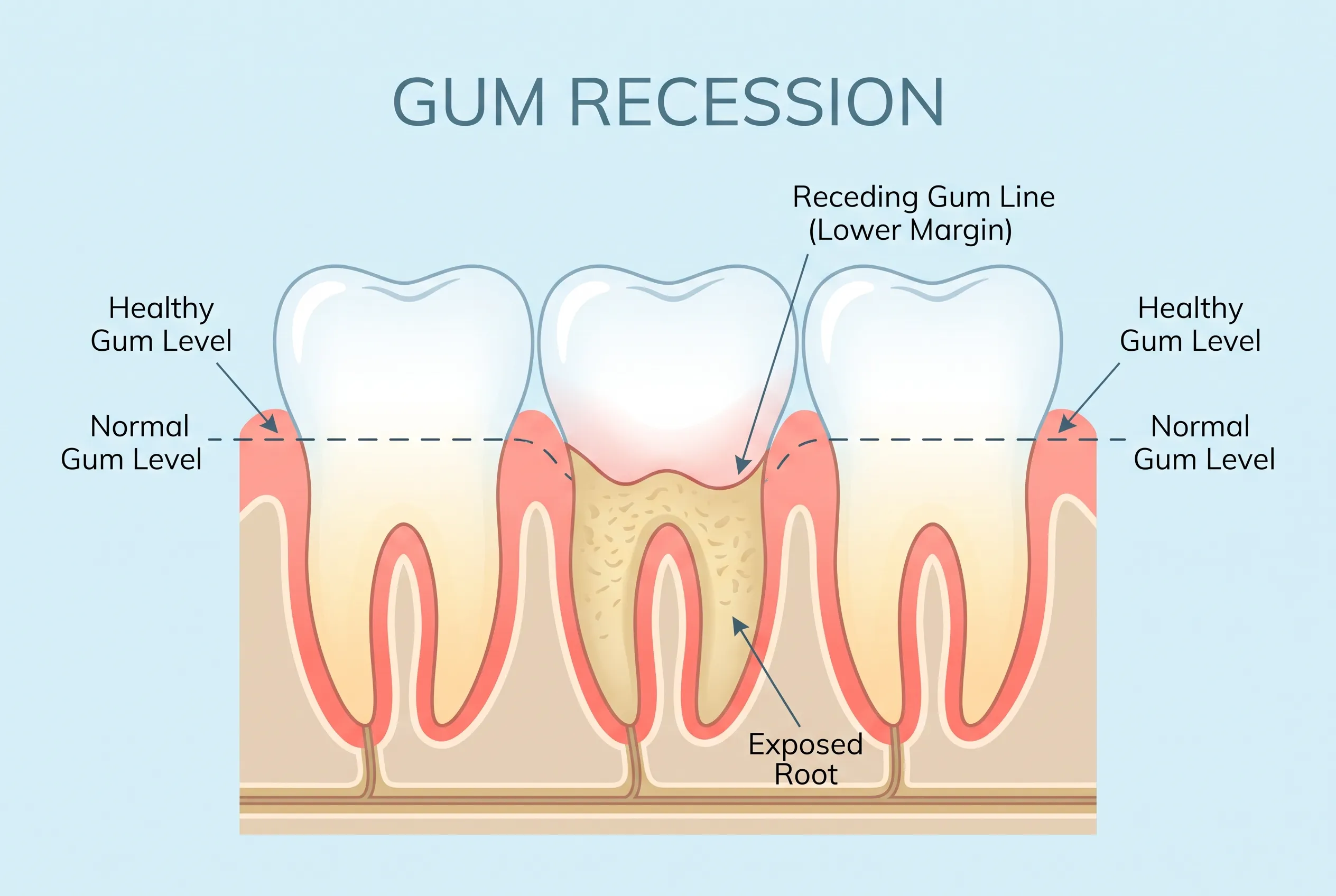
Localized gum recession means the gum has moved away from one specific tooth, exposing more of the tooth or its root. This can happen even when the gums around nearby teeth look healthy. One tooth may be more affected because of differences in local anatomy, tooth position, or site-specific forces.
As the gum margin moves toward the root, more of the tooth becomes visible — which is why a tooth with recession often appears longer than its neighbours. Because the cause can differ from one tooth to another, a dental evaluation helps determine whether the recession is stable or likely to progress.
Common Causes of Localized Gum Recession
PLAQUE INFLAMMATION OR PERIODONTAL DISEASE
Plaque and tartar buildup around one tooth can cause persistent inflammation. If this continues, the gum may pull away from the tooth and, in more advanced cases, the supporting bone may also be affected.
Not every receding gum is caused by periodontitis, but gum disease is one possibility a dentist will specifically check for during the evaluation.
BRUSHING TRAUMA OR HEAVY PRESSURE
Repeated heavy brushing, hard bristles, or excessive pressure on one area can contribute to gumline injury, especially where the tissue is naturally thin.
Brushing is not the cause of every recession site, but it can be a contributing factor in susceptible areas — particularly alongside the outer surfaces of premolars and canines.
THIN GUM TISSUE OR LOCAL ANATOMY
Some teeth naturally have thinner gum tissue or less bone covering the outer surface of the root. These areas may be more vulnerable to recession even with normal daily forces. Individual anatomy, including root shape and muscle attachment, can also influence how well the gum margin is supported.
TOOTH POSITION OR CROWDING
A tooth that sits farther toward the lip or cheek side of the dental arch may have thinner bone and gum tissue around it. Crowding can create similar site-specific vulnerabilities.
Tooth position does not always cause recession, but it can increase the risk in some cases — particularly when combined with thin tissue or brushing pressure.
ORTHODONTIC MOVEMENT OR PRIOR TOOTH MOVEMENT
Previous orthodontic movement may affect gum thickness or bone coverage around a tooth, depending on the direction of movement and the tissue anatomy at that site.
Orthodontic treatment does not automatically cause recession, but prior tooth movement can be relevant when evaluating a localized recession area.
LOCAL TRAUMA OR RESTORATION-RELATED IRRITATION
A filling, crown, or other restoration that does not fit well near the gumline can make plaque harder to remove and contribute to local irritation. Other possible contributors include trauma, ill-fitting appliances, or repeated mechanical irritation in the same area.
Can Receding Gums Grow Back?
In most cases, gum tissue that has truly receded does not grow back to its original position on its own. It is also important to distinguish recession from gingivitis — inflamed gums can improve with treatment, but that is different from replacing gum tissue that has already been lost.
- TISSUE LOSS ITSELF
Gum tissue that has genuinely receded typically does not regenerate on its own. Once the margin has moved and root is exposed, that position is generally permanent without intervention.
- WHAT TREATMENT CAN DO
Treating the underlying cause — plaque control, brushing technique, periodontal care — can help stop or slow further recession. In selected cases, a gum graft or root-coverage procedure may be an option.
GUM GRAFTING IS NOT SUITABLE FOR EVERY CASE
Root-coverage procedures are not appropriate for all recession sites. Results depend on the amount of recession, tissue thickness, bone support, and individual healing. A periodontal evaluation helps determine whether grafting is worth considering and what outcome is realistic.
What Are the Risks of Recession on One Tooth?
A receding gum does not mean the tooth is about to be lost, but exposed root surfaces can create several real problems that are worth addressing before they worsen.
Tooth sensitivity: Exposed dentin can make the tooth more sensitive to cold, touch, brushing, and certain foods — sometimes significantly so.
Root-surface decay: The exposed root is more vulnerable to cavities than enamel-covered tooth surfaces. This risk increases when oral hygiene around that area is compromised.
Further recession: If the underlying cause continues unchecked, the gumline may recede further over time — making the situation progressively more difficult to manage.
Aesthetic changes: The tooth may look visibly longer or the gumline may appear uneven compared to adjacent teeth.
Loss of periodontal support: If recession is related to active gum disease, the supporting bone and connective tissue may also be affected — extending beyond just the visible gum margin.
SURFACE GUM CHANGE OR DEEPER PROBLEM?
A dental exam can help determine whether the recession is mainly a surface-level gum change or part of a deeper periodontal condition affecting the supporting bone and tissues. The distinction changes the treatment approach.
Treatment Options Based on the Exam Findings
Treatment for a receding gum on one tooth depends on the cause, the amount of root exposure, and whether the recession is stable or progressing. The table below covers the most common findings and the treatment directions they may lead to.
| If the Exam Finds… | Treatment May Include… |
|---|---|
| Brushing-Related Irritation | A softer toothbrush, less pressure, and gentler brushing technique — with reassessment to monitor the site |
| Exposed Root with Sensitivity | Desensitizing toothpaste, fluoride varnish, or other protective measures applied at the exposed root surface |
| Plaque Buildup or Gingivitis | Professional cleaning and improved home care around the affected tooth and nearby gumline |
| Periodontal Disease | Periodontal treatment such as scaling and root planing, followed by ongoing maintenance appointments |
| Defective or Irritating Restoration | Adjustment or replacement of the restoration to eliminate the local irritant and improve cleanability |
| Stable, Mild Recession | Monitoring with periodic gumline measurements to confirm the recession is not progressing |
| Progressive Recession, Thin Tissue, or Significant Root Exposure | Periodontal evaluation to determine whether gum grafting or another root-coverage procedure may be appropriate |
When to See a Dentist or Periodontist
It is best to have localized gum recession evaluated when you first notice a change — rather than waiting for significant sensitivity or root exposure to develop. Early assessment usually means simpler management.

Schedule a dental exam if any of the following apply:
SEEK PROMPT DENTAL ATTENTION IF YOU NOTICE
Significant swelling, pus or drainage, severe pain, or a loose tooth near the receded area — these may indicate a separate dental problem that needs urgent evaluation rather than a routine appointment.
What the Dentist Checks During the Evaluation
WHEN A PERIODONTIST REFERRAL MAY BE RECOMMENDED
A referral to a periodontist may be appropriate if the recession is progressing, the periodontal condition is complex, or gum grafting or root-coverage treatment is being considered. Your Toothology dentist can advise whether a specialist evaluation is the right next step for your case.
Frequently Asked Questions
Why is my gum receding on one tooth?
Can one receding gum be fixed?
Is gum recession on one tooth serious?
Can brushing too hard cause gum recession?
When do you need a gum graft?
A gum graft may be considered when recession is progressing, causing significant sensitivity, exposing a significant amount of root, or leaving very thin remaining tissue at risk. If periodontal disease is also present, it must be controlled before a grafting procedure is appropriate. A periodontal evaluation is the right starting point.
Get the Cause Identified Before It Progresses
GUM RECEDING AROUND ONE TOOTH?
Early evaluation helps identify the cause and prevent further recession. Toothology can assess whether the change needs monitoring, treatment, or specialist referral.
IN THIS GUIDE
6 POSSIBLE CAUSES
Cause can differ from tooth to tooth — an exam is needed to identify the specific reason.
TOOTHOLOGY DENTAL
Williamsburg, Brooklyn, NY
Serving Greenpoint, Bushwick, Bed-Stuy & Downtown Brooklyn
718-678-3800
Emergency line available
Open Hours
Mon – Thu: 10:00 AM – 6:00 PM Friday: 10:00 AM – 2:00 PM Sunday: 10:00 AM – 2:00 PM Saturday: Closed
OUR COMMITMENT
- Board-Certified Pediatric Dentists
- Child-Friendly, Anxiety-Reducing Care
- Same-Day Emergency Slots
- Low-Radiation Digital X-Rays
- Most Major Insurance Accepted