
- Pediatric Guide · Williamsburg Brooklyn
When a permanent tooth erupts behind a baby tooth that hasn’t come out yet, it’s called ectopic eruption — or, more memorably, “shark teeth.” Here’s how to tell whether it’s a normal part of development or something that needs a dentist visit.
Shark Teeth in Kids: What It Means, When to Watch, and When to Call the Dentist
What Are "Shark Teeth"?
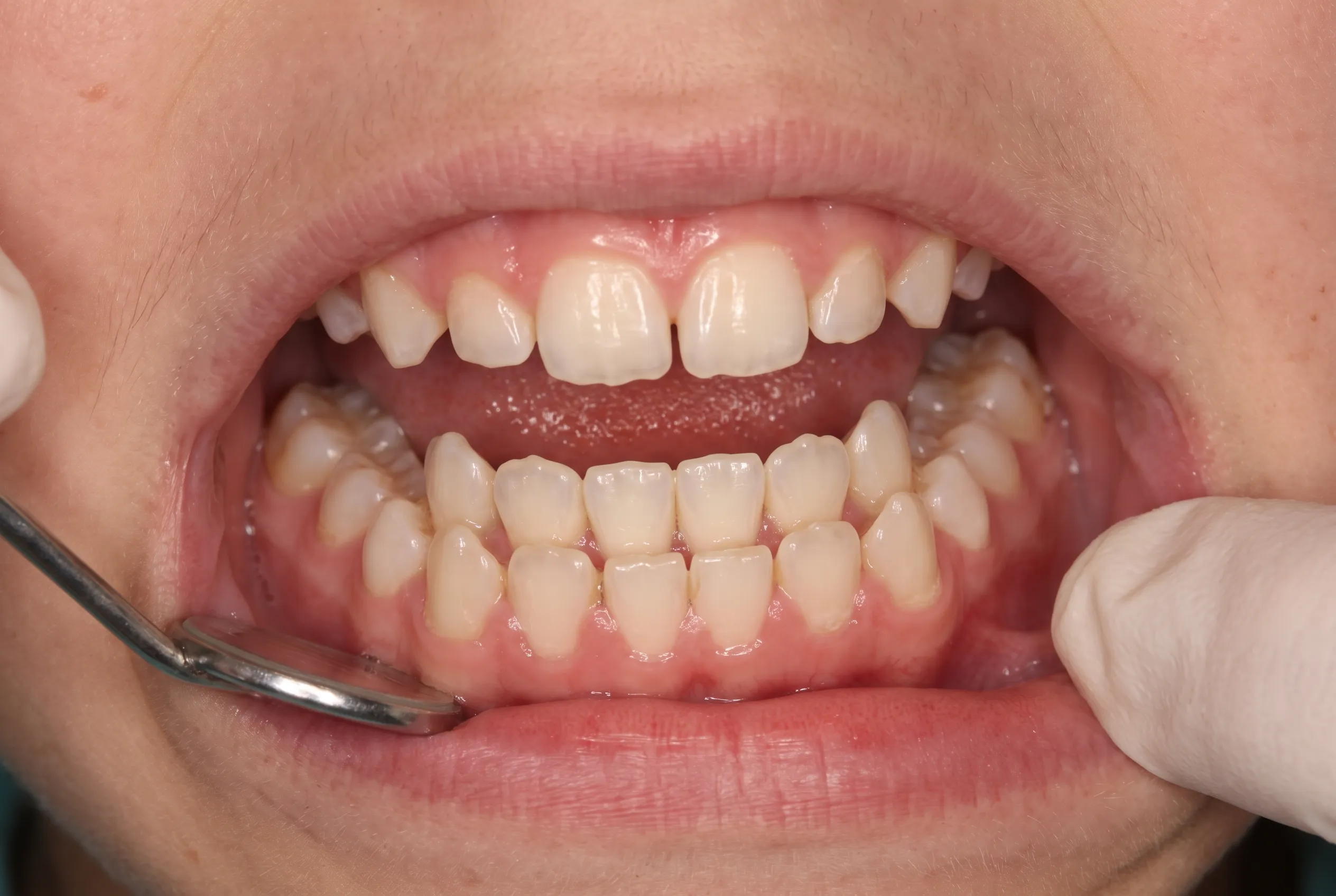
The term “shark teeth” refers to a situation where a child’s permanent tooth begins to erupt before the corresponding baby tooth has fallen out. Instead of pushing the baby tooth upward and out, the permanent tooth emerges lingual to it — meaning closer to the tongue or the inside of the mouth — creating a double row of teeth that resembles the layered dentition of a shark.
This occurs most commonly in the lower front teeth between ages 5 and 7, though it can also appear in the upper front teeth and occasionally in the molar region. Clinically, the condition is called ectopic eruption of the permanent tooth.
The cause is typically one of timing or space: the permanent tooth is ready to emerge, but the baby tooth’s root has not yet resorbed enough for the tooth to loosen and fall out naturally. In some cases, the permanent tooth simply takes a different path, erupting behind the baby tooth rather than directly beneath it.
Why Does It Happen?
During normal tooth development, the permanent tooth bud forms beneath the baby tooth and gradually pushes upward as it grows. Pressure from the emerging tooth stimulates the resorption of the baby tooth’s root, which causes the tooth to loosen and eventually fall out on its own. Shark teeth occur when this sequence is disrupted.
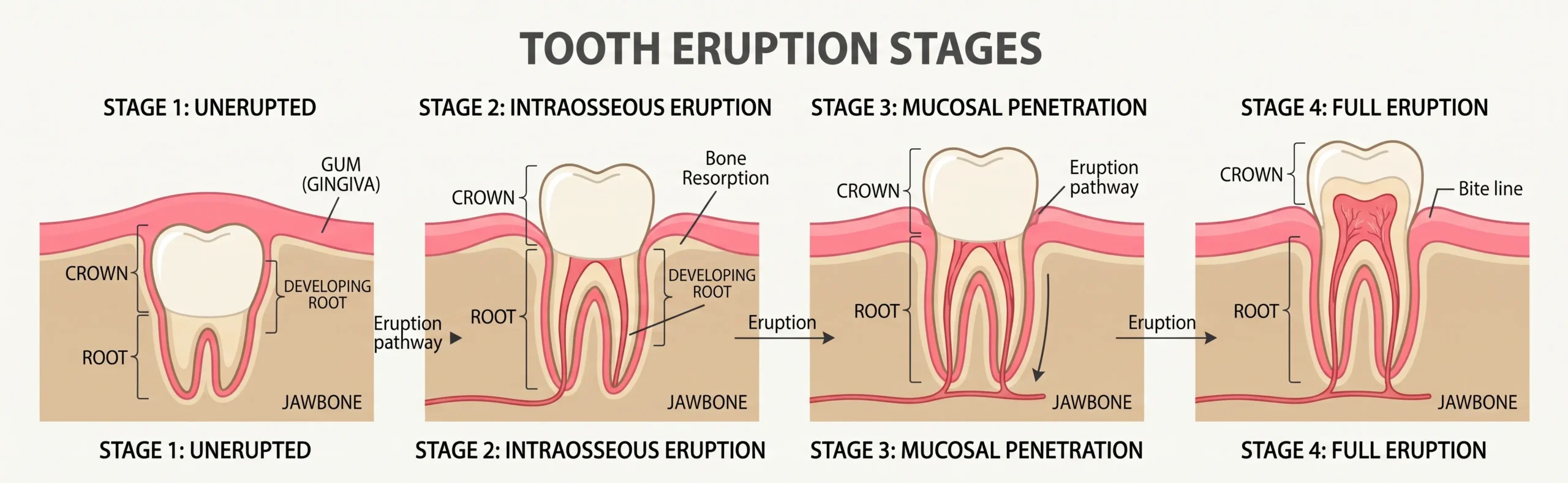
Several factors can contribute:
- The permanent tooth emerges on a slightly angled path that doesn't align directly beneath the baby tooth root, so root resorption is incomplete or delayed.
- The jaw may be smaller than the permanent teeth require, creating crowding that redirects the eruption path inward.
- There is natural variation in the timing and angle of eruption — some children simply develop this pattern without any underlying structural problem.
- In rarer cases, the baby tooth root is longer or more resistant to resorption, which can delay the natural shedding process.
For most children, ectopic eruption of the lower incisors is a normal developmental variation that resolves on its own once the baby tooth is lost. The tongue naturally pushes the permanent tooth forward into alignment over time as the jaw grows.
When It's Normal — and What to Watch
In most cases, shark teeth in the lower front region between ages 5 and 8 are a normal part of mixed dentition development. If the baby tooth is loose and wiggling, the situation is likely to resolve without intervention.
SIGNS THE SITUATION IS LIKELY TO RESOLVE ON ITS OWN
- The baby tooth in front of the new tooth is already loose or wiggling
- The child is between ages 5 and 8 and the new tooth is in the lower front region
- There are no signs of pain, swelling, or infection near the area
- Your child can comfortably bite and chew without discomfort
If the baby tooth falls out within a few weeks of noticing the double row, no further action is typically needed. The permanent tooth will usually shift forward into its correct position as the tongue exerts gentle forward pressure and the jaw continues to grow.
Encouraging the child to wiggle the loose tooth regularly with their tongue or clean fingers is appropriate. If the tooth is already quite loose, the child or parent can gently ease it out at home with clean hands and a small piece of gauze.
When the Baby Tooth Isn't Loose
The more significant concern arises when the permanent tooth is erupting behind a baby tooth that shows no signs of loosening. If the baby tooth remains firmly rooted while the permanent tooth continues to come in, the baby tooth may need to be extracted by a dentist to allow the permanent tooth space to move forward.
SITUATIONS THAT WARRANT A DENTIST ASSESSMENT
- The permanent tooth has been visible for two weeks or more and the baby tooth in front of it is still firm, not loose
- The new tooth is appearing in the upper jaw rather than the lower front — upper ectopic eruption is less common and warrants earlier evaluation
- Your child is 9 or older and the baby tooth is still present in an area where it should already be gone
- There are signs of crowding — the permanent tooth doesn't appear to have room to move forward even after the baby tooth is lost
- The shark teeth are appearing in more than one area of the mouth simultaneously
- The child reports ongoing discomfort, sensitivity, or difficulty chewing
- The new tooth is erupting at a very steep angle or sideways rather than in a roughly vertical direction
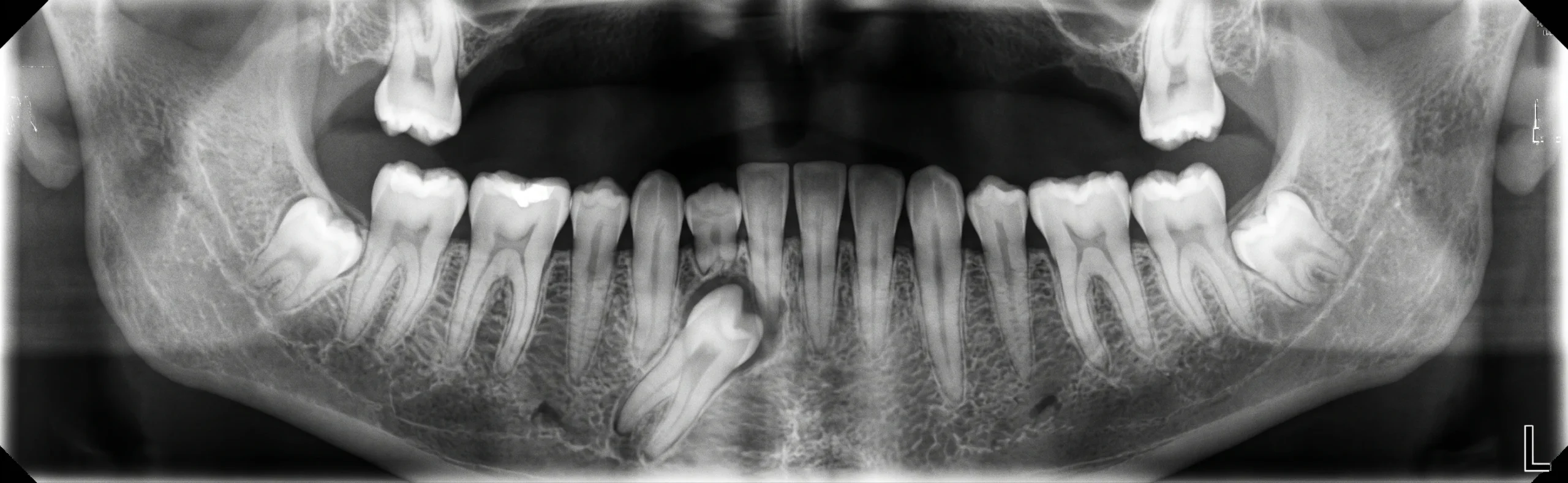
At the appointment, the dentist will evaluate the baby tooth’s root and overall structure, typically with an X-ray. If the root is still intact and the tooth is unlikely to loosen on its own within a reasonable timeframe, a simple extraction of the baby tooth may be recommended to allow the permanent tooth to migrate forward.
Baby Tooth Extraction: What to Expect
Extracting a retained baby tooth to make way for an incoming permanent tooth is a routine pediatric dental procedure. The process is typically straightforward and causes minimal discomfort.
The dentist will apply a topical numbing gel to the gum before using a local anesthetic injection to numb the area. Most children feel only a sensation of pressure during the procedure itself. The baby tooth, once numbed, is gently rocked and removed. Recovery is usually quick — mild soreness for a day or two, which can be managed with age-appropriate children’s pain reliever if needed.
DO NOT PULL A FIRM BABY TOOTH AT HOME
If the baby tooth is not loose, do not attempt to pull it at home. A tooth with an intact root requires proper technique and anesthesia for a comfortable removal. Forcing a firm tooth can break the root, cause pain, and leave root fragments that may complicate the permanent tooth’s eruption.
After the baby tooth is removed, the dentist may advise simply monitoring the permanent tooth’s movement. In most cases, particularly in the lower front region, the tongue’s pressure will gradually guide the tooth forward into correct alignment over the following weeks to months. No additional intervention is usually needed at this stage.
If the tooth does not fully align after a period of observation, or if there are broader spacing or bite concerns, the dentist may refer to an orthodontist for an evaluation. An early orthodontic consultation between ages 7 and 8 is recommended by the American Association of Orthodontists regardless of whether shark teeth are present, as it can help identify potential alignment issues early when intervention is simplest.
Signs That Need Immediate Attention
While most shark teeth situations are benign and manageable, certain signs warrant prompt contact with the practice rather than a wait-and-see approach.
CONTACT THE PRACTICE OR GO TO THE ER
- Significant swelling in the gum or jaw near the erupting tooth
- A visible blister or abscess on the gum near the new tooth
- Fever alongside dental swelling or pain
- The child is unable to open their mouth or is in significant pain
- Foul taste or discharge near the tooth area
- Swelling that extends to the cheek, neck, or floor of the mouth
These signs can indicate infection or impaction that requires prompt assessment. Dental infections in children, like in adults, can spread if left untreated. When in doubt, call the practice for guidance — the team can advise whether same-day evaluation is needed or whether monitoring is appropriate.
Frequently Asked Questions
Is it normal for an adult tooth to grow behind a baby tooth?
Should I pull the baby tooth if another tooth is growing behind it?
How long can shark teeth stay in place?
Will the permanent tooth move into the right position?
When should my child see a dentist for shark teeth?
Schedule an exam if the baby tooth stays firm, the permanent tooth continues to erupt behind it, there is pain or swelling, the eruption looks unusual, or crowding is a concern.
For dental pain, localized swelling, or dental trauma, contact the practice promptly. If your child has difficulty breathing or swallowing, rapidly spreading swelling of the face or neck, serious facial or jaw trauma, or bleeding that will not stop, call 911 or go to the nearest emergency room.
Noticed a Tooth Growing Behind a Baby Tooth?
If your child’s baby tooth isn’t loose and a permanent tooth has already started coming in behind it, a quick exam can determine whether extraction is needed — or whether you’re in watch-and-wait territory. Toothology sees pediatric patients in Williamsburg, Brooklyn.
BOOK A PEDIATRIC EXAM
Concerned about your child’s teeth? We see pediatric patients in Williamsburg, Brooklyn and can typically offer same-week appointments.
DIRECT LINE
IN THIS GUIDE
CLINICAL SOURCES
QUICK REFERENCE
Baby tooth is loose
Watch
Baby tooth is firm 2+ weeks
Assess
Child is 9+, tooth still present
Evaluate
Upper teeth affected
Assess
Tooth self-correcting
Normal
Swelling, fever, or discharge
Urgent
TOOTHOLOGY DENTAL
Williamsburg, Brooklyn, NY
Serving Greenpoint, Bushwick, Bed-Stuy & Downtown Brooklyn
718-678-3800
Emergency line available
Open Hours
Mon – Thu: 10:00 AM – 6:00 PM Friday: 10:00 AM – 2:00 PM Sunday: 10:00 AM – 2:00 PM Saturday: Closed
OUR COMMITMENT
- Board-Certified Pediatric Dentists
- Child-Friendly, Anxiety-Reducing Care
- Same-Day Emergency Slots
- Low-Radiation Digital X-Rays
- Most Major Insurance Accepted