
- Restorative Guide
A crown protects the tooth underneath — but the natural tooth structure can still develop decay, especially near the crown margin. Here’s what to watch for and how your dentist assesses it.
Cavity Under a Dental Crown: Symptoms and What Your Dentist Checks
A dental crown protects a damaged or heavily restored tooth, but the natural tooth structure beneath the crown can still develop decay. The crown itself does not get a cavity — it is made from ceramic, metal, or other restorative material. Instead, decay can form in the remaining natural tooth structure, often near the crown margin: the edge where the crown meets the tooth.
This is sometimes called recurrent or secondary decay. Some cases produce noticeable symptoms; others are found during a routine exam, sometimes with the help of X-rays, before pain develops.
THE SHORT ANSWER
Yes, you can get a cavity under a dental crown. If you notice symptoms near a crowned tooth — sensitivity, pain, food trapping, a bad taste, or a loose crown — it is worth having it examined. Decay around a crown can sometimes develop without symptoms, which is why regular dental exams remain important even when the tooth feels fine.
Can You Get a Cavity Under a Dental Crown?
Yes. The crown itself does not develop a cavity, but the natural tooth structure around and beneath it can still decay. Decay most often begins near the crown margin — the edge where the crown meets the tooth — where plaque can collect, especially if the area is difficult to clean or if the fit, gum position, or cement changes over time.
This can happen whether or not the tooth previously had a root canal. A root-canal-treated tooth has had the pulp removed from the treated canals, but the remaining natural tooth structure is still susceptible to decay.
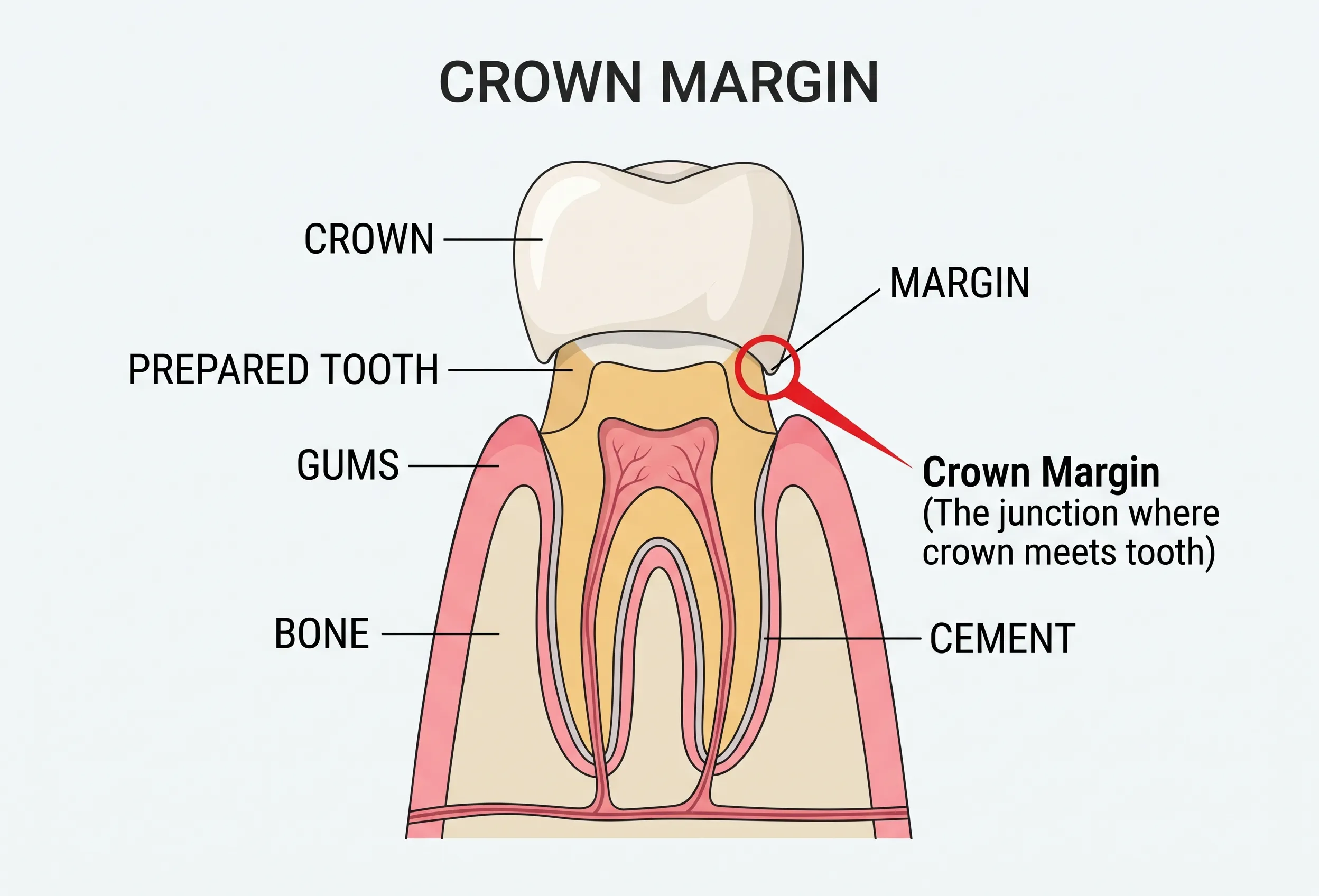
WHY THE CROWN MARGIN MATTERS
The crown margin is a key area dentists check because recurrent decay often starts there. Gum recession, wear, or gradual changes in the restoration over time can make the margin more vulnerable to plaque accumulation. That is why regular dental exams remain important even when a crowned tooth feels completely normal.
Common Signs of Tooth Decay Under a Crown
Decay under a crown can cause symptoms — but it can also be found incidentally during a routine exam or X-ray. These signs do not confirm a cavity on their own, but each is worth having checked.
Symptoms to Be Aware Of
Sensitivity or pain
New sensitivity to cold, sweets, or temperature changes may suggest something has changed around the crowned tooth. Pain when biting or persistent aching can also be relevant, although these symptoms may have other causes.
Food trapping or floss catching
If food repeatedly gets stuck near the crown, or floss begins to catch or shred at the margin, the area may have changed and should be examined.
Bad taste or odor
A recurring bad taste or odor from one crowned tooth may indicate bacterial buildup around the margin, beneath a loose crown, or in nearby tissues.
Crown looseness or bite change
A crown that feels loose, higher than before, or different when biting should be assessed promptly. Changes can be related to cement failure, fracture, or decay beneath the restoration.
Gum irritation near the crown
Persistent soreness, swelling, or bleeding around one crown may be linked to a margin problem, root exposure, or nearby gum changes.
DECAY CAN DEVELOP WITHOUT PAIN
Decay under a crown does not always cause symptoms, especially early on. Some cases are found during routine dental exams before the person notices any discomfort. Regular check-ups remain important for any crown, even when the tooth feels completely normal.
- CONTACT TOOTHOLOGY DIRECTLY FOR THESE
Call (718) 678-3800 rather than using routine online booking if you have:
- Significant or worsening pain near a crown
- Swelling around the tooth, jaw, or face
- Drainage or discharge near the crown
- A crown that has come off, cracked, or broken
- Recent trauma to the tooth or jaw
For rapidly spreading facial or neck swelling, difficulty breathing or swallowing, or severe symptoms, seek emergency medical care rather than a dental appointment.
Why Decay Can Form Around or Beneath a Crown
Decay around a crown usually develops because of several factors working together — not simply because the crown is “leaking” or because of poor oral hygiene alone.
Plaque at the crown margin
The area where crown meets tooth can collect plaque, particularly if it’s difficult to clean, if the fit has changed, or if gum recession has exposed part of the margin. Diet, fluoride exposure, and saliva flow also influence caries risk.
Changes at the margin over time
Gum recession, wear, or gradual changes in the cement or fit of a crown can expose areas where plaque and food collect more easily than they did when the crown was first placed.
Crown shape and cleaning access
The contour of the crown and the position of nearby teeth affect how easy it is to clean around the margin and between teeth. Some crown designs or positions make consistent cleaning more difficult.
Exposed root surface
If gum recession has exposed root structure near the crown edge, that area may be more vulnerable to decay than enamel, since root surface is generally more susceptible to caries.
Crown damage or loosening
A cracked, loose, or partially dislodged crown can change the seal between the crown and the tooth. This does not automatically mean decay is present, but it should be assessed promptly.
How Dentists Diagnose Decay Under a Crown
Diagnosing decay around or beneath a crown usually involves a review of the tooth’s history, a clinical examination, and imaging when clinically appropriate.
History Questions Your Dentist May Ask
When was the crown placed?
Has the tooth had a root canal?
Is food trapping near the crown?
What the Clinical Examination May Cover
Crown margins:
Checking accessible margins for roughness, visible defects, color changes, or areas that look or feel different from when the crown was placed.
Gum tissue:
Looking for recession, inflammation, swelling, or bleeding around the crown that may indicate a margin problem or root exposure.
Crown stability:
Assessing whether the crown feels loose, rocks, or has changed in the bite.
Cracks or structural damage:
Examining the crown and surrounding teeth for fractures or wear that may affect the tooth below.
Adjacent teeth and surrounding tissue:
Imaging: What X-rays Show and Their Limits
Bitewing or periapical X-rays may be recommended when they can provide useful information about the crown margin, underlying tooth structure, or surrounding tissues. However, X-rays may not show every area of recurrent decay around a crown — crown material, lesion location, and depth can affect visibility. Imaging is interpreted alongside the clinical exam, not in place of it.
WHEN FURTHER EVALUATION MAY BE NEEDED
If exam findings are unclear, the dentist may recommend monitoring, additional evaluation at a future appointment, or, in some cases, removing the crown to inspect the tooth underneath directly. A suspicious crown margin does not automatically mean the crown must come off — the decision depends on the overall clinical picture.
Treatment Options: Repair, New Crown, Root Canal, or Extraction
Treatment for decay under a crown depends on several factors: how much decay is present, how much healthy tooth structure remains, the condition of the crown itself, and whether the pulp or root is involved. The table below outlines the possible directions by scenario.
| Scenario | Possible Direction | Key Consideration |
|---|---|---|
| Small, accessible decay | Repair or filling may be possible | Depends on access and remaining tooth structure |
| Decay beneath a defective crown | Crown removal and replacement may be needed | The tooth must be assessed after the crown is removed |
| Decay involving the pulp | Root canal treatment may be considered | Only when the endodontic diagnosis supports it |
| Extensive decay but restorable tooth | Rebuild the tooth and place a new crown | Enough healthy tooth must remain |
| Tooth cannot be predictably restored | Extraction may be discussed | Reserved for cases where restoration is no longer reliable |
| No active decay found | Monitoring or treatment of another cause | Symptoms around a crown do not always mean decay |
Repair or Direct Filling
If the decay is small and accessible and the crown remains stable, a direct restoration may sometimes be possible without removing the crown. This depends on where the decay is located and how much tooth structure is affected.
Crown Removal and Replacement
If decay extends beneath the crown or the margin is significantly compromised, the crown may need to be removed. The tooth can then be properly treated and rebuilt before a new crown is planned.
Root Canal Treatment
Decay under a crown does not automatically mean a root canal is needed. Root canal treatment is considered only when examination and clinical testing show involvement of the pulp or the tissues around the root. For concerns involving a previously root-canal-treated tooth, see Toothology’s guide to dental crown pain after root canal treatment.
Extraction
Extraction may be discussed when there is not enough healthy tooth structure remaining for a predictable restoration, or when other findings make the tooth non-restorable. The right treatment can only be determined after examining the crown and the tooth structure beneath it.
NO ACTIVE DECAY FOUND
Symptoms around a crown do not always mean decay is present. If the exam and imaging find no active decay, the dentist may recommend monitoring or investigate other causes such as gum changes, bite issues, or cement changes.
Frequently Asked Questions
How do I know if I have a cavity under a crown?
Can an X-ray show decay under a crown?
Can a cavity under a crown be filled without replacing the crown?
Does decay under a crown mean I need a root canal?
When does a dental crown need to be replaced?
Replacement may be needed when there is significant decay around or beneath the crown, a defective margin, fracture, or loss of retention. Crown age alone does not determine whether replacement is necessary — the condition of the crown and the tooth underneath is what matters.
Concerned About a Cavity Under Your Crown?
CROWN CONCERN?
Toothology offers restorative assessments for crowns with sensitivity, food trapping, a loose fit, or suspected decay — at 42A Broadway, Williamsburg.
DIRECT LINE
IN THIS GUIDE
WHAT TO DO NEXT
No symptoms, crown is older
Book Exam
Food trapping near crown
Book Exam
New sensitivity or bad taste
Call Soon
Loose crown or bite change
Call Promptly
Swelling or drainage
Call Directly
Crown fell off or broke
Call Directly
TOOTHOLOGY DENTAL
Williamsburg, Brooklyn, NY
Serving Greenpoint, Bushwick, Bed-Stuy & Downtown Brooklyn
718-678-3800
Emergency line available
Open Hours
Mon – Thu: 10:00 AM – 6:00 PM Friday: 10:00 AM – 2:00 PM Sunday: 10:00 AM – 2:00 PM Saturday: Closed
OUR COMMITMENT
- Board-Certified Pediatric Dentists
- Child-Friendly, Anxiety-Reducing Care
- Same-Day Emergency Slots
- Low-Radiation Digital X-Rays
- Most Major Insurance Accepted