
Broken Retainer After Invisalign: What to Do Before Your Teeth Shift

Invisalign Aftercare Guide · Williamsburg Brooklyn If your Invisalign retainer breaks, cracks, stops fitting, or goes missing — don’t wait weeks to deal with it. Here’s exactly what to do, what not to do, and why early action matters. Broken Retainer After Invisalign: What to Do Before Your Teeth Shift WHAT TO DO FIRST REPLACEMENT PROCESS Written by Toothology Editorial Team | Reviewed by Dr. Ayala Lieberman, DDS July 2026 If your Invisalign retainer breaks, cracks, stops fitting properly, or goes missing, do not wait weeks to deal with it. An Invisalign retainer is what holds your teeth in their corrected position after active aligner treatment ends — and gaps in retainer wear are one of the most common reasons teeth begin shifting after Invisalign. The good news: a broken retainer caught early is a straightforward problem. You have finished treatment, your teeth are in the position you worked for, and a replacement retainer is generally a much simpler process than the treatment that got you there. The goal is to act quickly so the window before any shifting begins stays as small as possible. Why Retainers Matter After Invisalign Invisalign moves teeth into a planned position using a series of clear aligners. But once treatment ends, the teeth are not permanently locked in place. The bone and ligament tissue around them still need time to fully stabilise. Without consistent retainer wear, teeth can gradually shift back toward their previous positions — a process called orthodontic relapse. An Invisalign retainer, clear retainer, or fixed wire retainer holds the teeth in their corrected position after treatment. Consistent wear is essential because it protects the results you worked hard to achieve. WHEN ARE TEETH MOST VULNERABLE? Teeth are most vulnerable to movement immediately after active aligner treatment, when the supporting bone and ligament tissue are still stabilising. This is also why a broken or missing retainer needs to be dealt with quickly — the earlier the replacement is started, the smaller the window for unwanted movement. What to Do If Your Retainer Breaks A broken retainer should be handled quickly, but you do not need to panic. Follow these steps to protect your results and keep your options open. Stop wearing it if it is damaged. Do not wear a retainer with sharp edges, cracks, broken pieces, or a poor fit — it will not retain effectively and may irritate your mouth. Save the pieces. Bring the retainer and any fragments to your appointment — the dentist may be able to assess whether it can be replaced from existing records. Do not attempt to repair it at home. Glue, tape, heat, or household fixes will not restore proper retention and may make the retainer unsafe or unfit to use. Call the dental office promptly. The sooner a replacement is started, the lower the risk of unwanted tooth movement in the meantime. Ask before using an old or backup retainer. A backup retainer may not match your current tooth position — check with your dentist before wearing it. What Not to Do With a Broken Retainer DO NOT DO THIS Use glue, tape, or household adhesives on the retainer Apply heat or attempt to reshape it yourself Wear it if it has sharp edges or broken pieces Force it in if it feels tight or painful Order a generic retainer without a current scan or dental guidance Assume it is okay because it “sort of” fits DO THIS INSTEAD Stop wearing the damaged retainer immediately Save the retainer and all fragments Contact your dentist promptly for guidance Describe the damage when you call so they can prioritise Ask specifically whether any backup retainer may be safe to use temporarily Schedule a replacement evaluation as soon as possible Can Teeth Shift Quickly Without a Retainer? Yes — but the timeline varies significantly between patients. Some notice changes quickly, especially soon after Invisalign treatment, while others experience more gradual movement over time. There is no universal answer. Teeth shifting after Invisalign is a risk, not a certainty. Acting early gives your dentist more options to help protect your results. IF YOU MISSED A FEW NIGHTS — DON’T PANIC, BUT DON’T DELAY Missing a few nights of retainer wear is not catastrophic, but it is not something to keep postponing. The window between “no noticeable shift” and “visible movement” is unpredictable. Contact your dentist promptly rather than continuing to wait and see. Should You Wear an Old or Backup Retainer? Maybe — but only if your dentist confirms it is safe to do so. An old or backup retainer may not match your current tooth position, especially if it was made earlier in your Invisalign treatment or has not been used in a while. Fits comfortably and seats fully: May be usable temporarily — but confirm with your dental office first before relying on it. Feels slightly tight but not painful: Proceed with caution and call the office. Mild tightness may mean minor movement — your dentist should confirm whether it is safe to wear. Feels tight, painful, or does not seat fully: Do not force it in. Tightness may mean your teeth have shifted — wearing it could cause harm. Schedule an evaluation promptly. Cracked, warped, yellowed, or worn out: Do not rely on it for proper retention, even temporarily. It will not hold the teeth effectively. How Dentists Replace Invisalign Retainers The replacement process is usually straightforward — especially if your teeth have not shifted much since your last scan or impression. 1 CHECK CURRENT TOOTH POSITION The dentist looks for any tooth movement since your Invisalign treatment ended. This determines whether existing records are still accurate. 2 REVIEW EXISTING RECORDS If a recent digital scan is on file and still accurate for your current position, it may be used to make the replacement retainer without taking a new one. 3 NEW SCAN IF NEEDED If teeth have shifted or records are outdated, a new digital scan or impression is taken so the replacement retainer fits your actual tooth
TMJ & Jaw Pain: Could Your Headaches Be Caused by Teeth Grinding?

TMJ & Night Guard Guide · Williamsburg Brooklyn Waking up with headaches, jaw soreness, or facial tension that eases through the day? Your teeth and jaw may be part of the pattern — and a dental evaluation can help. TMJ & Jaw Pain: Could Your Headaches Be Caused by Teeth Grinding? BOOK A TMJ EVALUATION SIGNS FROM THE JAW Written by Toothology Editorial Team | Reviewed by Dr. Ayala Lieberman, DDS July 2026 If you wake up with headaches, jaw soreness, or facial tension that eases as the morning goes on, your teeth and jaw may be part of the problem. A TMJ headache can feel like pressure near the temples, jaw, ears, or face — and may be worse after a night of clenching or grinding without you even realising it is happening. Many people with recurring morning headaches never consider a dental connection. But when headaches happen alongside jaw pain, tooth wear, stiffness, or clenching, a dental evaluation can help determine whether your jaw, bite, or teeth grinding is contributing to the pattern. TMJ HEADACHES ARE ONE POSSIBLE CAUSE — NOT THE ONLY ONE TMJ headaches and bruxism are one possible cause of recurring headaches. Tension headaches, migraines, and medical conditions can cause similar symptoms. However, when jaw symptoms are part of the pattern, dentistry is worth including in the conversation. What Is TMJ and How Does It Cause Headaches? THE TEMPOROMANDIBULAR JOINT (TMJ) The TMJ is the hinge joint that connects the lower jaw to the skull, just in front of each ear. You use it every time you chew, speak, yawn, or swallow. When this joint or the surrounding jaw muscles become irritated, strained, or overworked, it can lead to temporomandibular disorders (TMD) — what most people call “TMJ problems.” Pain from the jaw area can spread toward the temples, ears, face, neck, or head. TMJ-related headaches can occur when jaw muscles are under repeated stress from clenching or grinding — especially during sleep. The jaw muscles are among the most powerful in the body, and when they work while they are supposed to be resting, the resulting muscle fatigue and tension can radiate outward toward the head, temples, and ears. When headaches occur with jaw soreness, chewing discomfort, facial tension, or pain near the ears, TMJ and teeth grinding may be worth evaluating. Can Teeth Grinding Really Cause Jaw Pain and Headaches? Bruxism — the clinical term for teeth grinding and jaw clenching — can contribute to jaw pain, facial tension, and headaches. When you clench or grind during sleep, the jaw muscles work far harder than they should while the rest of the body is resting. Over time, this leaves the chewing muscles tired, sore, and tight. Many people do not know they grind their teeth because sleep bruxism happens unconsciously. In some cases, a dentist may notice signs — such as tooth wear, jaw tenderness, or bite-related stress — before the patient has any idea grinding is occurring. Signs Bruxism May Be Affecting You Dull headaches near the temples, especially in the morning Jaw soreness, stiffness, or tight feeling when waking Facial muscle tension that eases during the day Tooth sensitivity, especially after waking Pain or pressure near the ears or jaw joint Teeth that look flat, worn, shorter, or chipped Difficulty opening the jaw wide in the morning A sleep partner who has heard grinding sounds at night TMJ Headache vs Tension Headache vs Migraine TMJ headaches, tension headaches, and migraines can overlap, which is why self-diagnosis is not always reliable. A clear pattern and a proper evaluation help identify what is driving the symptoms. Headache Type Common Pattern Clues to Look For Next Step TMJ-Related Pain or pressure near the temples, jaw, ears, face, or neck — often worse in the morning Jaw pain or soreness, clenching or grinding, chewing discomfort, clicking, morning stiffness, or visible tooth wear Dental / TMJ evaluation Tension Headache Band-like pressure around the head or forehead Neck and shoulder tension, stress, general muscle tightness — not specifically jaw-related Medical or dental evaluation depending on symptoms Migraine Moderate to severe pain, often one-sided or throbbing Light or sound sensitivity, nausea, visual disturbances, worsens with activity Medical evaluation WHEN TO SEEK URGENT MEDICAL CARE — NOT A DENTAL VISIT A sudden, severe headache unlike any previous headache Headache with fever or stiff neck Headache after significant head trauma Confusion, weakness, vision changes, or fainting Headache with chest pain or shortness of breath THESE SYMPTOMS ARE NOT TYPICAL TMJ SIGNS The warning signs above suggest medical causes that need urgent evaluation. They should not be approached as a dental issue. If you have any of these symptoms, seek medical care promptly. Signs Your Headache Is Coming From Your Jaw These signs do not confirm a TMJ diagnosis on their own — but if several apply together, a dental evaluation is a reasonable next step to see whether the jaw, bite, or teeth grinding is contributing. Morning headaches that ease as the day progresses Jaw soreness, stiffness, or pain when waking up Pain near the temples, ears, face, or jaw Clicking, popping, or grinding sounds in the jaw Pain or discomfort when chewing Awareness of clenching or grinding during the day A partner has heard grinding sounds during sleep Teeth that look flatter, shorter, chipped, or worn Tooth sensitivity without a clear cavity or gum issue Facial tension, neck stiffness, or tired jaw muscles How Dentists Diagnose TMJ-Related Headaches A dental evaluation for suspected TMJ headaches or bruxism is usually simple and non-invasive. The goal is to find out whether the teeth, bite, jaw joint, or jaw muscles may be contributing to symptoms. Symptom history: Headache timing, morning jaw pain, soreness, sleep habits, stress levels, and any grinding sounds reported by a partner Teeth: Signs of grinding — flat surfaces, chipped edges, cracks, worn enamel, or unusual sensitivity Bite: How the teeth come together and whether bite pressure may be straining the jaw joint
Loose Adult Tooth: Causes, Treatment Options, and When It’s Urgent

Urgent Dental Care · Emergency & Evaluation · Brooklyn If an adult tooth feels loose — even slightly — it should be taken seriously. A loose permanent tooth usually does not resolve on its own, and early evaluation gives the dentist more options. Loose Adult Tooth: Causes, Treatment Options, and When It’s Urgent CALL 718-678-3800 COMMON CAUSES Written by Toothology Editorial Team | Reviewed by Dr. Ayala Lieberman, DDS July 2026 If an adult tooth feels loose — even slightly — it should be taken seriously. A loose permanent tooth usually does not resolve on its own, and early evaluation gives the dentist more options to identify and treat the cause. While waiting for your appointment, avoid chewing on that tooth and do not keep testing it with your finger or tongue. Adult teeth can become loose because of gum disease, bone loss, dental injury, infection, bite pressure, or a failing restoration. The exact cause can only be confirmed with a dental exam and X-rays — and the cause determines whether the tooth can be stabilised. IF YOU HAVE SWELLING, SEVERE PAIN, OR TRAUMA If the looseness started after an injury, or you have swelling, fever, pus, or severe pain, contact Toothology right away at 718-678-3800. Do not wait to see if symptoms improve. Common Causes of a Loose Permanent Tooth A loose permanent tooth can happen for several reasons, and more than one issue may be involved at the same time. A dental exam and X-rays are needed to identify the specific cause and how advanced it is. Gum Disease Periodontal disease can damage the bone and ligament that support the tooth over time, causing it to feel loose or shift position. Dental Injury or Trauma A fall, sports impact, or biting something hard can damage the tooth, root, or surrounding ligament — even without obvious pain. Infection or Abscess Infection near the root or in the surrounding bone can progressively weaken the tissue and bone that keep the tooth stable. Bite Trauma or Grinding Clenching, grinding, or uneven bite pressure can overload the tooth and its supporting structures over time. Failing Restoration A cracked crown, failing bridge, or large damaged filling can affect how the tooth is loaded and supported. Bone or Health Factors Some medical conditions or medications can affect bone density or support. A full health history is part of the evaluation. Loose Tooth From Gum Disease The link between gum disease and loose teeth is significant. Periodontal disease is an infection that affects the gums, ligament, and bone that support the teeth. As it progresses, those structures can weaken — causing teeth to shift or become loose. The warning signs are often gradual and easy to overlook. Bleeding gums when brushing or flossing Red, swollen, or receding gum tissue Persistent bad breath that does not resolve with brushing New spaces appearing between teeth Pus at the gumline or a persistent bad taste Teeth that feel tender, loose, or have visibly shifted WHAT GUM DISEASE TREATMENT CAN AND CAN’T DO Treatment depends on how much bone and ligament support remains. A dentist may recommend scaling and root planing, periodontal maintenance, antibiotics when infection is active, tooth splinting in selected cases, or referral to a periodontist. Deep cleaning does not guarantee that a loose tooth will tighten — especially if there is significant bone loss. However, treating the infection can help stop further damage and give the tooth the best chance of stabilisation. Loose Tooth After Injury or Trauma A loose tooth after dental trauma should be checked as quickly as possible. Sports injuries, falls, collisions, or biting something hard can stretch the ligament around the tooth, move the tooth in its socket, fracture the root, or damage the surrounding bone. Even if the pain is mild, the injury may be more serious than it appears. AFTER TRAUMA — DO THIS Avoid chewing on the affected side Contact a dentist as soon as possible — same day if you can Get X-rays to check for root, bone, or ligament damage Keep a knocked-out tooth moist in milk, saliva, or a tooth-preservation product AFTER TRAUMA — AVOID THIS Do not keep touching or testing the tooth with your finger or tongue Do not try to push the tooth back into position yourself Do not chew on the affected side Do not wait to see if it improves without being seen A KNOCKED-OUT PERMANENT TOOTH IS A DENTAL EMERGENCY Keep the tooth moist in milk, saliva, or a tooth-preservation product. Do not let it dry out and do not scrub the root. Seek emergency dental care immediately — time matters significantly for reimplantation. Call Toothology at 718-678-3800. Can a Loose Adult Tooth Be Saved? Sometimes. Whether a loose adult tooth can be saved depends on the cause, how much bone and gum support remains, whether infection is present, and how quickly treatment begins. Some loose teeth can be stabilised with the right care — others may not be predictable to keep long-term. Only an exam and X-rays can give you a realistic picture. Treatment Option When It May Apply Important Note 🪥 Deep Cleaning / Scaling & Root Planing Gum disease, tartar buildup, or periodontal pockets are contributing to tooth mobility May help control infection — does not guarantee the tooth will tighten back up 🗓 Periodontal Maintenance After gum therapy, to monitor and keep infection controlled over time Ongoing care is needed to protect the progress made through treatment 🔗 Tooth Splinting When stabilisation during healing may be clinically appropriate Only suitable for selected cases — not a universal option for every loose tooth 😬 Bite Adjustment / Night Guard Grinding, clenching, or uneven bite pressure is contributing to the mobility Bite problems must be clinically diagnosed before treatment can be planned 🩺 Root Canal Therapy Infection or trauma affects the nerve, but the tooth is still structurally restorable Treats the infection inside the tooth — does not address bone or gum loss around it 🔄 Extraction
Back-to-School Dental Checklist for Kids in Brooklyn

Back-to-School Dental Guide · Brooklyn Families Backpack — checked. Supplies — checked. New sneakers — checked. Dental checkup — still not scheduled. August is the most practical time to get it done before the school routine makes weekday appointments genuinely hard. Back-to-School Dental Checklist for Kids in Brooklyn BOOK BEFORE SEPTEMBER WHAT TO EXPECT Written by Toothology Editorial Team | Reviewed by Dr. Ayala Lieberman, DDS July 2026 The back-to-school rush has a way of pushing the dental appointment lower and lower until suddenly September has arrived and nobody has had their teeth looked at since last spring. For Brooklyn and Williamsburg families, August is actually the most practical time to schedule a preventive dental checkup — before the school routine makes weekday appointments genuinely difficult. A back-to-school dental exam can identify early cavities, complete a professional cleaning, update preventive care recommendations, and catch any changes in how your child’s teeth and bite are developing — all before small issues have the chance to turn into the kind of toothache that disrupts a school week. The Back-to-School List Backpack & supplies New sneakers Lunch box sorted School forms signed Kids dental checkup — booked? Cavity check & cleaning — done? Why Kids Need a Dental Checkup Before School Starts A back-to-school dental visit is easier to schedule before classes, homework, sports, and activities fill the calendar. Summer appointments give families a window to handle preventive care before the school year takes over. Professional cleanings remove buildup that brushing at home cannot reach. A cavity check can catch early decay before it becomes a bigger problem. A dental exam also helps track how your child’s teeth are developing — permanent teeth, bite alignment, gum health, and habits like thumb sucking, mouth breathing, or nail biting. NEW YORK SCHOOL DENTAL FORMS Some New York schools request a dental health certificate or school dental form from a licensed dentist. Parents should check their school’s specific requirements before the start of the school year. Toothology can complete any required forms at the time of your child’s visit. What Happens During a Pediatric Dental Exam For children who are new to Toothology or feel nervous about the dentist, knowing what to expect can make the visit much easier. Here is what a kids’ dental checkup at Toothology typically includes. HEALTH HISTORY REVIEW Checking medications, allergies, or any health changes since the last visit. A good time to mention any concerns about your child’s overall health. VISUAL EXAM Looking at the teeth, gums, bite alignment, gum tissue, and tooth development. The dentist checks both baby teeth and incoming permanent teeth. ✨ PROFESSIONAL CLEANING Removing plaque and tartar — especially around the gumline and between teeth — followed by polishing. Once clean, early signs of decay are easier to spot. BRUSHING & FLOSSING GUIDANCE Age-appropriate tips for home care routines — covering technique, product selection, and how to make brushing consistent at home. DENTIST CONSULTATION Reviewing exam findings and answering parent questions about development, habits, sealants, fluoride, snacking, mouthguards, or anything else on your mind. X-RAYS — WHEN ARE THEY RECOMMENDED? X-rays are not needed at every child’s visit. They are recommended based on the child’s age, cavity risk, symptoms, and what the dentist sees during the exam. Toothology recommends X-rays only when clinically appropriate. Helping Anxious Kids Feel Comfortable at the Dentist Dental anxiety in children is common. A dental visit includes new sounds, sensations, people, and tools near the mouth — all of which can feel overwhelming for some kids. The goal is not a rushed appointment. It is a calm, predictable visit where the child knows what is happening, gets breaks when needed, and builds confidence over time. Talk About It Calmly Say “the dentist will check and clean your teeth to keep them strong” — and avoid scary words or over-explaining tools beforehand. Choose the Right Time Schedule when your child is usually rested and regulated — not during a normally difficult part of the day. Tell the Team Early Let Toothology know if your child is anxious so they can go slowly, explain each step, and build in breaks when needed. Bring a Comfort Item A small toy, headphones, or a fidget toy can help reduce stress during the appointment. Set Honest Expectations Instead of “it’ll be fun,” try “they’ll explain everything and give you breaks if needed.” This builds trust rather than disappointment. Tell-Show-Do Toothology uses a gentle approach: explain what will happen, show the child first, then proceed — helping anxious kids feel more prepared and involved. What to Bring to Your Child’s Back-to-School Appointment Insurance card Parent or guardian photo ID School dental form or health certificate, if required by your school Updated medical history — medications, allergies, or any health changes Previous dental records or X-rays, if your child is new to Toothology Your questions — about brushing struggles, pacifiers, bite development, or sports mouthguards A comfort item for anxious children, if helpful Any referral or school form that needs the dentist’s signature How Often Should Kids Get a Dental Checkup? 6 MONTHS — THE STANDARD STARTING POINT For many children, a dental checkup about every six months is a helpful baseline. But the right timing depends on your child’s cavity risk, oral health, and development. Some children may need more frequent visits if they have higher cavity risk, previous decay, orthodontic changes, or special health needs. START EARLY — BUILD COMFORT OVER TIME Early dental checkups for kids help build familiarity with dental visits before problems appear. Routine visits are almost always easier than a first visit that happens during a toothache or dental emergency. Signs Your Child’s Dental Checkup Shouldn’t Wait Most back-to-school dental visits are preventive, but some symptoms should be evaluated sooner — don’t wait for the scheduled checkup if your child has any of these. Toothache or ongoing tooth pain Sensitivity to hot or cold in one tooth Dark spots, white patches, or tooth colour changes Swelling of the gum, cheek, or jaw A
Restorative Dentistry in Brooklyn: How Dentists Repair Damaged, Decayed, or Missing Teeth
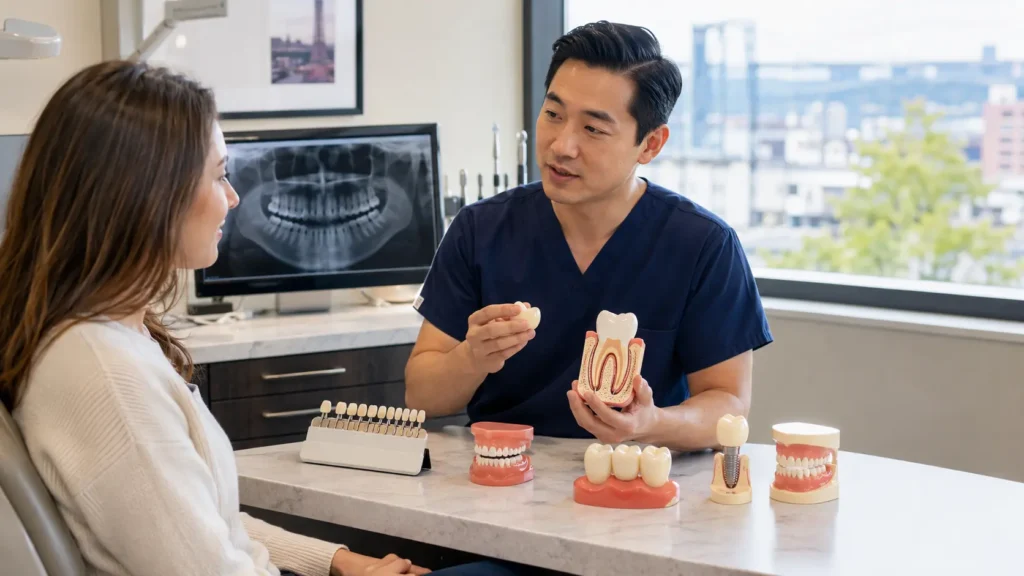
Restorative Dentistry Guide · Williamsburg Brooklyn From a cracked molar to a gap you’ve been covering when you smile — restorative dentistry is how dentists repair what’s broken and replace what’s missing so your mouth works the way it should. Restorative Dentistry in Brooklyn: How Dentists Repair Damaged, Decayed, or Missing Teeth EXPLORE TREATMENTS QUICK REFERENCE TABLE Written by Toothology Editorial Team | Reviewed by Dr. Ayala Lieberman, DDS July 2026 A tooth that has been hurting for weeks. An old filling that cracked while eating dinner. A gap from a missing tooth you have been covering with your hand when you smile. A crown that has been loose longer than you meant to let it go. These are exactly the situations restorative dentistry is designed to address — repairing what is damaged and replacing what is missing so the mouth can function comfortably, confidently, and without the daily awareness of a problem you are working around. The specific treatment that is right for a given situation depends on clinical findings — the extent of the damage, the amount of healthy structure remaining, the condition of surrounding teeth and gum tissue — not on a general hierarchy of which option is “best.” What Is Restorative Dentistry? Restorative dentistry focuses on repairing damaged teeth and replacing missing ones. The main goal is function — helping patients chew, speak, and maintain a healthy bite without pain, sensitivity, or instability. Restorative dental care can include simple tooth-colored fillings, crowns for cracked or weakened teeth, bridges, dentures, implant restorations, or more comprehensive treatment plans for multiple dental problems. RESTORATIVE VS COSMETIC Restorative and cosmetic dentistry can overlap — a porcelain crown, for example, can improve both the strength and appearance of a tooth. But restorative treatment is primarily about oral health and function, especially when a tooth is damaged, decayed, worn, or missing. Signs It May Be Time for a Restorative Dental Evaluation Restorative dental care may be needed when a tooth has lost structure or function because of decay, fracture, wear, injury, or missing teeth. Since enamel and dentin do not grow back, the right treatment depends on how much damage has occurred and what part of the tooth is affected. Pain is not the only signal. Cavities, cracks, and infections can sometimes progress without obvious symptoms — routine exams and X-rays help identify these issues earlier, before treatment becomes more complex. A cracked, chipped, or visibly broken tooth A large, dark, or growing cavity Tooth pain or sensitivity when biting or with hot or cold A loose, cracked, or uncomfortable filling, crown, or bridge A missing tooth affecting chewing or appearance Teeth that look worn down or shorter than before Food trapping around a gap or existing restoration Swelling, bad taste, or a bump near a tooth Difficulty chewing comfortably on one side for several weeks Common Restorative Dental Treatments The right option depends on your exam, X-rays, tooth structure, and overall treatment needs. Here is an overview of the most common restorative treatments available at Toothology in Williamsburg. TOOTH-COLORED FILLINGS Composite resin repairs small to moderate cavities and minor damage with a natural-looking, shade-matched result. Bonds directly to the tooth and is often completed in one visit. CONSERVATIVE · SINGLE VISIT DENTAL CROWNS A custom cap covers and protects a damaged tooth when a filling is not enough — often after large cavities, cracks, heavy wear, or root canal treatment. PROTECTS FULL TOOTH DENTAL BRIDGES Replaces one or more missing teeth by anchoring to nearby teeth or implants — restoring chewing function and helping prevent neighbouring teeth from shifting. FIXED REPLACEMENT DENTURES Partial or full dentures replace multiple or all missing teeth — improving chewing, speech, and appearance. Can be partial (some teeth remaining) or full arch. PARTIAL OR FULL IMPLANT RESTORATIONS The crown, bridge, or denture attached to a dental implant — creating a stable, long-term replacement for missing teeth that can feel and function like a natural tooth. STABLE · LONG-TERM BONDING Composite bonding repairs small chips, minor fractures, or surface irregularities when the tooth is otherwise healthy — a conservative option with minimal preparation. MINOR REPAIRS Fillings, Crowns, Bridges, Dentures & Implants: A Quick Reference Not sure which option applies to your situation? This table gives a side-by-side overview before your consultation. Treatment What It Does May Be Used For Patient Note Tooth-Colored Filling Repairs a cavity or small damaged area with a composite resin that matches your natural tooth shade Small to moderate decay, minor fracture, or surface damage with enough healthy tooth remaining Often completed in one visit Dental Crown Covers and fully protects the visible portion of a damaged or weakened tooth Large cavity, cracked tooth, broken cusp, weak remaining structure, or root-canal-treated tooth Used when a filling is not enough Dental Bridge Replaces one or more missing teeth by anchoring a fixed restoration to neighbouring teeth or implants One or more adjacent missing teeth with healthy anchor teeth or implants on either side Fixed; helps prevent tooth shifting Denture Replaces several or all missing teeth to restore chewing, speech, and appearance Multiple missing teeth across an arch, or full-arch tooth loss Can be partial or full; removable or implant-supported Implant Restoration Restores the visible tooth (crown, bridge, or denture) attached to a surgically placed dental implant Missing tooth replacement where implant placement is clinically appropriate Can feel and function like a natural tooth The right treatment is determined by exam and X-rays — not symptoms alone. The same painful tooth may need a filling, crown, root canal, or extraction depending on what is found clinically. How a Dentist Chooses the Right Treatment The right restorative treatment depends on exam findings — not preference alone. The same painful tooth could need a filling, a crown, a root canal and crown, or an extraction depending on what the X-rays and exam show. Remaining tooth structure: A small cavity may need a filling, while a weakened tooth with thin walls may
Dental Anxiety in Brooklyn: Sedation Options for Nervous Patients

Sedation & Dental Anxiety Guide · Williamsburg Brooklyn If you’ve avoided the dentist for months — or years — you’re not alone. Sedation dentistry and comfort-focused care are designed to make that cycle easier to break. Dental Anxiety in Brooklyn: Sedation Options for Nervous Patients SEE SEDATION OPTIONS COMFORT-FOCUSED CARE Written by Toothology Editorial Team | Reviewed by Dr. Ayala Lieberman, DDS July 2026 If you have avoided the dentist for months — or years — you are not alone. Dental anxiety is common among adults, and delaying care can make small dental problems feel bigger and more overwhelming over time. Sedation dentistry and comfort-focused care are designed to make that cycle easier to break. The goal is not to force yourself through discomfort. It is to make your dental visit feel more manageable — through a calm conversation about your anxiety, your treatment needs, and which comfort options are right for you. Why Dental Anxiety Is Common Dental anxiety often comes from a mix of experiences and triggers — a painful past visit, the sound of dental tools, fear of injections, feeling out of control in the chair, or embarrassment about not having seen a dentist in years. It can also create an avoidance cycle: the longer care is delayed, the more likely small issues become larger ones. Fear of Pain Worry that treatment will hurt or that numbing will not work properly. Dental Sounds & Sensations Drills, suction, pressure, and vibration can feel overwhelming — especially for patients with sensory sensitivity. Fear of Injections Needle anxiety can make the entire appointment feel stressful before any treatment even begins. Feeling Out of Control Lying back while someone works inside your mouth can feel vulnerable, especially if you cannot easily communicate. Embarrassment Many adults worry they will be judged for delaying dental care. A judgment-free approach changes this entirely. Past Traumatic Experiences A painful or frightening dental visit can create long-term fear that makes future appointments feel much harder. BREAKING THE AVOIDANCE CYCLE Dental anxiety and delayed care often reinforce each other. The sooner care feels accessible, the smaller and simpler treatment tends to be. Breaking the cycle early almost always means less, not more, treatment needed. Signs Sedation Dentistry Might Help Not every nervous patient needs sedation. For some people, a calm dental team, clear explanations, and the option to pause treatment are enough. For others, sedation can make the visit feel significantly more manageable. These signs suggest sedation options may be worth discussing. You have cancelled or delayed dental appointments because of anxiety Sitting in the dental chair causes racing heart, sweating, or trouble breathing You avoid dental care until a problem becomes urgent You have a strong gag reflex that makes dental work difficult You are afraid of dental injections You need a longer or more complex procedure You have had a painful or difficult dental experience in the past You find it hard to stay relaxed or still during treatment You feel embarrassed about the current condition of your teeth THE FIRST STEP IS A CONVERSATION If several of these feel familiar, sedation options are worth discussing before your next appointment. The first step is simply a conversation about your anxiety, your health history, and what may help you feel more comfortable. No pressure — no commitment. Nitrous Oxide vs Oral Sedation: How They Compare Sedation dental services vary in how they work, how they are given, and how deeply they relax the patient. Two common options for dental anxiety are nitrous oxide (laughing gas) and oral sedation. Factor 😮💨 Nitrous Oxide / Laughing Gas 💊 Oral Sedation How It’s Taken Breathed through a small nose mask combined with oxygen throughout the visit Medication taken by mouth before the visit — usually at home or just before the appointment Awareness Patient stays fully awake and responsive throughout treatment Patient is usually awake but very relaxed, calm, or drowsy — may have limited memory of the visit Onset & Recovery Works quickly; wears off soon after the mask is removed — most patients feel normal within minutes Takes longer to work; drowsiness often continues for several hours after the visit May Be Helpful For Mild to moderate anxiety, dental cleanings, simple procedures, gag reflex, or sound sensitivity Moderate to stronger anxiety, longer visits, complex procedures, or when deeper relaxation is needed Driving Afterward Dentist confirms when it is safe to leave — often the same visit, once the gas has cleared Requires a trusted adult escort; no driving for the rest of that day Sedation reduces anxiety — it does not replace local anesthesia. For most treatments, numbing is still needed. Sedation simply makes patients calmer before and during that step, making the whole appointment easier to manage. SEDATION DOES NOT REPLACE LOCAL ANESTHESIA Sedation helps reduce anxiety — but it does not numb the tooth. For many treatments, local anesthesia is still needed. The difference is that sedation can help patients feel calmer before and during that step, making the entire appointment easier to manage. Is Sedation Dentistry Safe? Sedation can be safe and well-tolerated for many patients when it is properly planned, the right option is selected, and the patient is monitored during treatment. It is not one-size-fits-all. Your dentist will review your health history before recommending any sedation option. Medications and supplements: Some can interact with sedatives and should all be disclosed Medical conditions: Breathing, heart, or metabolic conditions may affect sedation choices Sleep apnea: Airway and breathing concerns are important to discuss before any sedation Pregnancy: Patients who are pregnant or may be pregnant should always tell the dental team before sedation is planned Past sedation reactions: Any previous reactions to sedatives or anesthetics should be shared upfront COMPLEX CASES For patients with complex medical needs or deeper sedation requirements, referral to a specially trained sedation provider may be recommended. The goal is always the safest, most appropriate option for each individual patient. What Treatments Can Be Done With Sedation? Sedation is not only
Deep Cleaning vs Regular Cleaning: When Do You Need Scaling and Root Planing?
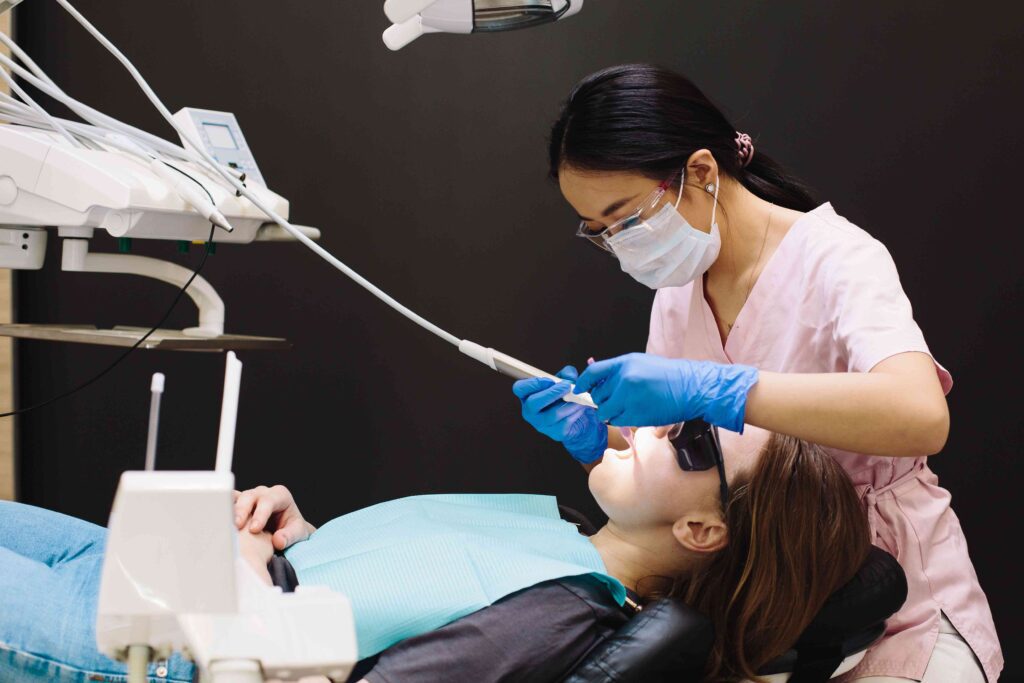
Gum Disease & Periodontal Care · Williamsburg Brooklyn You came in for a routine cleaning and left with a different recommendation. Here’s what scaling and root planing actually is, how it differs from a regular cleaning, and what to expect. Deep Cleaning vs Regular Cleaning: When Do You Need Scaling & Root Planing? SEE THE COMPARISON DOES IT HURT? Written by Toothology Editorial Team | Reviewed by Dr. Ayala Lieberman, DDS July 2026 You came in for what you thought was a routine cleaning. Your dentist or hygienist measured your gum pockets, took X-rays, and told you the cleaning you need is not a regular cleaning — it is a deep cleaning. You’re sitting in the chair wondering what exactly that means, whether it is going to hurt, and why this feels different from every other dental appointment you’ve had. The distinction between a regular dental cleaning and a deep cleaning — properly called scaling and root planing — matters because they serve genuinely different clinical purposes. A regular cleaning is preventive care designed to keep healthy gums healthy. A deep cleaning is gum disease therapy designed to address inflammation, tartar buildup, and bacterial accumulation that extends below the gumline into the pockets between teeth and gums. They are not the same procedure delivered in different intensities — they are different procedures with different clinical indications. Regular Cleaning vs. Deep Cleaning: The Core Difference REGULAR DENTAL CLEANING Preventive care · Dental prophylaxis Removes plaque and tartar from visible tooth surfaces above the gumline Appropriate for patients with healthy or stable gums Usually includes exam, X-rays, basic pocket measurements, polishing and flossing No anesthesia typically needed Goal: maintain gum health and prevent disease from developing DEEP CLEANING (SRP) Gum disease therapy · Scaling & Root Planing Removes plaque and tartar from below the gumline, inside periodontal pockets, and along root surfaces Recommended when gum pockets are deep, tartar is below the gumline, or periodontitis is diagnosed May be completed in sections (quadrants) over multiple visits Local anesthesia used for comfort when needed Goal: reduce bacterial load, allow gum tissue to heal, and stabilise gum disease NOT AN UPSELL — A DIFFERENT TREATMENT A recommendation for a deep cleaning is not an upsell. It is a different clinical treatment based on gum measurements, X-rays, and signs of periodontal disease. A regular cleaning cannot reach the areas a deep cleaning addresses. Deep Cleaning vs Regular Cleaning: A Quick Comparison Factor Regular Dental Cleaning Deep Cleaning / Scaling & Root Planing Main Purpose Preventive cleaning for generally healthy or stable gums Gum disease therapy for inflammation, gum pockets, and bacterial buildup below the gumline Where It Cleans Above the gumline and around visible tooth surfaces Below the gumline, inside gum pockets, and along root surfaces Used When Routine care and maintenance; no active periodontitis diagnosis Periodontal charting shows deep pockets, bleeding, tartar below the gumline, or bone loss on X-ray Comfort Usually no anesthesia needed Local anesthesia may be used if areas are tender or gum pockets are deep Follow-Up Usually routine recall schedule — every 6 months for most patients Re-evaluation 4–8 weeks later; may move to periodontal maintenance every 3–4 months A recommendation for a deep cleaning is not an upsell — it is a different clinical treatment. A regular cleaning cannot reach the areas that scaling and root planing addresses. Signs You May Need Scaling and Root Planing Gum disease often develops more quietly than patients expect. Bleeding gums are commonly overlooked or attributed to brushing technique rather than recognised as a potential clinical sign worth investigating. By the time gum disease causes noticeable symptoms — recession, loose teeth, or visible bone changes on X-ray — it has typically been active for some time. Gums that bleed regularly when brushing or flossing — not just occasionally Swollen, tender, or puffy-looking gum tissue Gums that appear to be pulling away from the teeth (recession) Persistent bad breath that does not resolve with brushing and rinsing Tartar buildup visible at the gumline even with regular brushing A dentist noting gum pocket depths of 4mm or greater during charting Bone loss noted on dental X-rays Teeth that feel or look loose without a clear dental explanation What Scaling and Root Planing Actually Involves Scaling and root planing is a non-surgical treatment. It does not involve incisions or stitches — but it goes deeper than a regular cleaning. Understanding what happens makes the procedure far less intimidating than the description might suggest. 1 PERIODONTAL CHARTING Gum pocket depths are measured around each tooth. Pockets 4mm or deeper in combination with other findings are a key indicator for SRP. 2 LOCAL ANESTHESIA The area being treated is numbed for comfort. Deep cleaning can be performed in quadrants — one section per visit — so anesthesia is focused on the area being treated that day. 3 SCALING (TARTAR REMOVAL) Ultrasonic instruments and/or hand scalers remove bacterial plaque and tartar from below the gumline and inside periodontal pockets. The ultrasonic device uses vibration and water to loosen and flush out buildup. 4 ROOT PLANING (SMOOTHING THE ROOT) The tooth root surfaces are smoothed so bacteria are less likely to reattach. Smoother root surfaces also allow the gum tissue to heal more closely around the tooth. 5 IRRIGATION AND COMPLETION The area is rinsed and any adjunctive medication may be applied depending on the clinical situation. Post-care instructions are reviewed before you leave. Does Deep Cleaning Hurt? Concern about discomfort is one of the main reasons patients hesitate after being told they need scaling and root planing. Most patients tolerate SRP well — and discomfort during the procedure is usually managed with local anesthesia. Before treatment begins, the area may be numbed, especially when gum pockets are deep or the tissue is tender. During the procedure, patients usually feel pressure and movement rather than sharp pain. The level of numbing depends on patient comfort and the clinical situation. Common Mild Side Effects in
Oral Cancer Screening: What Dentists Check During a Routine Exam
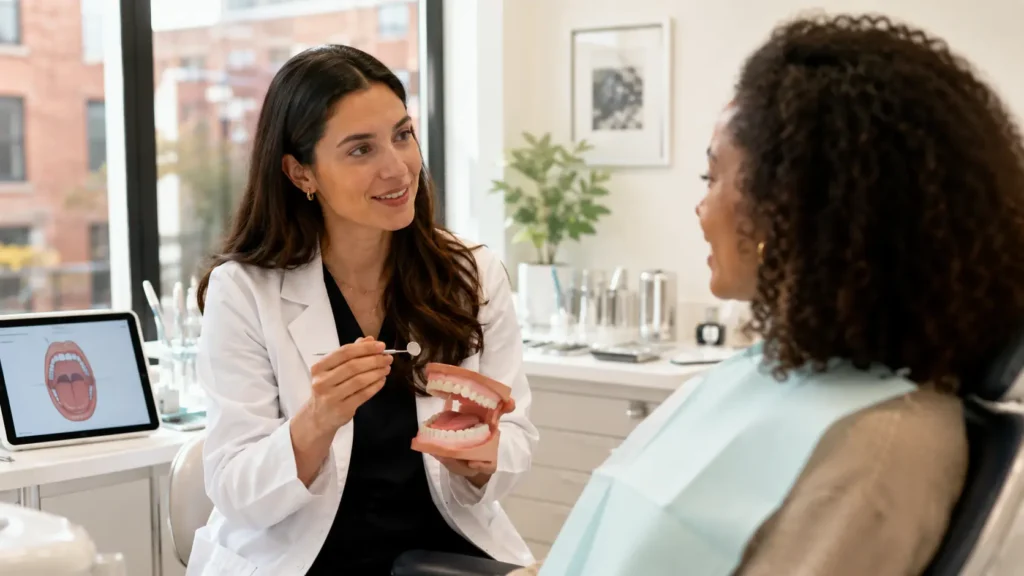
Preventive Dentistry Guide · Williamsburg Brooklyn Most people know their dentist checks for cavities. What many don’t realise is that a thorough exam also includes a soft tissue check — a visual and hands-on evaluation of the gums, tongue, cheeks, lips, and throat area. Oral Cancer Screening: What Dentists Check During a Routine Exam WHAT THE SCREENING INVOLVES SIGNS WORTH CHECKING Written by Toothology Editorial Team | Reviewed by Dr. Ayala Lieberman, DDS July 2026 Most people come to a routine dental exam expecting their dentist to check for cavities and assess gum health. What many do not realise is that a thorough dental exam also includes a soft tissue check — a visual and hands-on evaluation of the gums, cheeks, tongue, lips, floor and roof of the mouth, and the visible throat area. A red mark on the gum, a small sore that won’t heal, or a white patch noticed while brushing can all feel alarming. Most of the time, these changes have straightforward explanations — a minor irritation, a bite injury, a gum infection, or a temporary reaction. What matters clinically is not the appearance of a change in isolation, but whether it persists, worsens, or lacks an obvious explanation after a reasonable period. What Is an Oral Cancer Screening? An oral cancer screening is a quick visual and hands-on check of the mouth, gums, tongue, throat area, and nearby soft tissues. It helps identify unusual changes that may need monitoring or further evaluation. In most dental offices, this screening is part of a routine dental exam — it is painless, takes only a few minutes, and usually requires no special preparation. Part of Your Routine Exam An oral cancer screening is not a separate procedure. It is included as part of a comprehensive dental exam at Toothology in Williamsburg. Quick and Painless The check takes only a few minutes. No injections, no special equipment, and no preparation is required on your part. Screening ≠ Diagnosis A screening does not diagnose cancer. It helps your dentist spot changes that may need closer review. Only a biopsy examined by a pathologist can confirm a diagnosis. Covers Areas You Can’t See Yourself Areas like the underside of the tongue, floor of the mouth, and back of the throat are difficult to examine clearly at home — the exam provides proper lighting and positioning. Why Dentists Check the Gums, Tongue, Cheeks, and Throat A dental exam is not only about teeth. Dentists also check the soft tissues of the mouth because they can spot changes that patients may not notice on their own. During a routine exam, the dentist uses proper lighting, positioning, and touch to look for unusual tissue changes in each of these areas. Area Examined What the Dentist Looks and Feels For 👄 Lips & Lip Corners Sores, ulcers, rough areas, discolouration, swelling, or asymmetry 🫦 Cheeks & Inner Lining Red or white patches, lumps, ulcers, or thickened tissue along the inner cheek surface 🦷 Gums Persistent sores, unusual redness, white patches, swelling, or unexplained gum changes 👅 Tongue Red or white patches, lumps, ulcers, or restricted movement — top, sides, and underside are all checked ⬇ Floor of the Mouth Swelling, lumps, ulcers, or unusual tissue texture under the tongue — an area that is hard to check at home ⬆ Roof of the Mouth Persistent sores, red or white patches, or abnormal tissue changes on the hard or soft palate 🗣 Back of the Throat Visible changes or persistent unexplained irritation in the visible throat area 🫀 Jaw & Neck Enlarged lymph nodes or unexplained lumps felt during palpation of the jaw and neck area A screening does not diagnose cancer — it helps your dentist identify changes that may need monitoring or further evaluation. Only a biopsy examined by a pathologist can confirm a diagnosis. Oral Cancer Signs on the Gums That Should Be Checked The gums can show changes from irritation, infection, brushing habits, dentures, or other common causes. Not every red spot or sore is alarming — but changes that persist for about two weeks, worsen, grow, bleed without explanation, or cause numbness or pain should be checked by a dentist. A red or white patch on the gums, tongue, or inside the mouth lasting about two weeks A sore, ulcer, or rough area that does not heal or keeps returning A persistent red mark on the gum, cheek, or lip with no clear cause A lump, bump, or thickened area in the mouth, jaw, or neck Unexplained bleeding from gum or mouth tissue Numbness, tenderness, or pain without an obvious cause Difficulty chewing, swallowing, or moving the tongue or jaw Persistent sore throat or hoarseness lasting more than two weeks A loose tooth without a clear dental explanation Is a Red Mark on the Gum Always Serious? A red mark on the gum is usually caused by something benign — gum inflammation, minor irritation, infection, a canker sore, or a reaction to certain foods or dental products. Most mouth changes are not cancer. A red spot, gum sore, or patch is more often related to irritation, an accidental bite, brushing trauma, or gum disease. The Persistence Rule Usually less concerning: The red mark improves within one to two weeks — consistent with irritation, a minor bite, or temporary inflammation. Worth monitoring: The mark is present for two weeks but not worsening — worth mentioning at your next routine exam for documentation. Should be checked: The red mark improves within one to two weeks — consistent with irritation, a minor bite, or temporary inflammation. What Happens During a Dentist’s Oral Cancer Screening? During an oral cancer screening, the dentist or hygienist checks the soft tissues of the mouth and nearby areas for unusual changes. The process is calm, thorough, and completed as part of the regular exam. Face and neck: Checking for swelling, asymmetry, or enlarged lymph nodes Lips: Looking for sores, scaling, discolouration, or uneven changes Cheeks: Checking for red or white patches, ulcers, or
Does Aetna Cover Invisalign in Brooklyn?

Invisalign & Insurance Guide · Williamsburg Brooklyn You want Invisalign. You have Aetna dental insurance. Here’s exactly what to check in your plan before you commit to a consultation, a treatment plan, and a cost you’re not yet sure about. Does Aetna Cover Invisalign in Brooklyn? WHAT TO CHECK IN YOUR PLAN QUESTIONS TO ASK AETNA Written by Toothology Editorial Team | Reviewed by Dr. Ayala Lieberman, DDS July 2026 You want Invisalign. You have Aetna dental insurance. And you’re wondering whether those two things are going to work together before you commit to a consultation, a treatment plan, and a cost you’re not yet sure about. Does Aetna cover Invisalign, and what should Brooklyn patients check before starting treatment? The short answer is: it depends on your specific Aetna plan. Some Aetna dental plans include orthodontic benefits that may apply to Invisalign and other clear aligners. Others do not include orthodontic coverage at all, or may limit coverage by age, waiting period, or appliance type. Having Aetna dental insurance does not automatically mean Invisalign is covered — what matters is the exact benefit language in your specific plan. Does Aetna Usually Cover Invisalign? Aetna offers different dental plans, and Invisalign coverage depends on the specific plan. Some Aetna plans include orthodontic benefits, while others do not. Some may cover orthodontics only for children or dependents under a certain age. When orthodontic benefits are included, Invisalign may be covered similarly to braces as a clear aligner treatment. But if the plan does not include orthodontic coverage, Invisalign may not be covered — especially for adults. THE REAL QUESTION TO ASK The key question is not only, “Does Aetna cover Invisalign?” It is: does your plan include orthodontic benefits, and are clear aligners eligible under those benefits? Checking your plan documents or calling Aetna Member Services is the best way to confirm. What Type of Aetna Plan May Include Orthodontic Benefits? Aetna dental plans vary widely. Some are preventive-focused, while others include broader PPO coverage with orthodontic benefits. To understand whether Invisalign may be covered, look for these items in your benefit summary. Orthodontic benefits: Confirms whether braces, clear aligners, or Invisalign may receive coverage at all. Lifetime orthodontic maximum: The total amount the plan will contribute toward orthodontic treatment over your lifetime. Age limits: Some plans cover orthodontics only for children or dependents under a certain age. Waiting period: Some plans require you to be enrolled for a set period before orthodontic benefits begin. Deductible and coinsurance: These determine what you pay before and after the plan starts contributing. Provider network: In-network providers may reduce your out-of-pocket cost significantly. Clear aligner eligibility: Confirm specifically whether Invisalign or clear aligners are included or excluded from coverage. WHERE TO FIND THIS INFORMATION You can usually find this information in your Summary Plan Description, Aetna member portal, or by calling the Member Services number on your insurance card. Ask specifically about orthodontic benefits for clear aligners and Invisalign — not just general dental coverage. Is Invisalign Covered the Same Way as Braces? In many dental insurance plans, Invisalign and traditional braces are both treated as orthodontic treatment. If your Aetna plan includes orthodontic benefits, those benefits may apply to Invisalign as a clear aligner option. However, this is not guaranteed. Some plans cover any orthodontic treatment, while others may limit coverage to certain appliances, age groups, or treatment types. Coverage may also vary by coinsurance, lifetime maximum, and whether the provider is in-network. DON’T ASSUME — CONFIRM The practical takeaway: do not assume Invisalign is covered just because braces are. Confirm whether your plan specifically covers clear aligners or Invisalign, especially if you are an adult. Adults and Clear Aligner Eligibility Adult orthodontic coverage varies widely. Some plans cover orthodontics only for children or dependents, while adult coverage may require specific plan language or an added rider. Toothology can help verify whether your Aetna plan includes adult Invisalign benefits before treatment begins. How Much Does Invisalign Cost Without Full Insurance Coverage? Invisalign cost in Brooklyn varies by case, so an accurate estimate requires an exam and treatment plan. Cost usually depends on several factors. Treatment Complexity Mild spacing or crowding usually costs less than more complex bite correction requiring more aligners and time. Number of Aligners & Length Longer cases with more aligners typically involve a higher fee — your timeline directly affects total cost. Refinements Extra aligners may be needed to fine-tune results toward the end of treatment, depending on the case. Retainers Retainers are needed after treatment to maintain results, and may be included or billed separately. Records & Follow-Up Visits Scans, photos, X-rays, and monitoring visits throughout treatment are part of the total treatment plan and cost. OPTIONS BEYOND FULL COVERAGE If your Aetna plan includes orthodontic benefits, insurance may reduce your out-of-pocket cost. Without full coverage, HSA/FSA funds and office payment plans may help make Invisalign more manageable. Ask about these options during your consultation. What Questions Should You Ask Before Starting Invisalign? Before calling Aetna or scheduling an Invisalign consultation, use this checklist to get clearer answers. “Does my Aetna dental plan include orthodontic benefits?” “Are clear aligners or Invisalign specifically covered?” “Is there an age limit for orthodontic coverage?” “What is the lifetime orthodontic maximum?” “Is there a waiting period before benefits begin?” “Does the provider need to be in-network?” “Is a pre-treatment estimate or predetermination recommended?” “Are retainers covered after Invisalign treatment?” WHEN YOU CALL AETNA MEMBER SERVICES Have your member ID ready and write down the date, representative name, and reference number. Phone information is not a guarantee of payment, but it gives you a useful starting point before treatment begins. How Toothology Can Help Verify Insurance Benefits Insurance coverage for Invisalign can be confusing, but Toothology can help review your benefits during the consultation process. 1 YOU PROVIDE YOUR AETNA DETAILS Member ID, group number, and date of birth — the basic information needed to look up your specific plan. 2 THE OFFICE VERIFIES BENEFITS The team checks orthodontic
How Do Cavities Form? A Dentist’s Guide to Stopping Tooth Decay Early
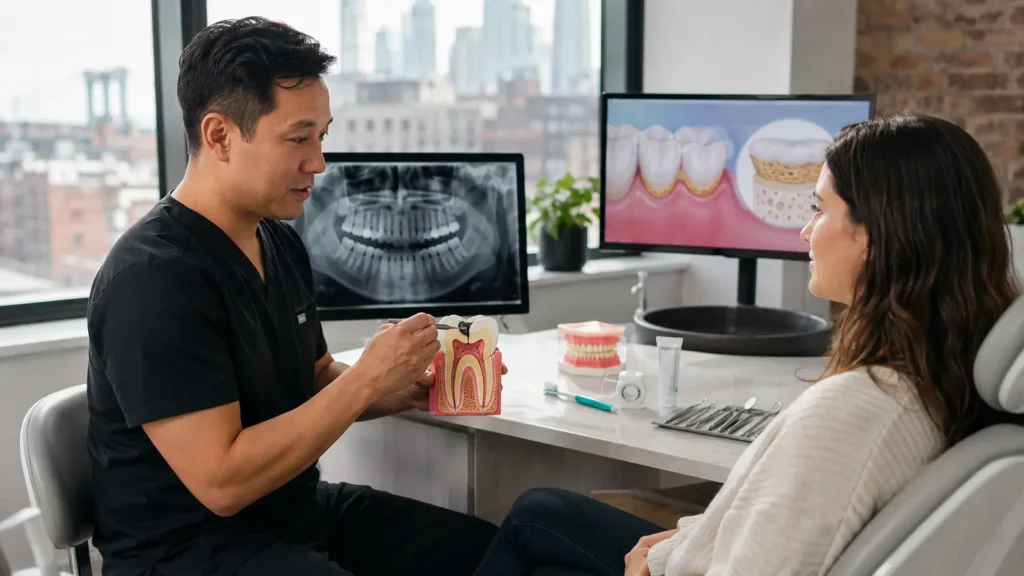
Preventive Dentistry Guide · Williamsburg Brooklyn Most cavities don’t start with pain. Understanding the predictable process behind tooth decay — plaque, bacteria, sugar, acid, and time — is the key to stopping it early. How Do Cavities Form? A Dentist’s Guide to Stopping Decay Early SEE HOW IT FORMS DAILY PREVENTION HABITS Written by Toothology Editorial Team | Reviewed by Dr. Ayala Lieberman, DDS June 2026 Most cavities do not start with pain. A dentist points to a small dark spot on an X-ray and a patient says they had no idea it was there. A teen comes in for a routine checkup and there’s a soft groove on a back molar that wasn’t there six months ago. A parent who brushes their child’s teeth carefully every night still hears that a cavity has formed. The answer to how cavities form starts with plaque, bacteria, sugar, acid, and time — and understanding that process is the foundation of stopping decay early. A cavity is not something that appears overnight. It is the end result of repeated acid attacks on tooth enamel over time, and that process gives you multiple opportunities to interrupt it before it becomes a hole that needs a filling. The earlier tooth decay is caught, the more conservative the solution can usually be. How Cavities Actually Form Tooth decay follows a specific, predictable sequence. Understanding each step makes it much clearer why certain habits accelerate decay and why certain preventive measures work. 1 PLAQUE FORMS Bacteria, food particles, and saliva create a sticky film on the teeth — this happens to everyone, every day. 2 BACTERIA FEED ON SUGAR Bacteria in plaque consume sugars and fermentable carbohydrates from the foods and drinks you consume. 3 ACID IS PRODUCED The bacteria release acids as a byproduct, and that acid attacks the enamel surface within minutes of eating or drinking. 4 ENAMEL LOSES MINERALS Repeated acid exposure weakens enamel and may create white or chalky spots — the first visible sign of demineralisation. 5 ENAMEL BECOMES POROUS Without enough saliva, fluoride, and recovery time, the weakened spot can progress into a small hole — a true cavity. 6 DECAY SPREADS INWARD Untreated decay can move into dentin and toward the nerve, causing pain or infection if it continues unaddressed. IT’S NOT SUGAR ALONE — IT’S FREQUENCY The key issue is not sugar alone — it is how often teeth are exposed to acid. Sipping a sugary drink throughout the day causes repeated acid attacks, while having the same amount of sugar at one time gives teeth more recovery time. That’s why snacking habits and drink frequency matter so much in cavity prevention. Why Plaque and Acid Damage Tooth Enamel Plaque forms on everyone’s teeth every day. It’s a sticky film of bacteria, and the problem starts when those bacteria frequently feed on sugars and refined carbohydrates. After you eat or drink anything other than water, plaque bacteria produce acid that attacks enamel within minutes. Saliva helps neutralise acid and return minerals to the tooth surface, but it needs time. When teeth are exposed to sugar or acid too often — or when saliva flow is low — enamel damage can outpace repair. Risk Factors for Enamel Erosion and Decay Incomplete Brushing & Flossing Plaque that is not removed can harden into tartar, which requires professional cleaning to fully remove. Frequent Sugar or Acid Exposure Juice, sports drinks, soda, crackers, white bread, and dried fruit can feed decay-causing bacteria, especially consumed slowly over time. Dry Mouth Reduced saliva flow from medications, health conditions, or mouth breathing increases cavity risk significantly. Deep Grooves in Molars Some back teeth have grooves that trap bacteria and food, making them harder to clean thoroughly. Orthodontic Appliances Braces, wires, and aligners create more places for plaque to collect and hide from a toothbrush. Missed Dental Cleanings Professional cleanings remove tartar and help reduce the bacterial buildup that contributes to decay over time. Early Signs of a Cavity Many early cavities cause no pain at all. Discomfort often appears only after decay has moved deeper into the tooth, which is why routine exams and X-rays are important. That said, these signs are worth mentioning at your next dental visit. A white, chalky, or matte spot on the tooth surface A dark brown or black spot in a groove or pit Sensitivity to sweets or cold drinks A visible pit, rough edge, or small depression Food getting stuck in the same spot repeatedly Floss catching or tearing in one specific area A bad taste from one part of the mouth A mild, dull ache in a specific tooth THESE SIGNS DON’T CONFIRM A CAVITY — BUT THEY CONFIRM AN EXAM These signs do not always mean you have a cavity. Stains, sensitivity, and rough edges can have other causes. But an exam and X-rays can confirm what’s happening and help keep treatment more conservative if decay is found. Can a Cavity Heal on Its Own? It depends on the stage of decay. If you’re asking “can you heal a cavity?” or “will cavities heal?”, the answer depends on whether decay is still in the early enamel mineral-loss stage or whether a true hole has already formed. EARLY STAGE — BEFORE A HOLE FORMS Enamel mineral loss can sometimes be slowed, stopped, or partially reversed Better brushing and fluoride toothpaste can help strengthen enamel Reduced sugar frequency gives teeth more recovery time Professional fluoride treatment can accelerate remineralisation TRUE CAVITY — HOLE HAS FORMED Cannot heal or close on its own — teeth do not regrow lost structure Dental treatment is needed, usually a filling Waiting allows decay to spread deeper into the tooth Home remedies cannot reverse an actual structural hole A NOTE ON OIL PULLING AND HOME REMEDIES Searches like “oil pulling teeth cavity” often overstate what oil pulling can do. Oil pulling is sometimes promoted online for cavities, but it should not replace brushing with fluoride toothpaste, flossing, or professional dental care. It